Lucky Indoor Plants: 12 Plants for Good Luck and Where to Put Them
The 12 plants traditionally kept for good luck and prosperity — money plant, lucky bamboo, jade, tulsi and more — with the placement each tradition recommends.
The short answer
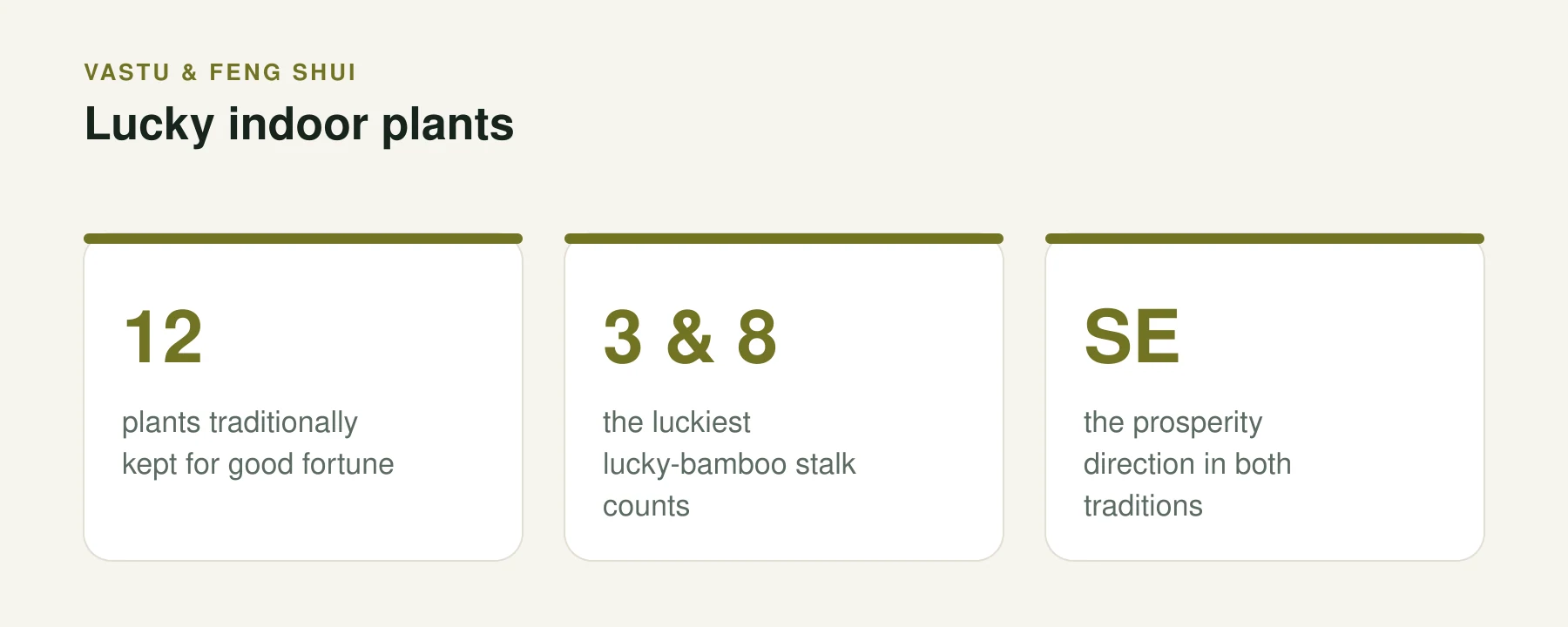
- Money plant, lucky bamboo, jade, tulsi and areca palm are the plants most kept for good fortune.
- Every tradition agrees a dying plant is inauspicious — so choose species you can actually keep alive.
- Rounded, upward-facing leaves are favoured; thorns and bonsai are kept out of the home.
Key takeaways
- Every tradition agrees on one point: a dying plant is inauspicious, so pick species you can keep healthy.
- Rounded, upward-facing leaves are considered lucky; thorns and downward-drooping leaves are not.
- Lucky bamboo stalk counts carry specific meanings — three for happiness, eight for wealth.
- The recommended positions usually match decent growing light, but check before committing a plant to a dark corner.
Plants have carried meaning in Indian, Chinese and many other households for centuries, and what strikes me reading across the traditions is how consistent the advice is: upward growth, rounded leaves, evergreen foliage, no thorns, and above all a plant that is visibly thriving. Whatever you make of the symbolism, that last rule has real practical value — a healthy plant is, almost by definition, a well-placed plant.
#The 12 plants most often kept for luck
| Plant | Associated with | Traditional placement | Care difficulty |
|---|---|---|---|
| Money plant (pothos) | Wealth, prosperity | South-east corner | Very easy |
| Lucky bamboo | Growth, harmony | East or south-east | Very easy |
| Jade plant | Prosperity, friendship | Near the entrance, south-east | Very easy |
| Tulsi (holy basil) | Purity, protection | North or north-east, in sun | Moderate |
| Areca palm | Positive energy, calm | East or north | Moderate |
| Peace lily | Peace, harmony | Living room, indirect light | Easy |
| Snake plant | Protection | South, east or south-east | Very easy |
| Rubber plant | Abundance, wealth | South-east | Easy |
| Bamboo palm | Prosperity, protection | East | Easy |
| Orchid | Fertility, refinement | Living room or bedroom | Moderate |
| Citrus / lime plant | Abundance | Balcony or bright window | Difficult indoors |
| Basil (sweet basil) | Protection, wealth | Kitchen windowsill | Moderate |
#Lucky bamboo and what the stalk count means
Lucky bamboo (Dracaena sanderiana, not a true bamboo at all) is the most explicitly symbolic of these plants, because the number of stalks carries specific meaning in Chinese tradition.
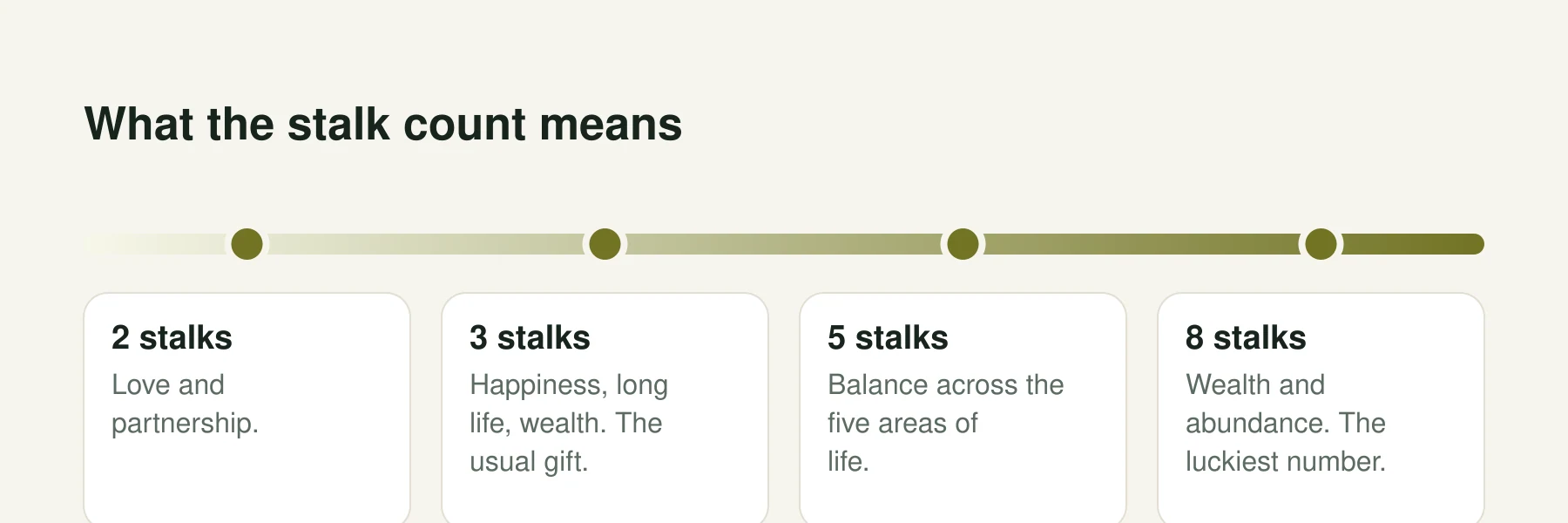
- 2 stalks — love and partnership
- 3 stalks — happiness, long life and wealth; the most commonly given arrangement
- 5 stalks — the five areas of life, and balance across them
- 6 stalks — prosperity and good fortune
- 7 stalks — good health
- 8 stalks — wealth and abundance, eight being the luckiest number
- 9 stalks — great fortune
- 4 stalks — avoided, as the word for four resembles the word for death
Practically, lucky bamboo lives in a vase of water with 5 cm of pebbles. Change the water weekly, keep it out of direct sun, and use filtered or rested water — the yellowing tips people see are usually a reaction to chlorine or fluoride in fresh tap water.
#What the traditions agree on
Keep plants healthy
A wilting, yellowing or dying plant is considered inauspicious in both vastu and feng shui. This is the rule with the most practical force: choose species you can actually keep alive in your light.
Prefer rounded, upward leaves
Rounded, upward-facing foliage is read as welcoming energy. Spiky, thorny or sharply pointed leaves are associated with tension.
Avoid thorny plants indoors
Cacti in particular are discouraged inside the home in vastu, and generally kept to balconies and outdoor spaces.
Do not let plants trail on the floor
Climbing and trailing plants are traditionally trained upward — a money plant should climb a moss pole or hang, not spread across the ground.
Remove dead leaves promptly
Both traditions treat accumulated dead material as stagnant. It is also good horticulture, since decaying matter breeds fungus gnats.
#Where the tradition and the plant disagree
Tulsi is the most common casualty of this. It is a genuine sun plant needing four to six hours of direct light, so a north-east indoor position without a bright window will not keep it alive. Traditionally it is grown in an open courtyard or balcony for exactly that reason, and that remains the best advice.
#Plants traditionally kept out of the home
- Cactus and thorny plants — associated with conflict and obstacles in vastu.
- Bonsai — deliberately stunted growth is read as restricting the growth of the household.
- Dead or dying plants of any kind — replace or revive them rather than leaving them in place.
- Cotton plants and artificial flowers in some vastu interpretations, as they are associated with inertia.
- Plants that shed heavily indoors, which is as much a housekeeping judgement as a spiritual one.
Whether or not you follow the symbolism, the practical residue of these rules is sound: keep plants alive, keep them clean, train them upward, and put them where people will actually see them. Our vastu placement guide covers the direction-by-direction detail, and the feng shui guide covers the Chinese tradition.
Frequently asked questions
Which plant is lucky for home?
The money plant is the most widely kept lucky plant, associated with prosperity and traditionally placed in the south-east corner. Lucky bamboo and the jade plant are the next most common, and all three are among the easiest houseplants to keep alive.
How many lucky bamboo stalks should I have?
Three stalks for happiness, long life and wealth is the most common gift arrangement; eight stalks are associated with wealth and abundance. Four stalks are avoided, as the number is linked with death in Chinese tradition.
Where should lucky plants be placed in a house?
Most traditions place wealth-associated plants such as money plant, jade and rubber plant in the south-east, and calming plants in the east or north. The overriding practical rule is to place them where they get enough light to stay healthy.
Is a cactus unlucky indoors?
In vastu shastra, yes — thorny plants including cacti are associated with conflict and are traditionally kept outdoors or on a balcony rather than inside the home. There is no such restriction in horticultural terms.
Do lucky plants need special care?
No, but they do need to stay healthy, since a dying plant is considered inauspicious in every tradition that recommends them. Choose species suited to your light: money plant, lucky bamboo, jade and snake plant are all very tolerant.
Sources and further reading
- Houseplants: plant profiles — Royal Horticultural Society. Species-level profiles and cultivation notes.
- Plant Finder — Missouri Botanical Garden. Botanical names, native range and cultural requirements.
- North Carolina Extension Gardener Plant Toolbox — NC State Extension. Species data, hardiness and toxicity cross-checks.
- Toxic and Non-Toxic Plants List — ASPCA Animal Poison Control. Toxicity status of every plant named, checked under its botanical name.
Related guides
Feng Shui Indoor Plants: Placement, Shape and Positive Energy
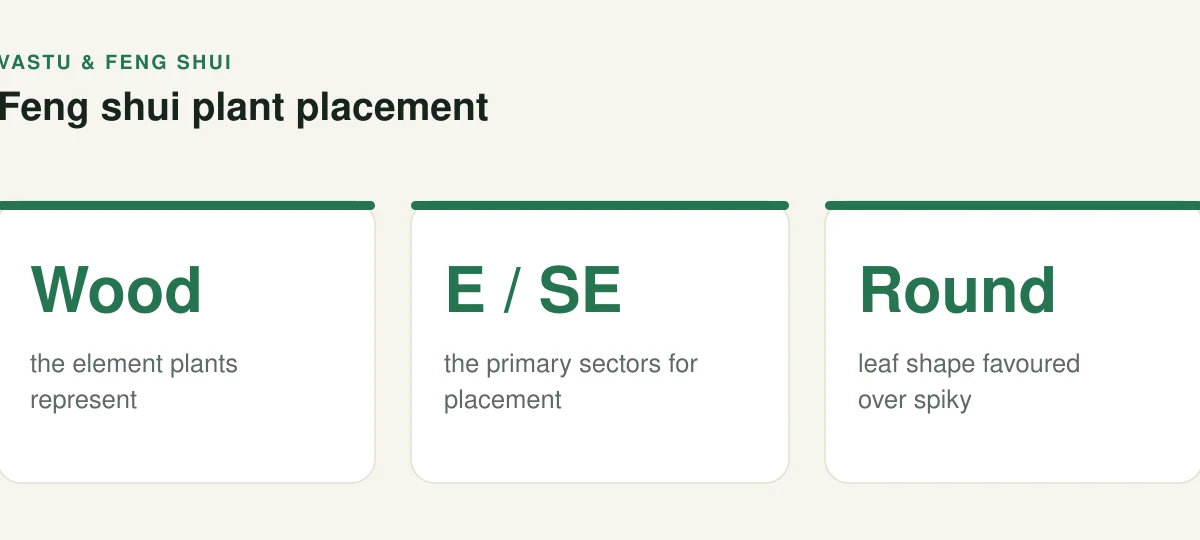
How feng shui uses plants to move energy through a home — which shapes and species to choose, where the wood element belongs, and what to keep out of the bedroom.
Vastu Indoor Plants: Direction-by-Direction Placement Guide
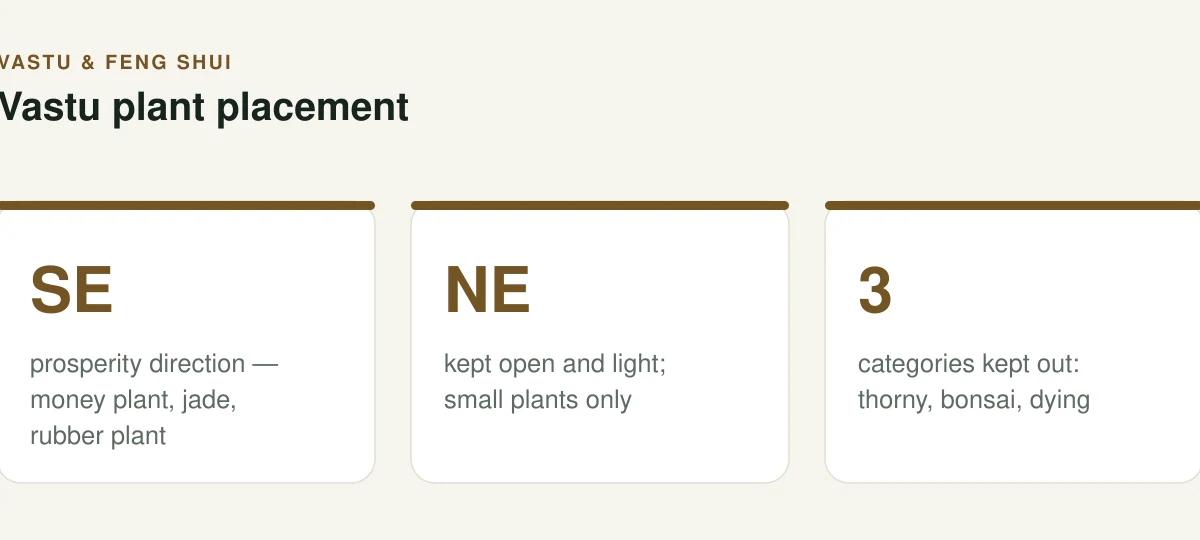
Which indoor plants vastu shastra recommends for each direction of the home, which to avoid, and how to follow the placement without putting a plant where it will die.
Indoor Hanging Plants: 15 Trailing and Climbing Plants That Thrive
The best indoor hanging plants for baskets, shelves and ceiling hooks — including which cope with the hot, dry air that collects near a ceiling.