Best Indoor Plants for Oxygen: Which Ones Give Oxygen 24 Hours?
Snake plant, aloe, tulsi and orchids release oxygen at night — here is why, how much it actually amounts to, and the 10 highest oxygen producing indoor plants.
The short answer
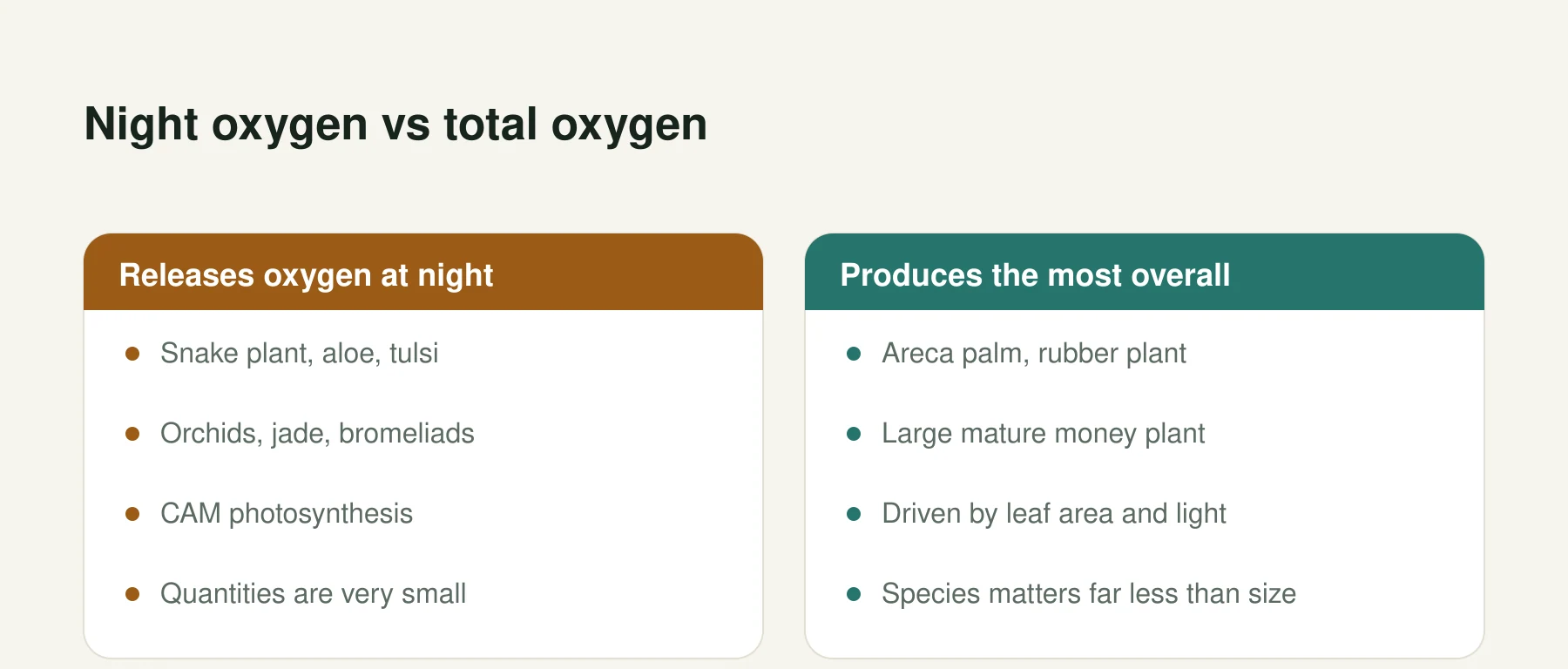
- CAM plants — snake plant, aloe, tulsi, orchids — open their pores at night and release oxygen then.
- Total output depends on leaf area and light, so a big areca palm beats any small 'oxygen plant'.
- No practical number of houseplants changes a room's oxygen level; ventilation does that.
Key takeaways
- Oxygen output scales with leaf area and light — a big plant in a bright room produces most.
- CAM plants (snake plant, aloe, tulsi, orchids) release oxygen at night rather than during the day.
- A room's oxygen concentration is not measurably changed by houseplants; ventilation dominates completely.
- The night-oxygen plants are still excellent bedroom plants for other reasons.
Two questions sit behind every search for oxygen plants: which plant produces the most, and which produces it at night. Both have real botanical answers, and they are genuinely interesting. Both also come with a piece of arithmetic that almost never gets mentioned alongside them, so it is included here — not to spoil the idea, but because you deserve to know what a plant can and cannot do before you buy one for that reason.
#Why some plants give oxygen at night
Most plants use C3 photosynthesis: they open their stomata during the day, take in CO₂, and release oxygen while the light lasts. At night the process stops and they respire like any other organism.
Plants from hot, dry environments evolved a workaround called crassulacean acid metabolism, or CAM. To avoid losing water in daytime heat, they keep their stomata shut during the day and open them at night, storing CO₂ as an acid until morning. A side effect of that gas exchange is that CAM plants release some oxygen after dark — which is the entire basis of the '24 hours oxygen' claim.
| Plant | Botanical name | Light | Difficulty |
|---|---|---|---|
| Snake plant | Dracaena trifasciata | Low to full sun | Very easy |
| Aloe vera | Aloe barbadensis | Bright to direct | Easy |
| Tulsi / holy basil | Ocimum tenuiflorum | Direct sun, 4–6 hrs | Moderate |
| Orchid | Phalaenopsis | Bright indirect | Moderate |
| Christmas cactus | Schlumbergera | Bright indirect | Easy |
| Jade plant | Crassula ovata | Bright to direct | Very easy |
| Bromeliad | Guzmania, Neoregelia | Bright indirect | Easy |
| Peperomia | Peperomia obtusifolia | Moderate to bright | Very easy |
#Which plants produce the most oxygen overall
Total oxygen output is a function of two things: how much leaf area a plant has, and how much light reaches it. Species matters far less than size. A two-metre areca palm in a bright room out-produces a shelf of small succulents many times over, whatever the species lists say.
- Areca palm — large frond area, fast growth, the highest practical output of any common indoor plant.
- Rubber plant — big, thick leaves and vigorous growth in bright light.
- Money plant / pothos — modest per leaf, but a mature vine carries an enormous number of leaves.
- Peace lily — good leaf area and productive even in moderate light.
- Spider plant — dense clumps of leaves plus plantlets, all photosynthesising.
- Weeping fig (Ficus benjamina) — thousands of small leaves add up to a large total area.
- Bamboo palm — tall, leafy and tolerant of indoor conditions.
- Boston fern — very high surface area, though only in humid conditions.
- Snake plant — moderate output, but uniquely delivered at night.
- Tulsi — modest in size, but the most productive of the small CAM plants in real sun.
#The arithmetic nobody includes
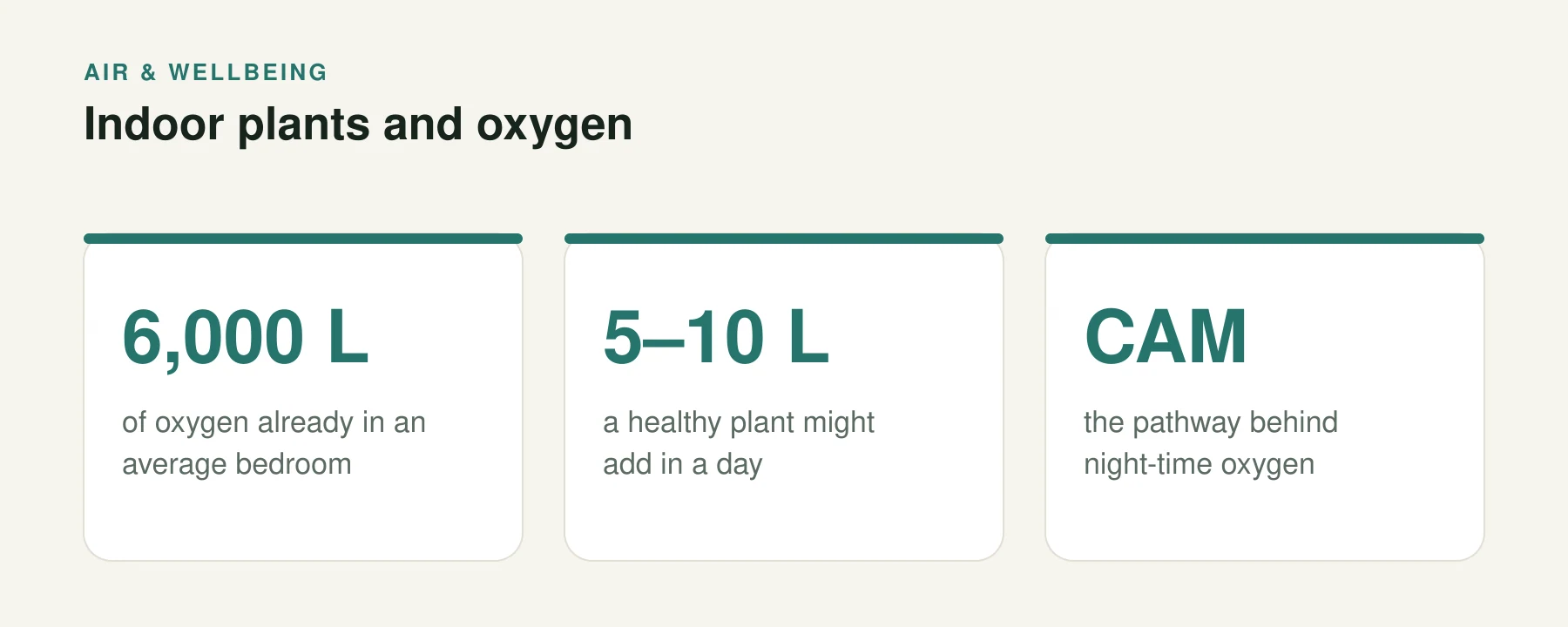
Air is about 21% oxygen. A typical bedroom holds roughly 30,000 litres of air, containing around 6,000 litres of oxygen. A healthy houseplant in good light might produce somewhere in the region of five to ten litres of oxygen a day — and consumes a portion of that itself through respiration. Against a background of 6,000 litres, constantly exchanged with outdoor air through gaps, doors and ventilation, the contribution is immeasurably small.
#Tulsi indoors
Tulsi deserves a separate note because it is so often recommended for indoor oxygen and so often dies indoors. It is a sun plant: it needs four to six hours of direct sunlight, which in practice means a south-facing windowsill or a balcony, not a shelf in a living room. Given less, it stretches, thins and goes woody within a couple of months. Keep it in the brightest position you have, water when the top 2 cm dries, and pinch the growing tips regularly to keep it bushy.
#Getting the most from what you have
Prioritise light over species
The same plant in a bright spot photosynthesises several times faster than in a dim one. Moving a plant a metre closer to the window does more than swapping it for a 'better' species.
Choose bigger plants
Leaf area is the variable that matters. One large palm beats a dozen small pots.
Keep leaves clean
Dust reduces the light reaching the leaf surface by a fifth or more. Wipe large leaves monthly with a damp cloth.
Do not crowd
Plants shading each other reduces total photosynthesis. Space them so each gets light.
Open a window
The single most effective thing you can do for the air you breathe indoors, and it costs nothing. Our air purifying plants guide works through why.
Frequently asked questions
Which indoor plant gives oxygen 24 hours?
CAM plants — snake plant, aloe vera, tulsi, orchids, bromeliads, jade plant and Christmas cactus — open their stomata at night and release oxygen after dark as well as, in some cases, during the day. The quantities are very small.
Which indoor plant gives the most oxygen?
The areca palm, because oxygen output depends mainly on leaf area and growth rate rather than species. Any large, fast-growing plant in bright light will out-produce a small one, whatever its reputation.
How many plants do you need to oxygenate a room?
More than would fit. A room's oxygen supply is dominated by air exchange with outdoors, and a houseplant contributes a few litres a day against a background of thousands. No practical number of plants changes a room's oxygen level.
Is it good to keep a snake plant in the bedroom?
Yes, though not for the oxygen. It tolerates the low light and cool temperatures of a bedroom, survives weeks without water, and needs no humidity. The night-time oxygen it releases is real but far too small to affect you.
Can tulsi be grown indoors?
Only in a very bright position — four to six hours of direct sun, which usually means a south-facing windowsill or balcony. In ordinary indoor light tulsi stretches, thins and turns woody within a few months.
Sources and further reading
- Interior landscape plants for indoor air pollution abatement — NASA Technical Reports Server, 1989. The original 1989 sealed-chamber study behind every air-purifying plant list.
- Potted plants do not improve indoor air quality: a review and analysis of reported VOC removal efficiencies — Journal of Exposure Science & Environmental Epidemiology, 2020. Reanalysis converting chamber results into clean air delivery rates.
- Indoor Air Quality (IAQ) — US Environmental Protection Agency. Ventilation and source control as the primary indoor air measures.
- Plant Finder — Missouri Botanical Garden. Botanical names, native range and cultural requirements.
Related guides
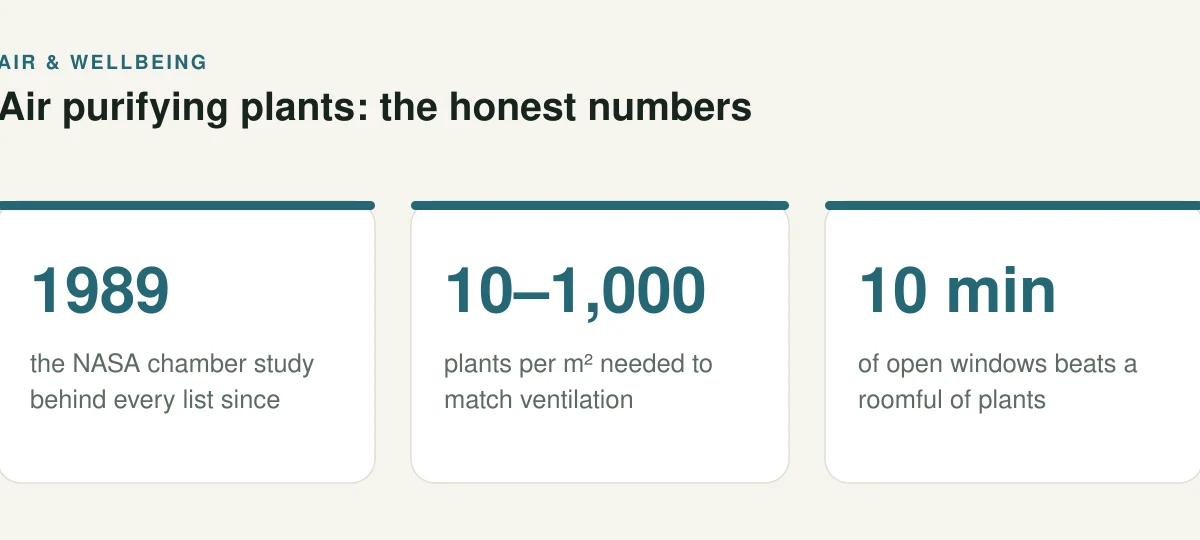
Air Purifying Indoor Plants: What the NASA Study Really Found
The 12 plants from NASA's clean air study, what they actually remove, and the honest arithmetic on how many you would need to change the air in a real room.
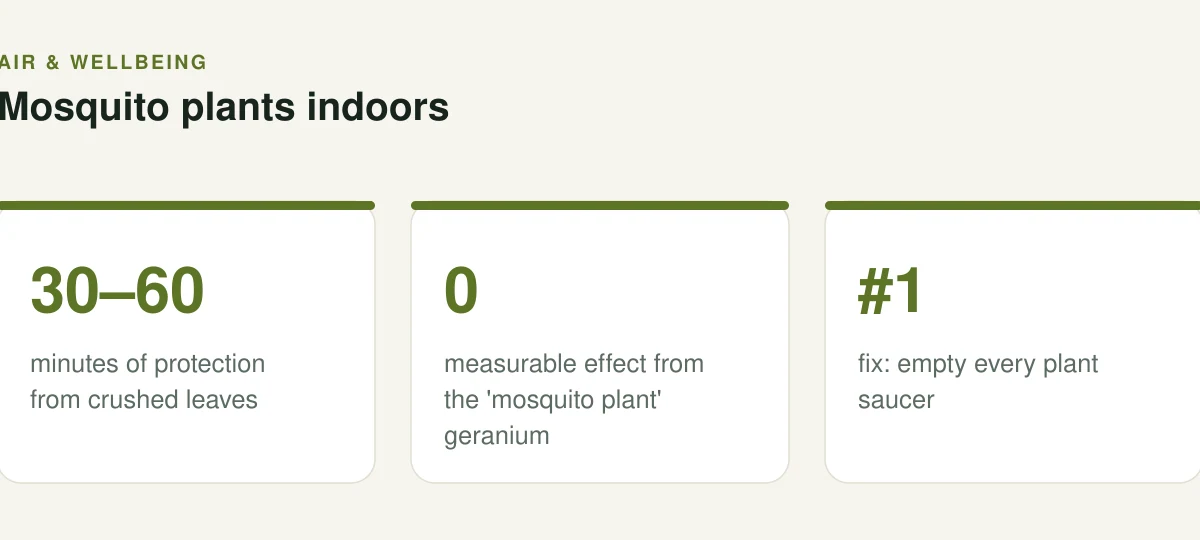
Mosquito Repellent Plants Indoor: What Works and What Doesn't
Citronella, tulsi, lemongrass and lavender are sold as mosquito plants. Here is what the research shows about repelling mosquitoes indoors — and what actually works.
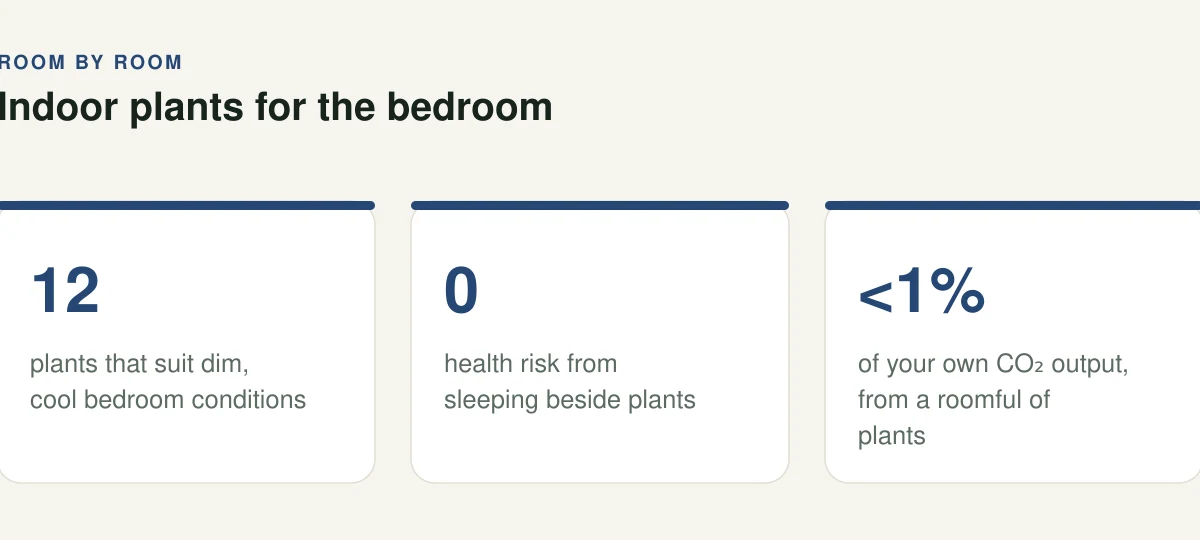
Indoor Plants for the Bedroom: 12 Best Picks (and the Sleep Myths Explained)
Bedrooms are dim, cool and often north-facing. These 12 indoor plants suit those conditions — plus an honest look at whether plants in a bedroom affect your sleep.