Indoor Plants for the Bedroom: 12 Best Picks (and the Sleep Myths Explained)
Bedrooms are dim, cool and often north-facing. These 12 indoor plants suit those conditions — plus an honest look at whether plants in a bedroom affect your sleep.
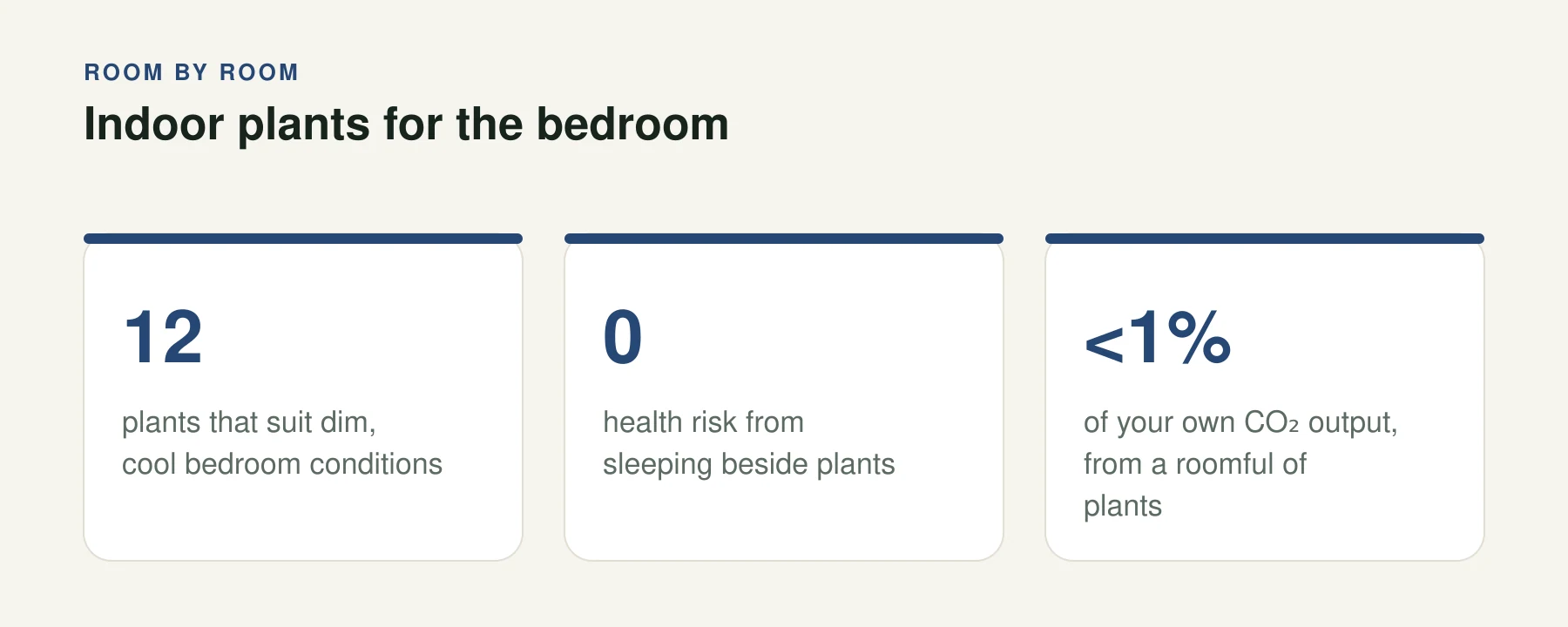
The short answer
- Bedrooms are usually the dimmest and coolest room, so choose shade tolerant plants.
- Snake plant, ZZ plant, pothos, aglaonema and parlour palm all suit those conditions.
- It is completely safe to sleep with plants in the room — the night-time CO₂ is negligible.
Key takeaways
- Bedrooms are usually darker and cooler than the rest of the home — choose shade tolerant species.
- It is safe to sleep with plants in the room; the CO₂ they release at night is trivially small.
- Snake plants and other CAM plants do release oxygen at night, but far too little to matter.
- Skip heavily scented plants next to a bed — the scent is far stronger at 30 cm than at three metres.
Bedrooms tend to be the room people plant last, and the room least suited to plants: often north-facing, curtains drawn for a third of the day, heating turned down at night, and no reason to be in there during daylight hours anyway. The good news is that the plants which tolerate all of that happen to be the same ones that need the least attention from you — so a bedroom is a genuinely easy room to plant, once you stop trying to put a calathea in it.
#12 plants that suit bedroom conditions
| Plant | Light | Water | Pet safe |
|---|---|---|---|
| Snake plant | Low to bright | Every 3–4 weeks | No |
| ZZ plant | Low to moderate | Every 3–4 weeks | No |
| Pothos / money plant | Low to bright | Every 7–14 days | No |
| Aglaonema | Low to moderate | Every 7–14 days | No |
| Areca palm | Bright indirect | Every 5–7 days | Yes |
| Parlour palm | Low to moderate | Every 7 days | Yes |
| Spider plant | Moderate | Every 7 days | Yes |
| Peace lily | Low to moderate | Every 5–7 days | No |
| Cast iron plant | Low | Every 2 weeks | Yes |
| Philodendron | Low to bright | Every 7–14 days | No |
| Peperomia | Moderate | Every 10–14 days | Yes |
| Lucky bamboo | Low to moderate | Water change weekly | No |
#Is it safe to sleep with plants in the room?
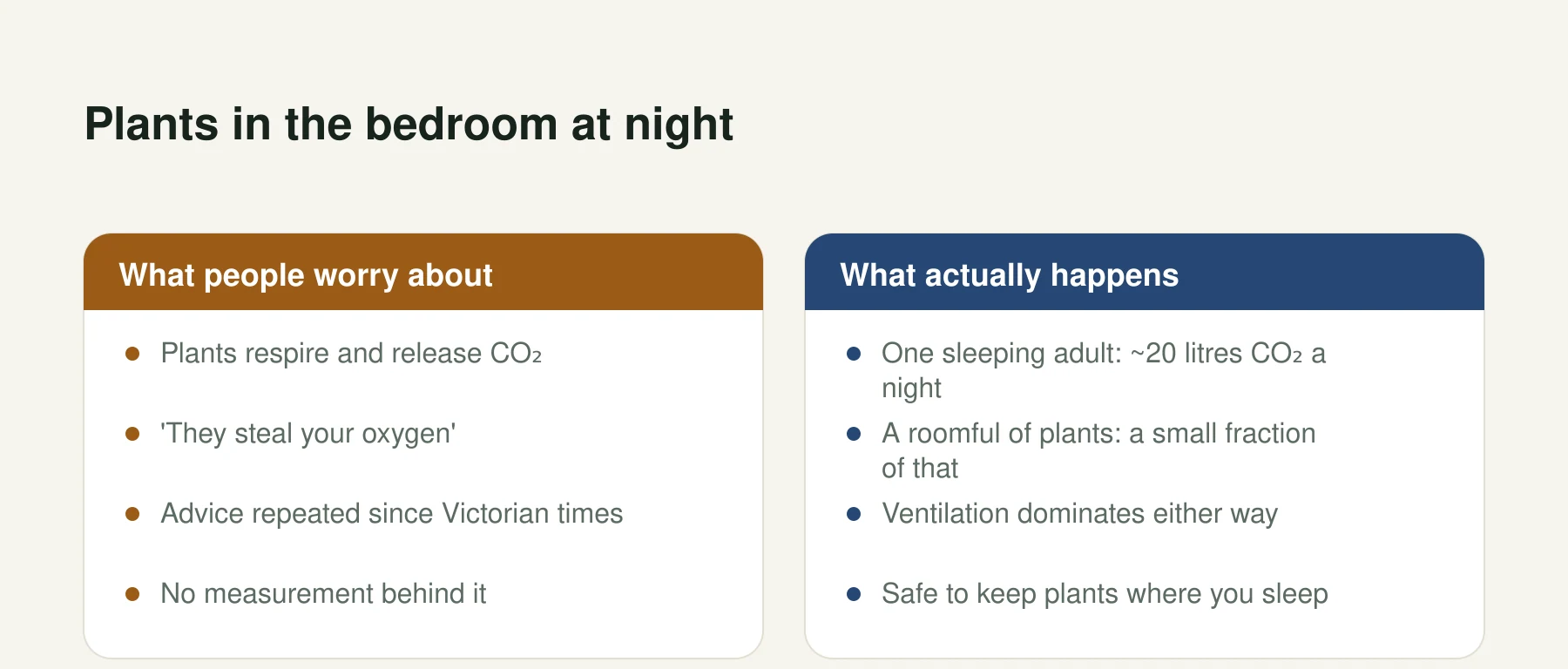
Yes. The concern comes from the fact that plants respire at night, taking in oxygen and releasing carbon dioxide. The quantities involved are negligible: a room full of houseplants produces a small fraction of the CO₂ that the sleeping person does. If plants in a bedroom were a problem, sharing a bed with someone would be a far bigger one.
#What actually helps sleep
There is reasonable evidence that visible greenery lowers self-reported stress and improves perceived comfort in a room, and lower bedtime stress does help sleep. There is no good evidence that any houseplant changes oxygen levels, humidity or air quality enough to affect sleep physiologically. Lavender is the one plant with some published support for its scent and relaxation — though the effect in studies comes from concentrated essential oil, not from a living plant on a windowsill.
#Plants to avoid in a bedroom
- Strongly scented flowering plants — jasmine, gardenia, hyacinth. Pleasant across a room, overwhelming beside a pillow, and a headache trigger for some people.
- Anything needing bright light — fiddle leaf figs, crotons and succulents will slowly decline behind bedroom curtains.
- Large plants beside the bed if you have dust sensitivity — soil surfaces and dusty leaves both add to the load in a room where you spend eight hours.
- Cacti at reaching distance from a bed, for obvious reasons.
- Toxic species at floor level in a bedroom shared with pets that sleep there — dieffenbachia and philodendron especially.
#Bedroom plants and vastu
Vastu shastra generally recommends keeping heavy plant presence out of the bedroom, allowing small plants in the south-west or west corner, and specifically discourages cacti and thorny plants in a sleeping space. The money plant is usually considered acceptable and auspicious; the tulsi plant is traditionally kept in a more public, north-east position rather than a bedroom.
From a horticultural point of view those placements are workable: a south-west corner in the northern hemisphere gets warm afternoon light, which suits most of the plants on this page. Where the tradition and the plant disagree — a species that needs light placed in a dark corner for auspicious reasons — the plant will lose. Choose a species that fits the direction rather than forcing a plant into a spot it cannot photosynthesise in. Our vastu plant guide works through each direction in detail.
#Practical bedroom setup
Put the plant where the curtain is not
If curtains stay drawn until late morning, the plant loses the best light of the day. Position it beside the window rather than behind the curtain line.
Keep pots off the floor near a radiator
Bedroom radiators usually sit under the window — exactly where you want the plant. Raise it on a stand or move it a metre to the side.
Water in the morning
Watering at night in a cool bedroom leaves the soil wet and cold for hours, which is precisely the condition root rot wants. Water in the morning and it is used through the day instead.
Use a cover pot with a saucer you can see
Bedrooms are where forgotten cachepot reservoirs kill plants, because nobody is checking them during the day.
Wipe leaves monthly
Bedrooms are dusty — fabric, bedding, low airflow. Dust cuts the light a leaf receives, which matters most in the room that has least.
Frequently asked questions
Is it OK to have plants in your bedroom at night?
Yes. Plants release a very small amount of carbon dioxide at night, far less than a sleeping person, and there is no health risk from keeping plants in a bedroom. The old advice against it has no scientific basis.
Which plant gives oxygen at night?
Snake plants, aloe vera, orchids and other CAM plants open their stomata after dark and release some oxygen at night. The quantity is negligible compared with what a person breathes, so the benefit is aesthetic rather than physiological.
What is the best plant for a bedroom with no window light?
The ZZ plant or cast iron plant. Both hold condition at very low light levels for long periods. In a genuinely windowless room, add a small full-spectrum LED bulb on a 12-hour timer or rotate the plant to a brighter room every few weeks.
Do bedroom plants help you sleep better?
Indirectly at best. Visible greenery reduces self-reported stress, which can help you settle, but no houseplant changes the oxygen, humidity or air quality of a room enough to alter sleep physiologically.
Which plants should not be kept in a bedroom?
Strongly scented flowering plants such as jasmine and gardenia, bright-light plants that will slowly decline there, and — if you follow vastu — cacti and thorny plants. Toxic species are also best kept off the floor if pets sleep in the room.
Sources and further reading
- Houseplants — Royal Horticultural Society. General indoor growing guidance, light and watering advice.
- Interior landscape plants for indoor air pollution abatement — NASA Technical Reports Server, 1989. The original 1989 sealed-chamber study behind every air-purifying plant list.
- Potted plants do not improve indoor air quality: a review and analysis of reported VOC removal efficiencies — Journal of Exposure Science & Environmental Epidemiology, 2020. Reanalysis converting chamber results into clean air delivery rates.
- Toxic and Non-Toxic Plants List — ASPCA Animal Poison Control. Toxicity status of every plant named, checked under its botanical name.
Related guides
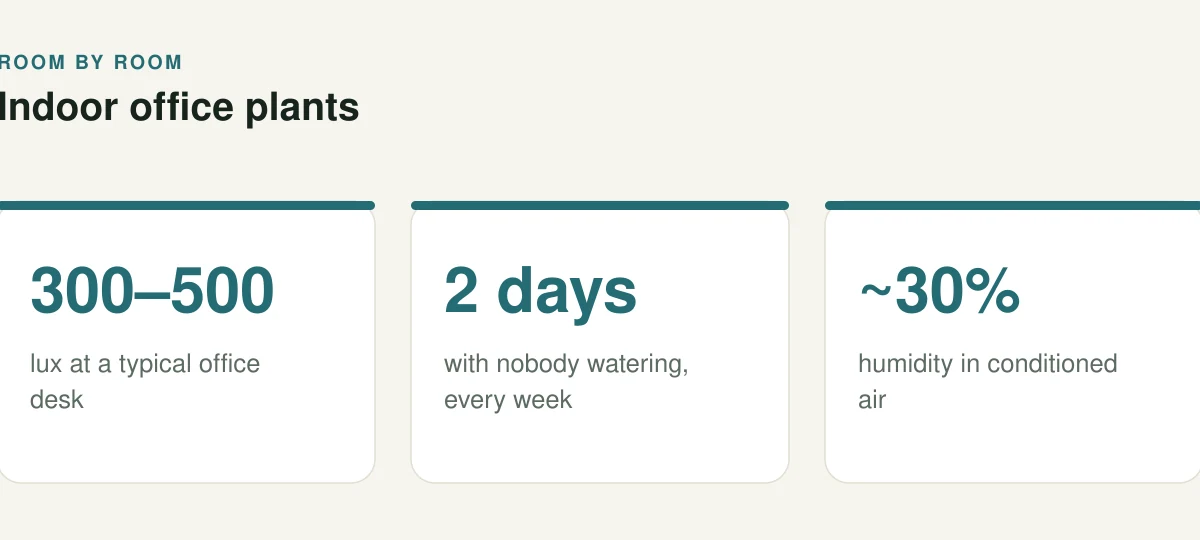
Indoor Office Plants: 12 That Survive Fluorescent Light and Long Weekends
Office plants have to cope with artificial light, air conditioning and nobody watering them on Saturday. These 12 handle all three — including desk-sized options.
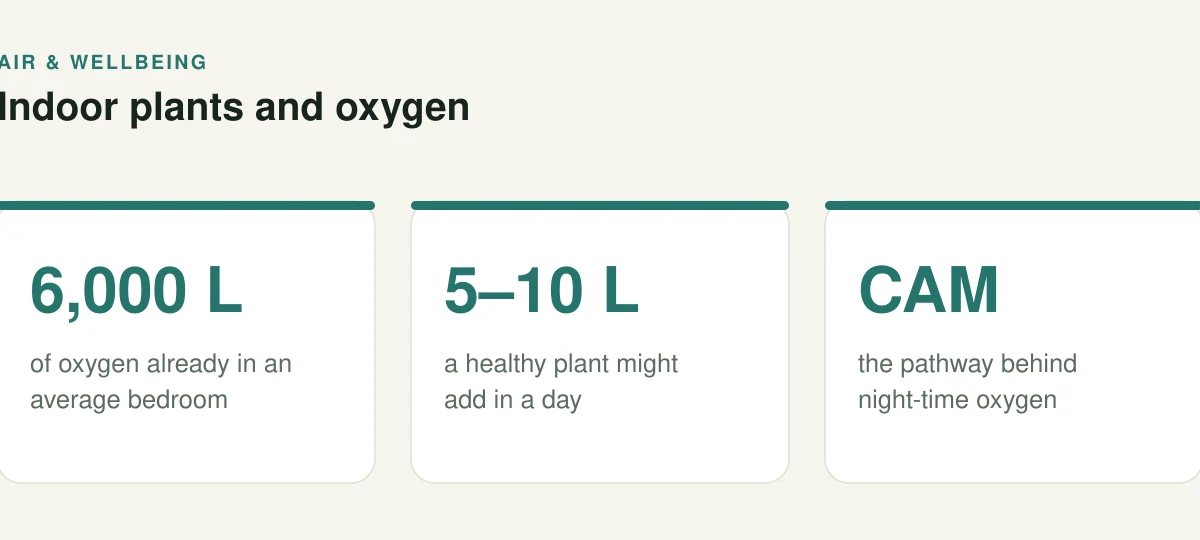
Best Indoor Plants for Oxygen: Which Ones Give Oxygen 24 Hours?
Snake plant, aloe, tulsi and orchids release oxygen at night — here is why, how much it actually amounts to, and the 10 highest oxygen producing indoor plants.
Indoor Plants That Need No Sunlight: 10 for Rooms With No Windows
No plant grows in true darkness — but these 10 survive on ambient and artificial light alone, in windowless bathrooms, hallways and interior rooms.