Indoor Office Plants: 12 That Survive Fluorescent Light and Long Weekends
Office plants have to cope with artificial light, air conditioning and nobody watering them on Saturday. These 12 handle all three — including desk-sized options.
The short answer
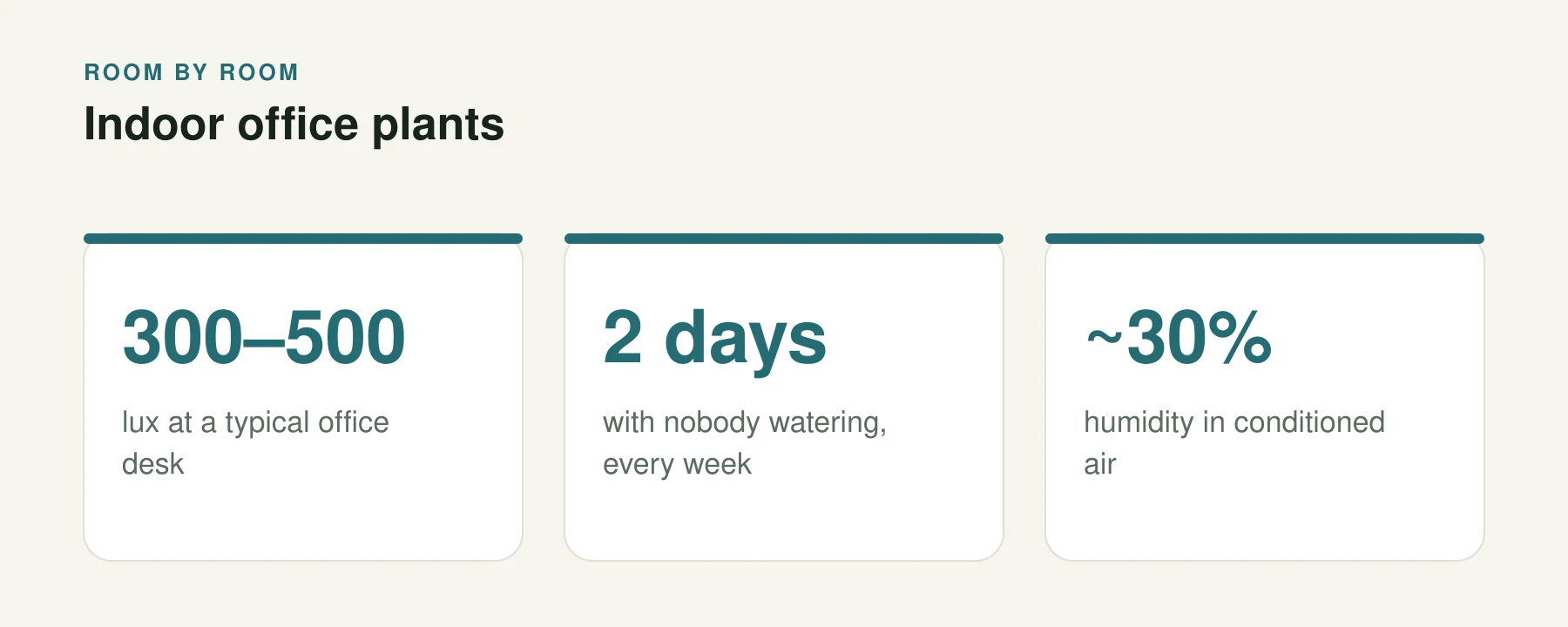
- Offices fail plants three ways at once: weak light, dry conditioned air, and nobody there at weekends.
- ZZ plant, snake plant, pothos, aglaonema and cast iron plant handle all three.
- Water on a Friday, not a Monday — the plant then enters the gap with a full pot.
Key takeaways
- Offices fail plants in three ways at once: weak light, dry conditioned air, and a two-day gap in care every week.
- Fluorescent and LED ceiling lighting does support plant growth — it is simply much weaker than daylight.
- Desk plants in small pots dry out fastest; choose semi-succulents rather than ferns.
- Self-watering pots genuinely solve the weekend problem for offices, unlike in most homes.
An office is a harsher place for a plant than most people realise. The light comes from ceiling fixtures rather than windows, air conditioning holds humidity around 30%, the temperature drops overnight and again at weekends, and for two days in seven nobody is there at all. The plants that shrug off all four of those at once make a short list — and it is not the list on the garden centre display.
#Does office lighting count as light?
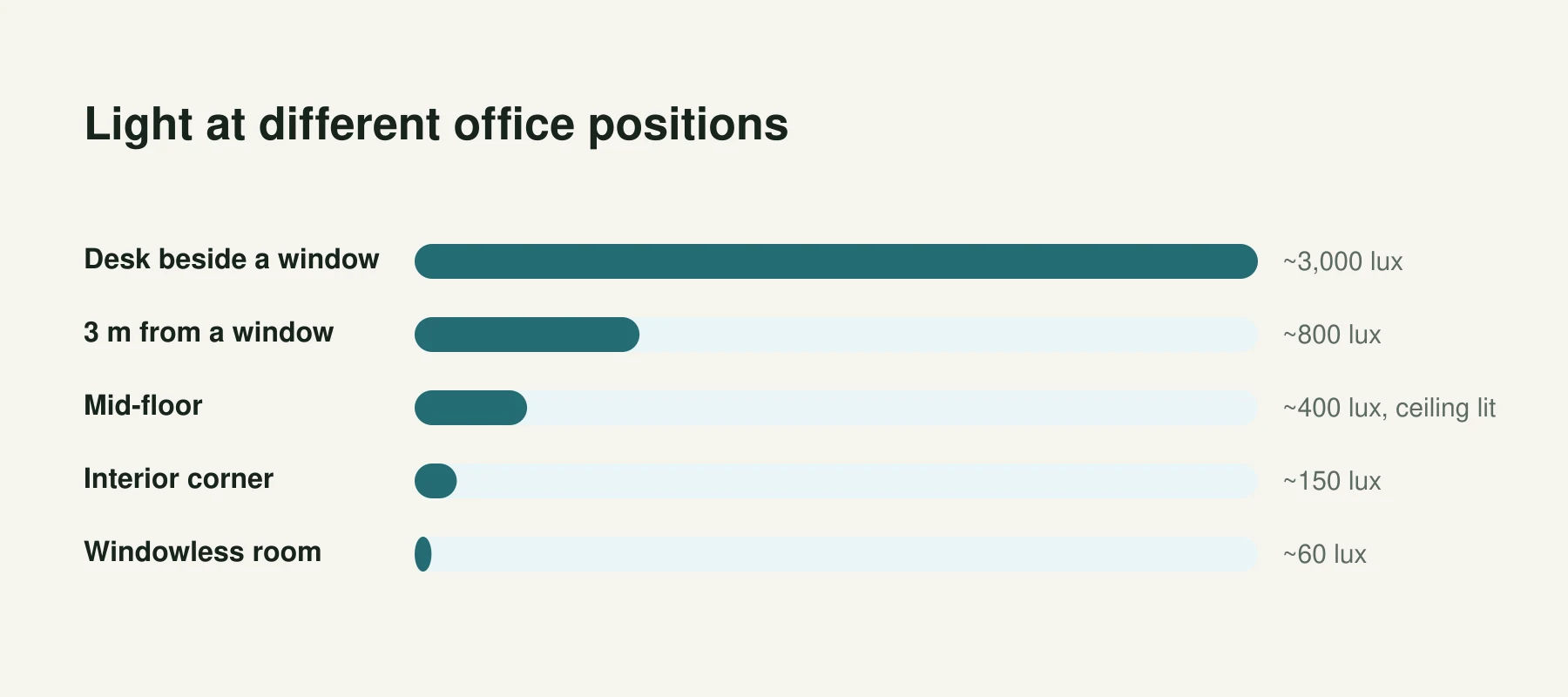
Yes, but weakly. A typical office is lit to 300–500 lux at desk level, which is roughly the bottom of what shade-tolerant houseplants need. Daylight through a nearby window can add several thousand lux; the difference between a desk by a window and one in the middle of the floor is enormous even though both look equally 'well lit' to your eyes.
#Best plants for an office floor or shelf
| Plant | Tolerates fluorescent only | Water | Notes |
|---|---|---|---|
| ZZ plant | Yes | Every 3–4 weeks | The single toughest office plant |
| Snake plant | Yes | Every 3–4 weeks | Upright, fits narrow gaps |
| Pothos / money plant | Yes | Every 10–14 days | Trails from cabinets and shelves |
| Aglaonema | Yes | Every 10–14 days | Adds colour without needing light |
| Cast iron plant | Yes | Every 2 weeks | Handles the darkest corners |
| Dracaena 'Janet Craig' | Yes | Every 2 weeks | Floor-standing height |
| Philodendron | Yes | Every 10–14 days | Fast, cheap, easy to propagate |
| Kentia palm | Near a window | Every 7–10 days | Best large plant for a reception area |
| Peace lily | Near a window | Every 7 days | Wilts visibly when thirsty — a useful reminder |
#Desk plants that survive a small pot
- Small snake plant cultivars ('Futura', 'Hahnii') — under 25 cm and nearly unkillable.
- Haworthia — succulent, compact, happy under a desk lamp.
- Peperomia — semi-succulent leaves, tolerates a forgotten fortnight.
- Syngonium — fast and forgiving, roots in a glass of water on the desk.
- Lucky bamboo — lives in water, so the routine is a weekly top-up and nothing else.
- Pothos cutting in a jar — the cheapest office plant there is, and it looks good for months.
#Solving the weekend problem
Choose a bigger pot
A 20 cm pot holds several times the water of a 12 cm one. This is the simplest fix and costs nothing extra beyond the pot.
Use self-watering planters
A reservoir pot with a wick keeps soil evenly moist for one to three weeks. In a home these often cause overwatering; in an office they are genuinely the right tool.
Water on Friday, not Monday
Water thoroughly at the end of the week so the plant enters the two-day gap with a full pot rather than an empty one.
Group plants together
Clustered plants raise local humidity by transpiring into the same pocket of air, which measurably slows drying in a conditioned room.
Add a desk grow light for an interior desk
A small clip-on full-spectrum LED on a timer turns a windowless desk into a workable spot for anything on this page.
#Office conditions worth checking
| Condition | Effect on plants | What to do |
|---|---|---|
| Air conditioning vent overhead | Cold draught, rapid drying, leaf drop | Move the plant out of the direct airflow |
| Heating off at weekends | Temperature swings of 10 °C or more | Choose tolerant species; avoid tropicals near external walls |
| Blinds closed most of the day | Effective light far lower than it appears | Treat the desk as low light regardless of window proximity |
| Cleaning staff watering plants | Frequent light watering, chronic overwatering | Leave a note with the interval, or use self-watering pots |
| Long holiday shutdowns | Two to three weeks unattended | Water thoroughly before leaving and move plants away from windows |
#Do office plants improve productivity?
The honest position: the air-purification claims are overstated — you would need an implausible density of plants to change the air quality of a ventilated office. The wellbeing findings are more robust. Multiple workplace studies have found modest but repeatable improvements in reported concentration, satisfaction and perceived air quality in planted offices compared with bare ones. The effect appears to come from the psychological benefit of visible greenery rather than from any measurable change in the atmosphere.
Which is a good enough reason to keep a ZZ plant on the filing cabinet. Just do not expect it to replace ventilation — our air purifying plants guide goes through what the research actually measured, and it is not what the marketing says.
Frequently asked questions
What is the best plant for an office desk?
A small snake plant cultivar or a haworthia. Both tolerate the small pot, dry air and irregular watering of a desk, and neither needs more light than an office ceiling provides. A pothos cutting in a jar of water is the cheapest good option.
Can office plants survive without natural light?
Yes, in a limited way. Fluorescent and LED ceiling lighting at 300–500 lux supports slow growth in shade-tolerant species such as the ZZ plant, snake plant, pothos and cast iron plant. A small desk grow light on a timer improves results dramatically.
How often should office plants be watered?
Most tolerant office plants want water every two to three weeks; pothos and philodendron every ten to fourteen days. Water on a Friday so the plant goes into the weekend with a full pot, and always check the soil rather than following a fixed schedule.
Which office plants are best for low light?
The ZZ plant and cast iron plant tolerate the least light of any commonly sold plant, followed by the snake plant, pothos and aglaonema. All five hold their condition in interior spaces without windows.
Do plants really clean office air?
Not meaningfully. The often-cited NASA study used sealed chambers; scaled to a ventilated office you would need a very large number of plants per square metre to match the effect of normal air exchange. The measurable benefits are on comfort and reported wellbeing, not air chemistry.
Sources and further reading
- Houseplants — Royal Horticultural Society. General indoor growing guidance, light and watering advice.
- Potted plants do not improve indoor air quality: a review and analysis of reported VOC removal efficiencies — Journal of Exposure Science & Environmental Epidemiology, 2020. Reanalysis converting chamber results into clean air delivery rates.
- Indoor Air Quality (IAQ) — US Environmental Protection Agency. Ventilation and source control as the primary indoor air measures.
- Toxic and Non-Toxic Plants List — ASPCA Animal Poison Control. Toxicity status of every plant named, checked under its botanical name.
Related guides
Indoor Plants for the Bedroom: 12 Best Picks (and the Sleep Myths Explained)
Bedrooms are dim, cool and often north-facing. These 12 indoor plants suit those conditions — plus an honest look at whether plants in a bedroom affect your sleep.
Indoor Plants That Need No Sunlight: 10 for Rooms With No Windows
No plant grows in true darkness — but these 10 survive on ambient and artificial light alone, in windowless bathrooms, hallways and interior rooms.
Low Light Indoor Plants: 12 That Genuinely Survive a Dark Room
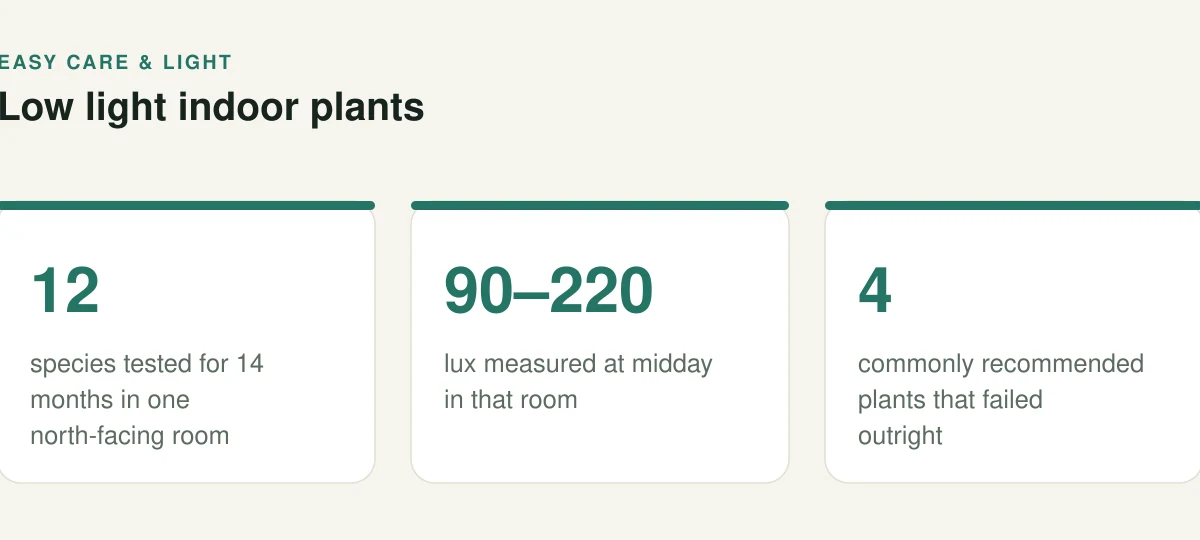
North-facing room? These 12 houseplants genuinely tolerate low light — with the light levels each one needs, in lux, and honest notes on what they will not do.