Indoor Lavender Plant: Benefits, Care and Why It's Hard Indoors
Lavender is a Mediterranean sun plant, which makes it genuinely difficult indoors. Here is what it needs, which variety to choose, and the honest benefits.
The short answer
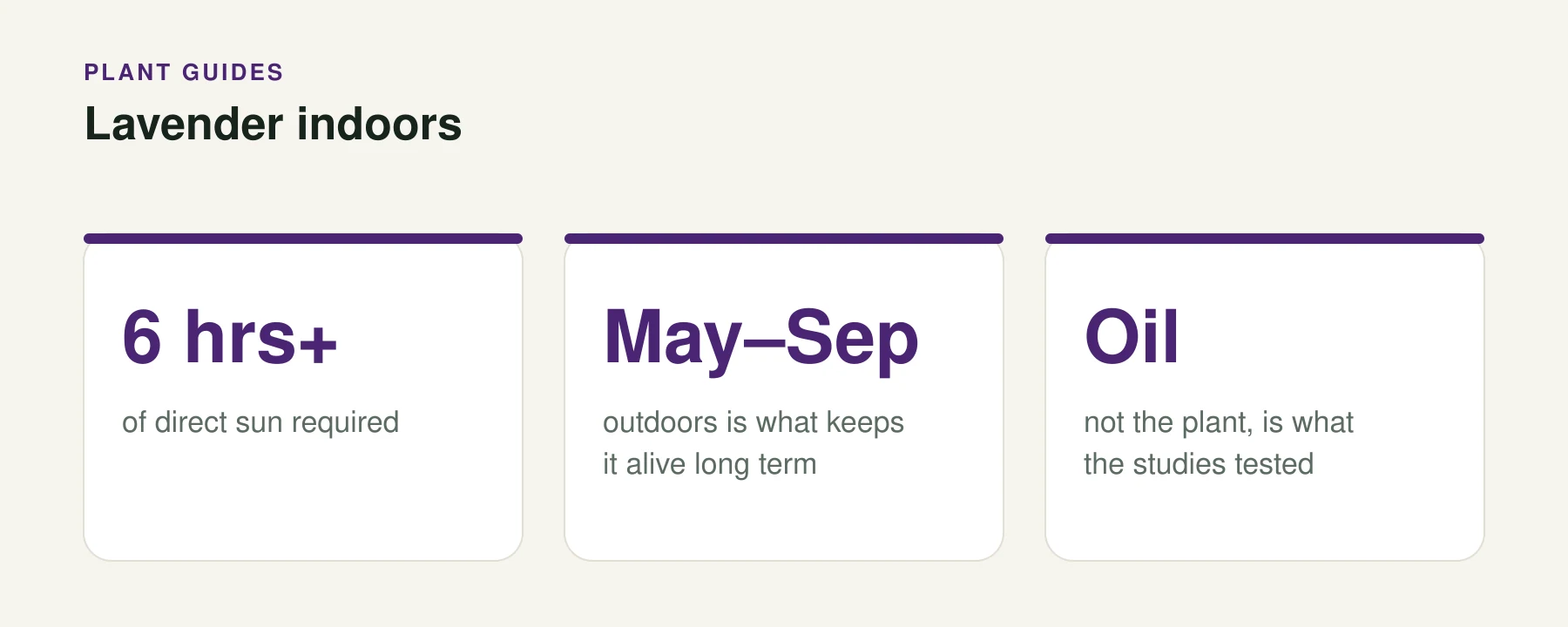
- Lavender is a Mediterranean sun plant and genuinely difficult indoors — expect a high failure rate.
- It needs six hours of direct sun, gritty alkaline soil, sparse water and moving air.
- The calming evidence relates to concentrated oil, not to a living plant on a windowsill.
Key takeaways
- This is a difficult indoor plant — the failure rate is high and it is nearly always about light.
- Lavender rots in rich, moist potting soil; it wants gritty, lean, slightly alkaline conditions.
- Air movement matters as much as light; stagnant indoor air causes fungal problems.
- Move it outdoors for summer if you possibly can — that is what keeps indoor lavender alive long term.
Lavender is one of the most requested indoor plants and one of the least suited to the job. It evolved on dry, stony Mediterranean hillsides — blazing sun, constant air movement, poor alkaline soil — and a living room offers the opposite of all four at once. It can be done, and I will show you how, but you deserve to know what you are taking on before you spend the money. If someone has told you lavender is an easy windowsill herb, they have not tried it through a winter.
#What it actually needs
| Factor | Requirement | Why it fails indoors |
|---|---|---|
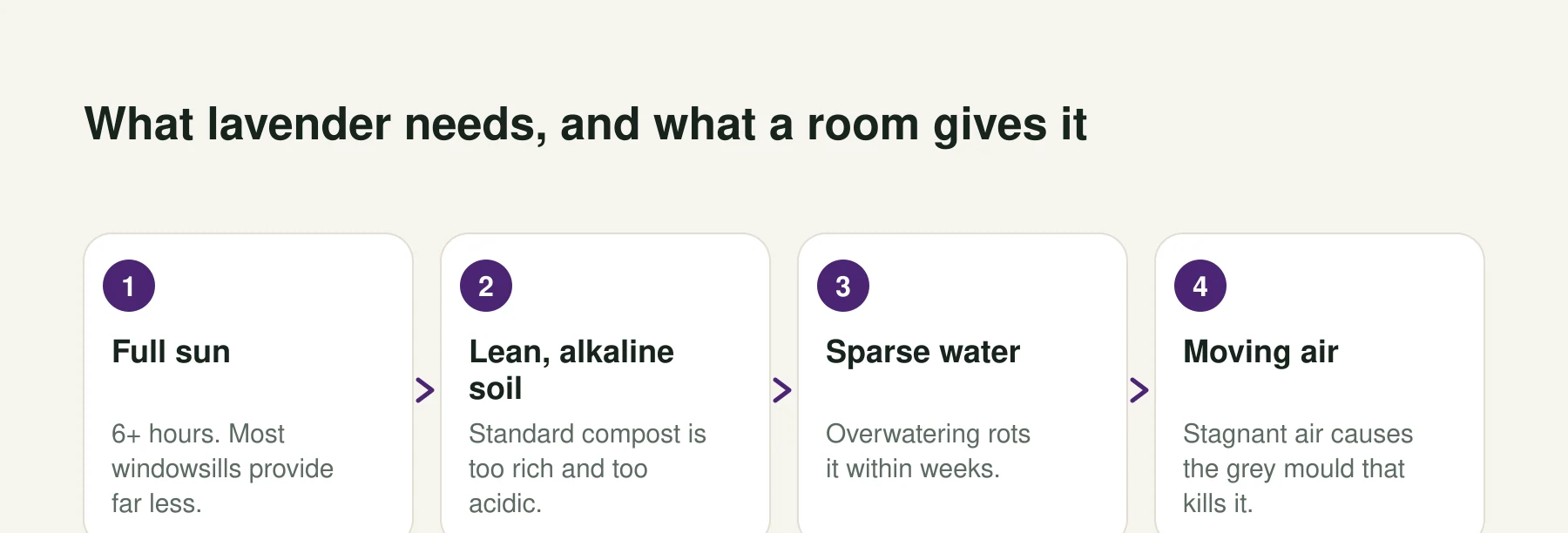
| Light | 6+ hours direct sun | Most windowsills provide far less |
| Soil | Gritty, lean, alkaline (pH 6.7–7.3) | Standard potting mix is too rich and acidic |
| Water | Only when top 3 cm is dry | Overwatering causes root rot quickly |
| Air | Constant movement | Stagnant indoor air invites fungal disease |
| Humidity | Low | Kitchens and bathrooms are wrong for it |
| Winter | Cool rest, 5–10 °C | Heated rooms prevent dormancy and weaken the plant |
#Which variety to choose
- French lavender (Lavandula dentata) — the best indoor choice. Longer flowering, more tolerant of pot life and warmth, less demanding of a cold winter.
- Spanish lavender (Lavandula stoechas) — distinctive 'rabbit ear' bracts, flowers over a long season, adapts reasonably well to containers.
- English lavender (Lavandula angustifolia) — the classic scent and the hardiest outdoors, but it needs a proper cold dormancy and struggles in a heated house.
- Avoid lavandins (L. × intermedia, e.g. 'Grosso') indoors — they grow too large for practical pot culture.
#Growing it successfully
Put it in the sunniest window you have
A south-facing sill, right against the glass. If your best window still falls short, add a full-spectrum grow light for 12 hours a day — lavender responds well to supplementary light.
Use a gritty, alkaline mix
Two parts potting soil to one part coarse sand or perlite, plus a tablespoon of garden lime or crushed eggshell to raise the pH. Lavender will not thrive in acidic peat-based compost.
Choose terracotta
The porosity wicks moisture out of the mix, which is exactly what this plant wants. Never use a pot without a drainage hole.
Water sparingly and from below
Only when the top 3 cm is dry — usually every 7–10 days in summer and every 2–3 weeks in winter. Avoid wetting the foliage, which encourages fungal spotting.
Give it moving air
Open a window regularly or run a small fan nearby. Stagnant air around dense grey foliage is what causes the grey mould that finishes off most indoor lavender.
Prune after flowering
Cut back by about a third once flowers fade, staying above the woody base. Lavender does not reliably regrow from old bare wood.
#The benefits, honestly assessed
Lavender has more published research behind it than most houseplants, and it is worth separating what applies to the plant from what applies to the oil.
| Claim | Evidence | Applies to a potted plant? |
|---|---|---|
| Aids relaxation and sleep | Reasonable evidence for inhaled lavender oil | Weakly — a plant releases far less |
| Reduces anxiety | Some clinical support for oral and inhaled preparations | Not at the concentrations a plant produces |
| Repels moths and some insects | Well established for dried flowers and oil | Partially, near the plant |
| Repels mosquitoes | Linalool has some repellent activity | Minimal from a living plant |
| Improves indoor air | No specific evidence | No |
| Pleasant scent when brushed | Self-evident | Yes — this is the real benefit |
The scent released when you brush past a lavender plant is genuine and pleasant. The measured therapeutic effects come from concentrated essential oil at levels a living plant on a windowsill does not approach. Grow lavender because you like it, not as a sleep intervention.
#Common problems
| Symptom | Cause | Fix |
|---|---|---|
| Grey mould on stems and leaves | Stagnant air and damp foliage | Increase air movement; water at the base only |
| Leggy, sparse growth | Too little light | Move to full sun or add a grow light |
| Yellowing, wilting despite water | Root rot from overwatering | Reduce watering; repot in gritty mix |
| Woody, bare base | Natural ageing plus insufficient pruning | Prune by a third yearly, never into old wood |
| No flowers | Insufficient light or no winter rest | More sun; a cool dormancy at 5–10 °C |
| Leaf drop in winter | Warm room preventing dormancy | Move to a cool, bright room and water less |
Frequently asked questions
Can lavender be grown indoors?
Yes, but it is difficult. It needs six or more hours of direct sun, gritty alkaline soil, sparse watering and moving air. French and Spanish lavender adapt better to pots than English lavender, and plants that spend summer outdoors last far longer.
What are the benefits of a lavender plant indoors?
The genuine benefit is its scent when brushed, plus some moth-repelling effect. The evidence for relaxation and sleep relates to concentrated lavender oil rather than to a living plant, which releases far smaller amounts.
How often should I water indoor lavender?
Only when the top 3 cm of soil is dry — typically every seven to ten days in summer and every two to three weeks in winter. Water at the base rather than over the foliage, and never leave it standing in water.
Why is my indoor lavender dying?
Almost always too little light or too much water. Lavender needs full direct sun and a gritty, free-draining mix. Grey mould on the stems points to stagnant air and wet foliage, which is the other common cause indoors.
Which lavender is best for indoors?
French lavender (Lavandula dentata) is the most tolerant of pot culture and indoor warmth, with a long flowering season. Spanish lavender is a good second choice. English lavender needs a cold winter dormancy that a heated house cannot provide.
Sources and further reading
- Lavender — US National Center for Complementary and Integrative Health. What the clinical evidence does and does not support for lavender.
- Houseplants: plant profiles — Royal Horticultural Society. Species-level profiles and cultivation notes.
- Plant Finder — Missouri Botanical Garden. Botanical names, native range and cultural requirements.
- North Carolina Extension Gardener Plant Toolbox — NC State Extension. Species data, hardiness and toxicity cross-checks.
Related guides
Scented Indoor Plants: 12 That Actually Perfume a Room
The indoor plants that genuinely smell good — flowering, foliage and herb options — with how strong each one is and how much light it needs to produce scent.
Bird of Paradise Indoor Plant Care (and Why Yours Won't Flower)
Strelitzia care indoors: the light it needs, how often to water, why the leaves split, and the honest answer on getting a bird of paradise to flower in a house.
Indoor Cactus Plants and Succulents: Care Without Killing Them
Why indoor cacti stretch, rot and fail — and the watering, light and soil regime that keeps desert and jungle cacti healthy in a house.