Scented Indoor Plants: 12 That Actually Perfume a Room
The indoor plants that genuinely smell good — flowering, foliage and herb options — with how strong each one is and how much light it needs to produce scent.
The short answer
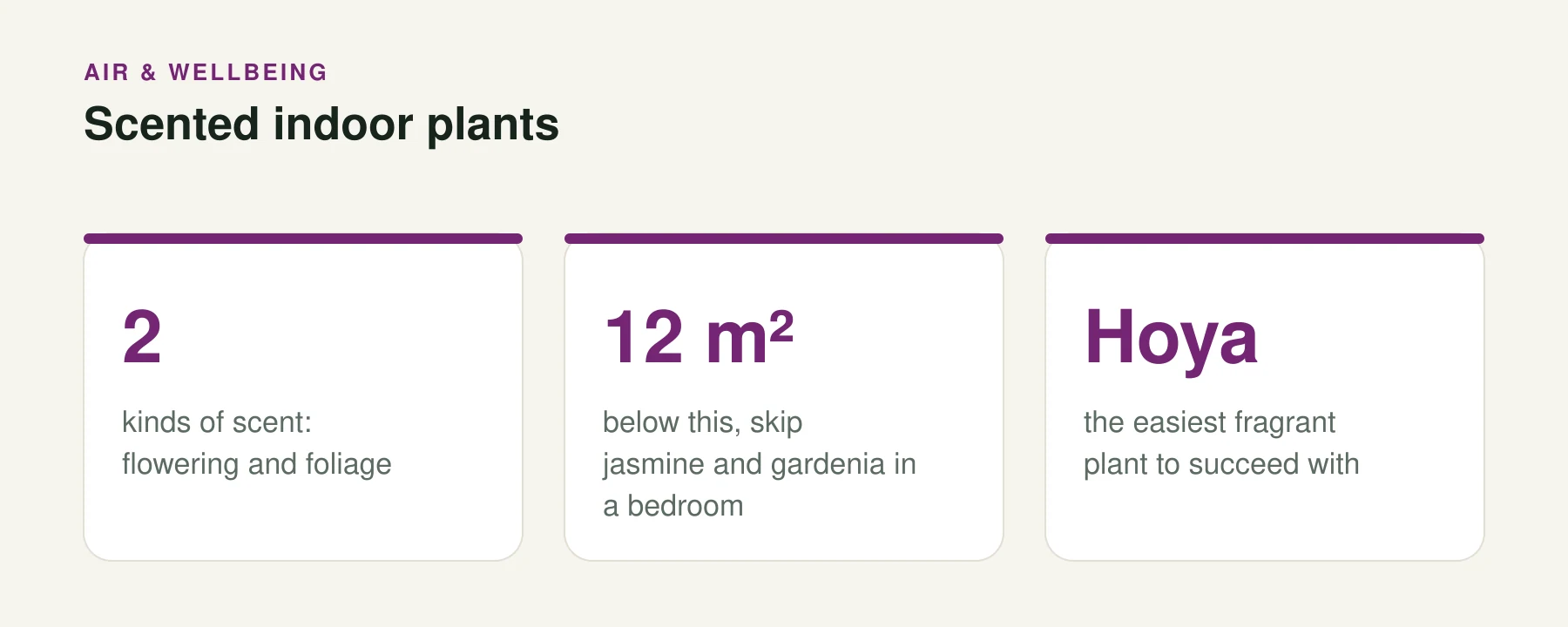
- Flowering scent needs bright light — a fragrant plant in a dim room simply will not bloom.
- Jasmine, gardenia, stephanotis and hoya perfume a room; scented pelargoniums release oils when brushed.
- Keep the strongest scents out of small bedrooms; they are common headache triggers.
Key takeaways
- Scent comes from flowers or from crushed foliage — two completely different requirements.
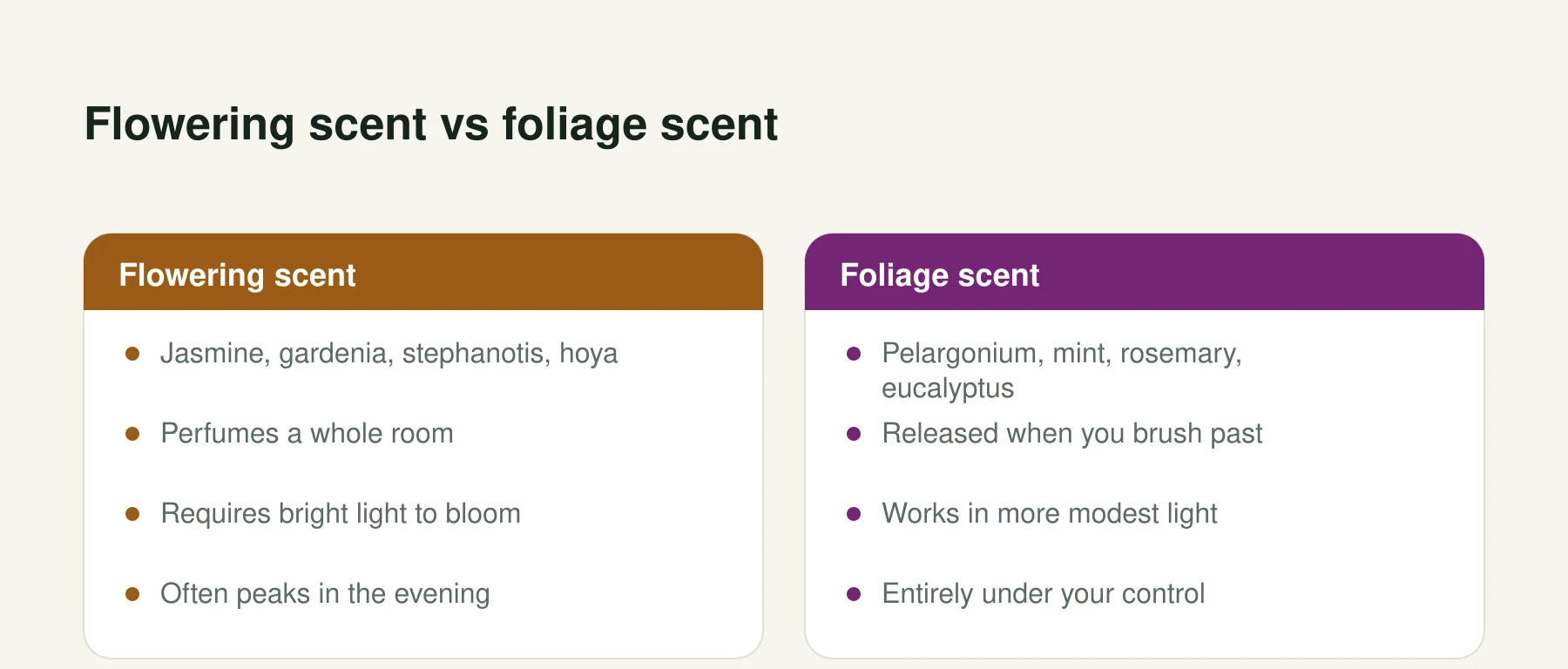
- Flowering scent needs bright light; a fragrant plant in a dim room simply will not bloom.
- Most floral scent is released in the evening, when the moths that pollinate them are active.
- Strong scents are unpleasant at close range — keep jasmine and gardenia out of small bedrooms.
Scented plants divide neatly into two groups, and knowing which one you are buying decides whether you get a perfumed room or a disappointment. Flowering scent — jasmine, gardenia, stephanotis — perfumes a whole room, but it requires the plant to actually bloom, which requires real light. Foliage scent — pelargoniums, herbs, eucalyptus — is released when you brush the leaves, works in far more modest light, and happens whenever you want it to.
#Flowering plants that perfume a room
| Plant | Scent | Strength | Light needed |
|---|---|---|---|
| Arabian jasmine (Jasminum sambac) | Sweet, heady, evening-peaking | Very strong | 4+ hrs direct sun |
| Gardenia | Rich, creamy, classic | Very strong | Bright indirect to direct |
| Stephanotis | Sweet, clean, jasmine-like | Strong | Bright indirect |
| Hoya carnosa | Honey, chocolate, at night | Moderate | Bright indirect |
| Citrus (calamondin, lemon) | Orange blossom | Strong when flowering | 5+ hrs direct sun |
| Tuberose | Intense, sweet, narcotic | Overpowering | Direct sun |
| Paperwhite narcissus | Sharp, musky-sweet | Strong, divisive | Bright, seasonal |
| Wax flower (Hoya lacunosa) | Cinnamon, evening | Moderate | Bright indirect |
#Scented foliage plants
- Scented-leaf pelargoniums — available in rose, lemon, mint, apple and nutmeg scents; the most reliable scented plant for an ordinary home. Bright light, minimal water.
- Eucalyptus — camphor-fresh, needs strong light and grows fast; often better as cut stems than as a permanent houseplant.
- Rosemary — resinous and clean, but needs a genuinely sunny windowsill and good airflow.
- Mint — the easiest scented plant there is, tolerates moderate light, and needs its own pot.
- Lemon balm — soft citrus scent, tolerant of less light than most herbs.
- Basil and tulsi — culinary and fragrant; both need 4–6 hours of direct sun to stay bushy.
- Plectranthus 'Vicks' — strongly camphor-scented foliage, easy and shade-tolerant.
#How strong is too strong?
Scent that is delightful across a living room can be overwhelming beside a pillow. Jasmine, gardenia, tuberose and paperwhites are all capable of dominating a small room, and all four are common headache triggers. Two practical rules: keep strongly scented flowering plants out of bedrooms under about 12 m², and put them where air moves — near a door or window — so the scent disperses rather than concentrating.
| Room | Suits | Avoid |
|---|---|---|
| Living room | Jasmine, gardenia, hoya, citrus | Nothing, if the room is reasonably large |
| Bedroom | Hoya, scented pelargonium, lavender | Jasmine, gardenia, tuberose, paperwhites |
| Kitchen | Mint, basil, lemon balm, rosemary | Heavily floral scents near food |
| Bathroom | Stephanotis, eucalyptus | Anything needing full sun |
| Hallway or entrance | Jasmine, citrus | Nothing — air movement helps here |
#Getting scented plants to flower
Maximise light
Scented flowering plants are almost all sun plants. A south or west facing window is the minimum for jasmine, gardenia and citrus.
Feed for flowers, not leaves
Switch to a higher-phosphorus bloom fertiliser at half strength while buds are forming. General feed drives foliage at the expense of flowers.
Give a cool winter rest
Jasmine, citrus and stephanotis all set buds better after a period at 10–15 °C with reduced water. A permanently warm room suppresses flowering.
Do not move a budding plant
Gardenia and stephanotis in particular drop buds when moved, draughted or allowed to dry out. Pick a spot and leave it.
Keep humidity up for gardenia
Gardenias need 50%+ humidity and acidic, ericaceous compost. They are the most demanding plant on this page by some distance.
#What about air quality?
Scented plants are sometimes marketed as natural air fresheners. They do mask odours pleasantly, which is a real if modest benefit, but they do not clean the air — and unlike synthetic air fresheners and scented candles, they at least do not add volatile organic compounds to the room. If odour is the actual problem, ventilation remains the answer, as covered in our air purifying plants guide.
Frequently asked questions
Which indoor plant smells the best?
Arabian jasmine (Jasminum sambac) has the strongest and most admired indoor fragrance, followed by gardenia and stephanotis. All three need bright light to flower. For an easier option with real scent, Hoya carnosa flowers in bright indirect light and perfumes a room in the evening.
Why doesn't my scented plant smell?
Because it is not flowering, and it is not flowering because it lacks light. Fragrance exists to attract pollinators, so it appears only with blooms. Move the plant to your brightest window and switch to a higher-phosphorus fertiliser while it buds.
Which fragrant plants are good for a bedroom?
Hoya, scented-leaf pelargonium and lavender are mild enough for a bedroom. Avoid jasmine, gardenia, tuberose and paperwhites in small bedrooms — at close range they can be overpowering and are common headache triggers.
Do scented plants freshen the air?
They mask odours pleasantly but do not clean the air. Unlike synthetic air fresheners and scented candles they add no volatile organic compounds, which is a genuine if indirect advantage. Ventilation is what actually improves indoor air.
What is the easiest fragrant indoor plant to grow?
Scented-leaf pelargoniums for foliage scent — rose, lemon and mint varieties release fragrance whenever you brush past, and they need only bright light and minimal water. Hoya carnosa is the easiest for flowering scent.
Sources and further reading
- Houseplants: plant profiles — Royal Horticultural Society. Species-level profiles and cultivation notes.
- Lavender — US National Center for Complementary and Integrative Health. What the clinical evidence does and does not support for lavender.
- Plant Finder — Missouri Botanical Garden. Botanical names, native range and cultural requirements.
- North Carolina Extension Gardener Plant Toolbox — NC State Extension. Species data, hardiness and toxicity cross-checks.
Related guides
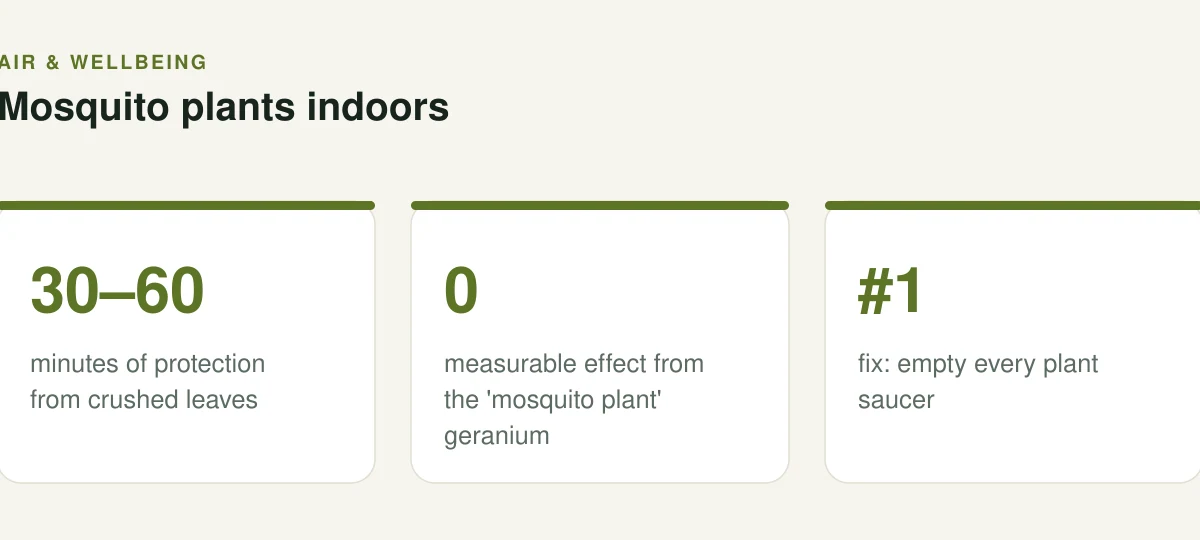
Mosquito Repellent Plants Indoor: What Works and What Doesn't
Citronella, tulsi, lemongrass and lavender are sold as mosquito plants. Here is what the research shows about repelling mosquitoes indoors — and what actually works.
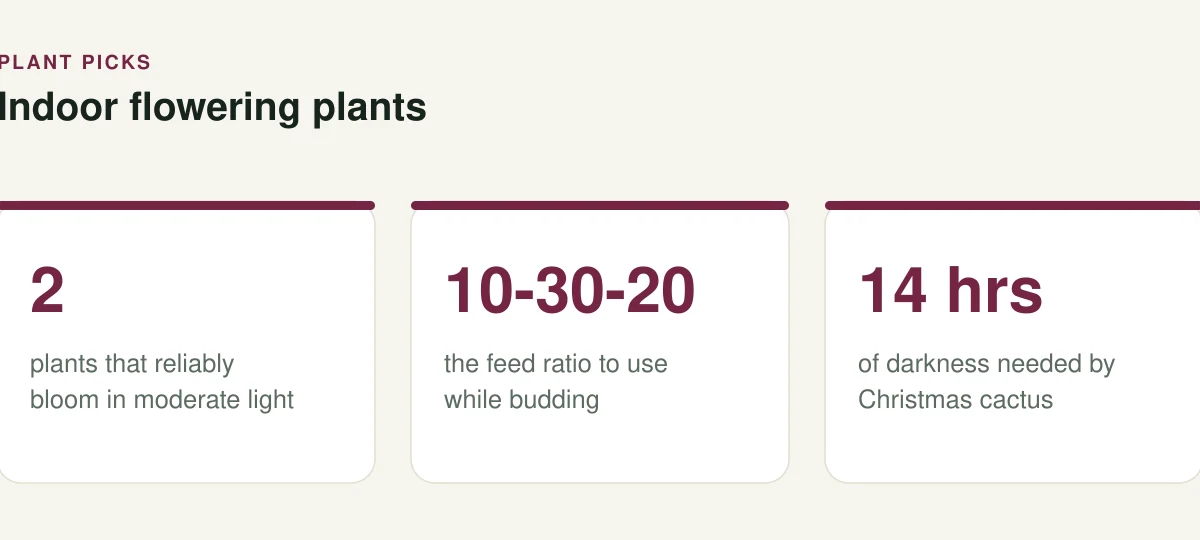
Indoor Flowering Plants: 14 That Actually Bloom Inside a House
Most indoor flower plants stop blooming within weeks of coming home. These 14 keep flowering indoors — with the light each one needs to set buds at all.
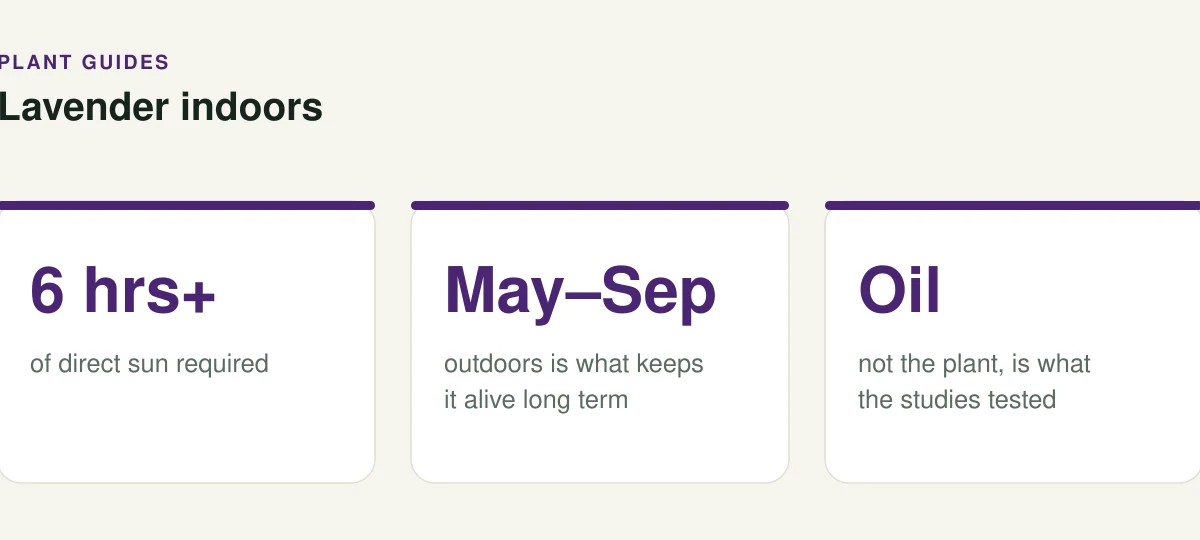
Indoor Lavender Plant: Benefits, Care and Why It's Hard Indoors
Lavender is a Mediterranean sun plant, which makes it genuinely difficult indoors. Here is what it needs, which variety to choose, and the honest benefits.