Air Purifying Indoor Plants: What the NASA Study Really Found
The 12 plants from NASA's clean air study, what they actually remove, and the honest arithmetic on how many you would need to change the air in a real room.
The short answer
- Houseplants do remove VOCs — but only in sealed laboratory chambers, not in a ventilated room.
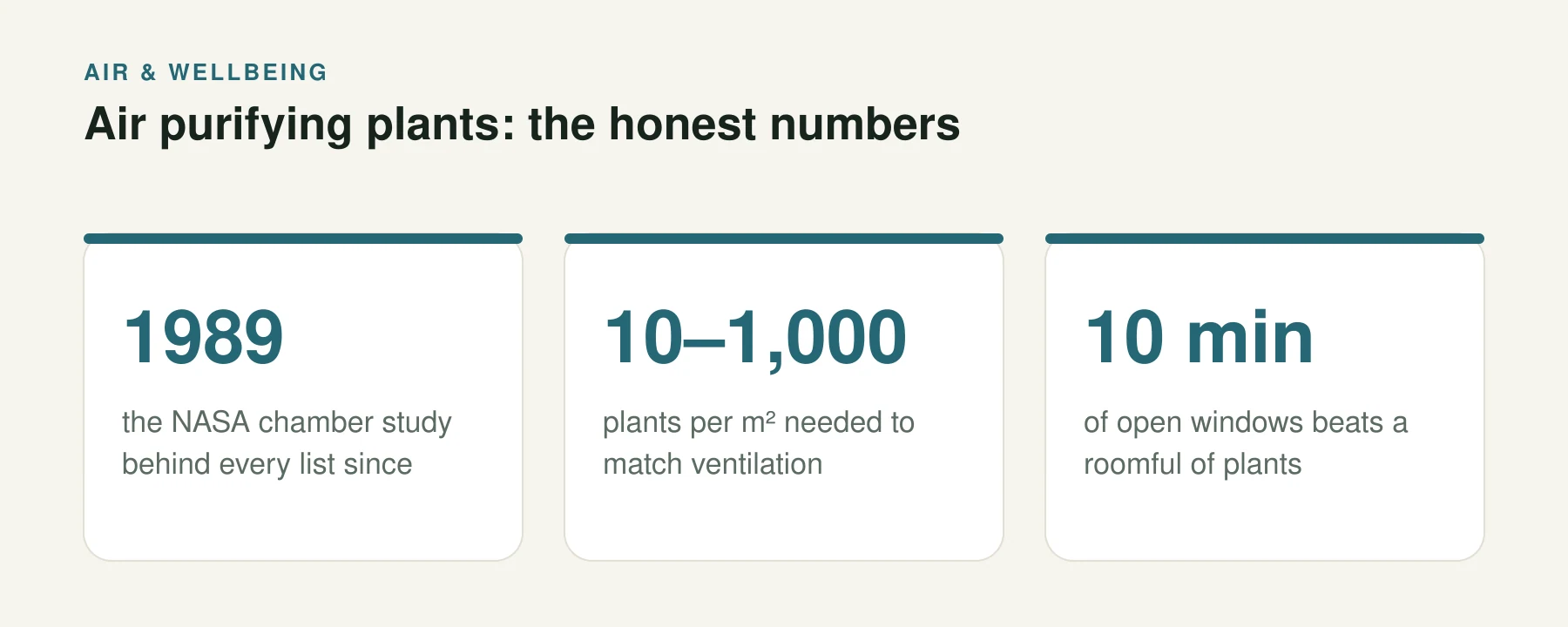
- You would need roughly 10–1,000 plants per square metre to match opening a window.
- Keep peace lilies, areca palms and snake plants because they are good plants, not as air filters.
Key takeaways
- The famous NASA result is real — but it was measured in sealed chambers, not in homes.
- Later analyses put the clean-air delivery rate of a houseplant far below that of ventilation.
- Plants do measurably raise humidity and lower reported stress, which are genuine benefits.
- Buy these plants because they are tough and handsome; treat air cleaning as a bonus, not a reason.
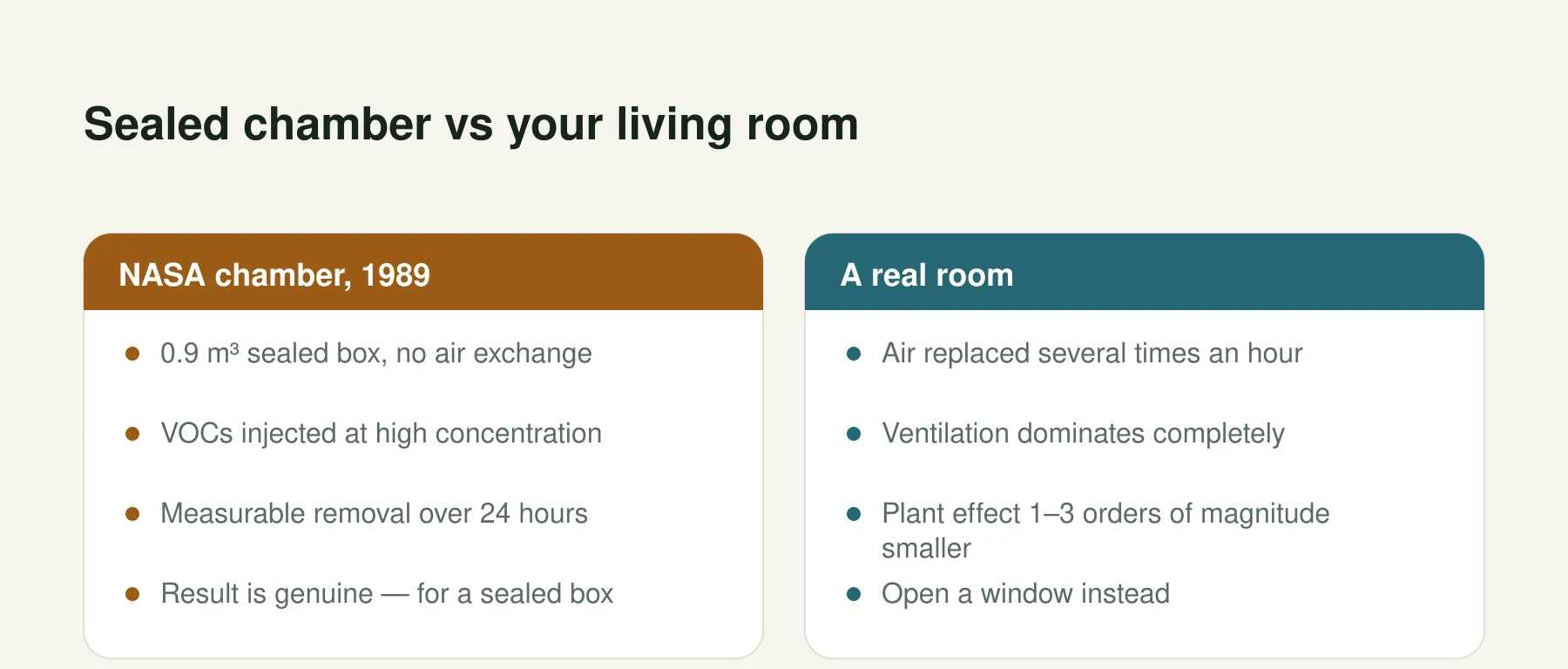
Almost every air purifying plant list you have ever read traces back to one source: a 1989 NASA study by B.C. Wolverton, which tested houseplants in sealed chambers for their ability to remove benzene, formaldehyde and trichloroethylene. The results were striking and they have been repeated ever since — usually without the one caveat that changes everything, which is that a sealed 0.9 m³ chamber is not a living room. I went and read the original paper, and then the reanalysis, because the gap between the two is the whole story.
#The 12 plants NASA tested well
| Plant | Botanical name | Removed in testing | Difficulty |
|---|---|---|---|
| Peace lily | Spathiphyllum wallisii | Benzene, formaldehyde, TCE, xylene, ammonia | Easy |
| Areca palm | Dypsis lutescens | Formaldehyde, xylene, toluene | Moderate |
| Snake plant | Dracaena trifasciata | Benzene, formaldehyde, TCE, xylene | Very easy |
| Spider plant | Chlorophytum comosum | Formaldehyde, xylene | Very easy |
| Money plant / pothos | Epipremnum aureum | Benzene, formaldehyde, xylene | Very easy |
| Boston fern | Nephrolepis exaltata | Formaldehyde, xylene | Moderate |
| Rubber plant | Ficus elastica | Formaldehyde | Easy |
| Dracaena 'Janet Craig' | Dracaena fragrans | Benzene, formaldehyde, TCE | Very easy |
| Aloe vera | Aloe barbadensis | Formaldehyde, benzene | Easy |
| Chrysanthemum | Chrysanthemum morifolium | Benzene, formaldehyde, ammonia | Short-lived indoors |
| Gerbera daisy | Gerbera jamesonii | Benzene, TCE | Difficult |
| Bamboo palm | Chamaedorea seifrizii | Formaldehyde, benzene | Easy |
#What the numbers actually say
In 2019, researchers at Drexel University reanalysed a dozen chamber studies and converted the results into clean air delivery rate — the standard measure used for air purifiers and ventilation. Their conclusion was blunt: the rate achieved by potted plants is one to three orders of magnitude below the effect of ordinary building ventilation. To match the air exchange already happening in a normal room, you would need somewhere between ten and a thousand plants per square metre of floor space.
#What plants genuinely do to indoor air
- Raise humidity. Transpiration from a group of larger plants measurably lifts relative humidity in a room, which helps with dry winter air, static and irritated sinuses.
- Lower perceived stress. This is the best-supported finding: studies of planted offices and hospital rooms consistently report improved mood, comfort and concentration.
- Absorb some particulate matter on leaf surfaces — which is one argument for dusting leaves rather than leaving them.
- Slightly increase CO₂ at night in most species — trivially small, and not a health concern.
#If air quality is the actual goal
Ventilate
Open windows on opposite sides of the home for ten minutes twice a day. This does more for VOC and CO₂ levels than any other intervention, free.
Remove the source
New furniture, paint, adhesives, air fresheners and scented candles are the main indoor VOC sources. Airing new furniture before it comes inside is more effective than filtering afterwards.
Use a HEPA filter for particulates
A HEPA unit sized for the room genuinely removes PM2.5 — relevant in cities with high outdoor pollution, where opening the window is not the answer.
Add an activated carbon filter for VOCs
Carbon adsorption is the mechanism plants use, done at scale. This is what actually replicates the chamber results in a real room.
Then add plants
For the humidity, the stress reduction and the fact that a room with plants in it is a nicer room. Just not as the air quality strategy.
#For homes in high-pollution cities
In cities where outdoor PM2.5 is regularly above safe limits — much of northern India during winter, among others — the ventilation advice inverts: opening windows at peak pollution brings the problem in. There the practical answer is a HEPA purifier sized to the room, running during the worst hours, with ventilation timed to cleaner parts of the day. Plants remain a pleasant addition; they do not filter particulates at any meaningful rate.
Frequently asked questions
Do indoor plants really purify the air?
They remove volatile organic compounds in sealed chamber experiments, but the effect in a ventilated home is negligible. A 2019 reanalysis found you would need between ten and a thousand plants per square metre to match the air exchange a normal room already has.
Which indoor plant purifies air the most?
In the NASA chamber trials the peace lily removed the widest range of compounds, followed by the areca palm and Dracaena 'Janet Craig'. In real rooms the differences between species are far smaller than the difference made by opening a window.
How many plants do I need to purify a room?
Far more than is practical — estimates from the Drexel reanalysis range from ten to a thousand plants per square metre of floor space. For actual air cleaning, use ventilation and a HEPA or activated carbon filter.
Are air purifying plants worth buying?
Yes, for reasons other than air chemistry. They raise humidity, improve reported mood and concentration, and the species on the NASA list happen to be among the toughest and most attractive houseplants available.
Which air purifying plants are best for India?
The areca palm, money plant, snake plant and peace lily are all widely available, suit warm interiors and tolerate the light levels of a typical apartment. In cities with high winter PM2.5, pair them with a HEPA purifier rather than relying on them.
Sources and further reading
- Interior landscape plants for indoor air pollution abatement — NASA Technical Reports Server, 1989. The original 1989 sealed-chamber study behind every air-purifying plant list.
- Potted plants do not improve indoor air quality: a review and analysis of reported VOC removal efficiencies — Journal of Exposure Science & Environmental Epidemiology, 2020. Reanalysis converting chamber results into clean air delivery rates.
- Indoor Air Quality (IAQ) — US Environmental Protection Agency. Ventilation and source control as the primary indoor air measures.
- Houseplants — Royal Horticultural Society. General indoor growing guidance, light and watering advice.
Related guides
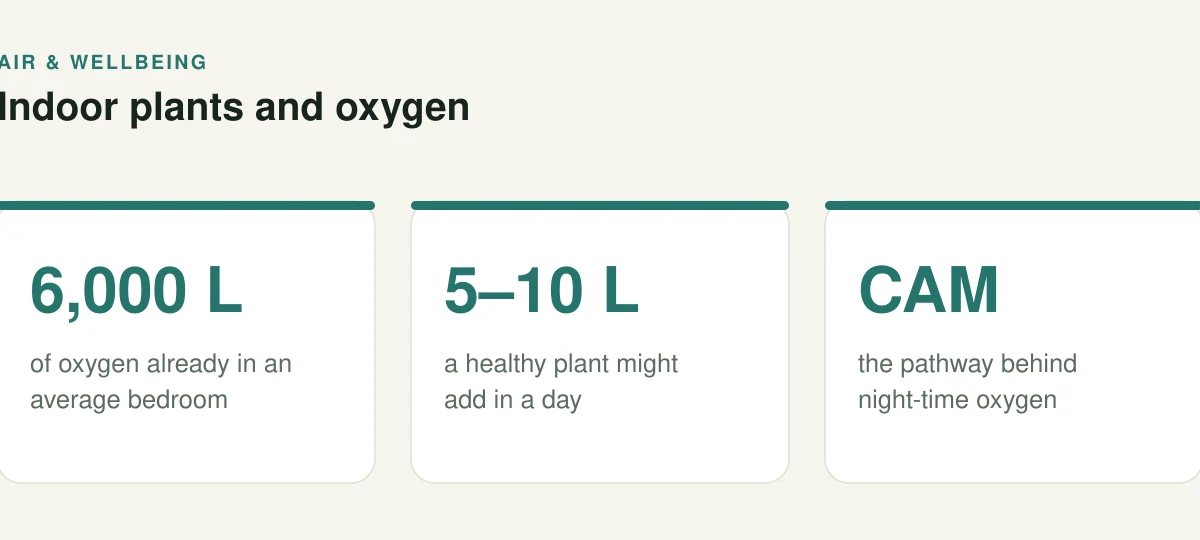
Best Indoor Plants for Oxygen: Which Ones Give Oxygen 24 Hours?
Snake plant, aloe, tulsi and orchids release oxygen at night — here is why, how much it actually amounts to, and the 10 highest oxygen producing indoor plants.
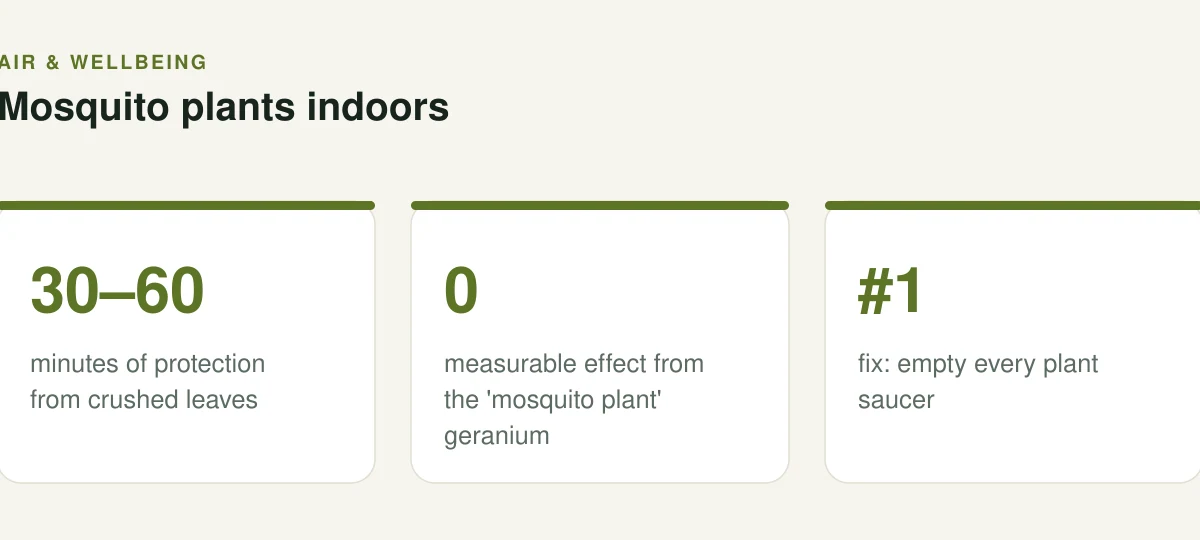
Mosquito Repellent Plants Indoor: What Works and What Doesn't
Citronella, tulsi, lemongrass and lavender are sold as mosquito plants. Here is what the research shows about repelling mosquitoes indoors — and what actually works.
Indoor Flowering Plants: 14 That Actually Bloom Inside a House
Most indoor flower plants stop blooming within weeks of coming home. These 14 keep flowering indoors — with the light each one needs to set buds at all.