Low Light Indoor Plants: 12 That Genuinely Survive a Dark Room
North-facing room? These 12 houseplants genuinely tolerate low light — with the light levels each one needs, in lux, and honest notes on what they will not do.
The short answer
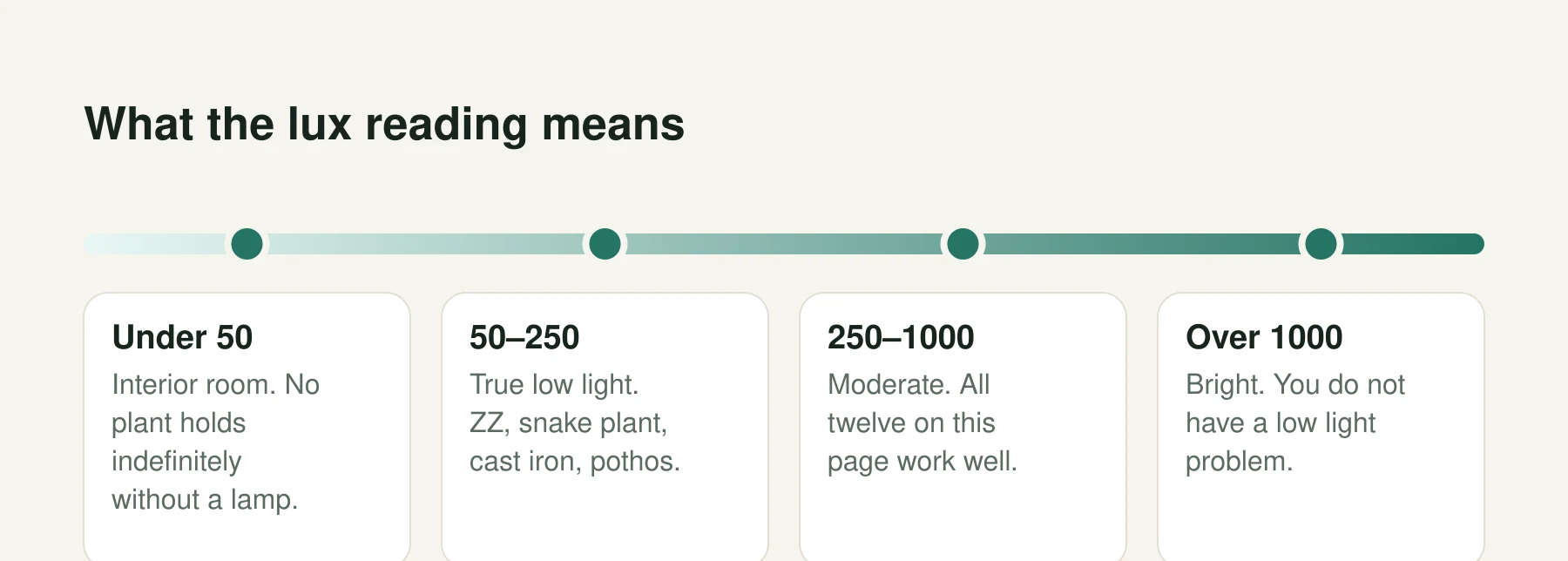
- Low light means 50–250 lux: a north window, or two metres back from any other window.
- ZZ plant, snake plant, pothos, cast iron plant, philodendron and peace lily hold their shape there.
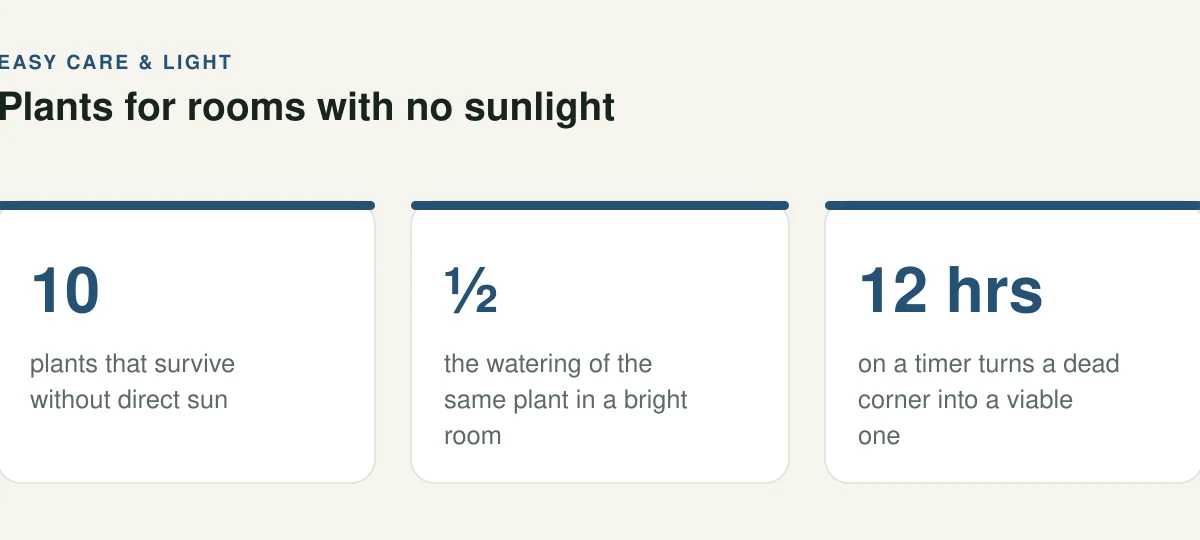
- Water half as often as you would in a bright room — dark corners kill by root rot, not darkness.
Key takeaways
- Low light tolerance means surviving and holding shape, not growing quickly — expect one to three new leaves a year.
- Measure with a free lux meter app: under 250 lux is genuinely low light, 250–1000 lux is moderate.
- Plants in low light need dramatically less water; overwatering is what actually kills them, not the dark.
- No flowering plant except the peace lily performs reliably below 250 lux.
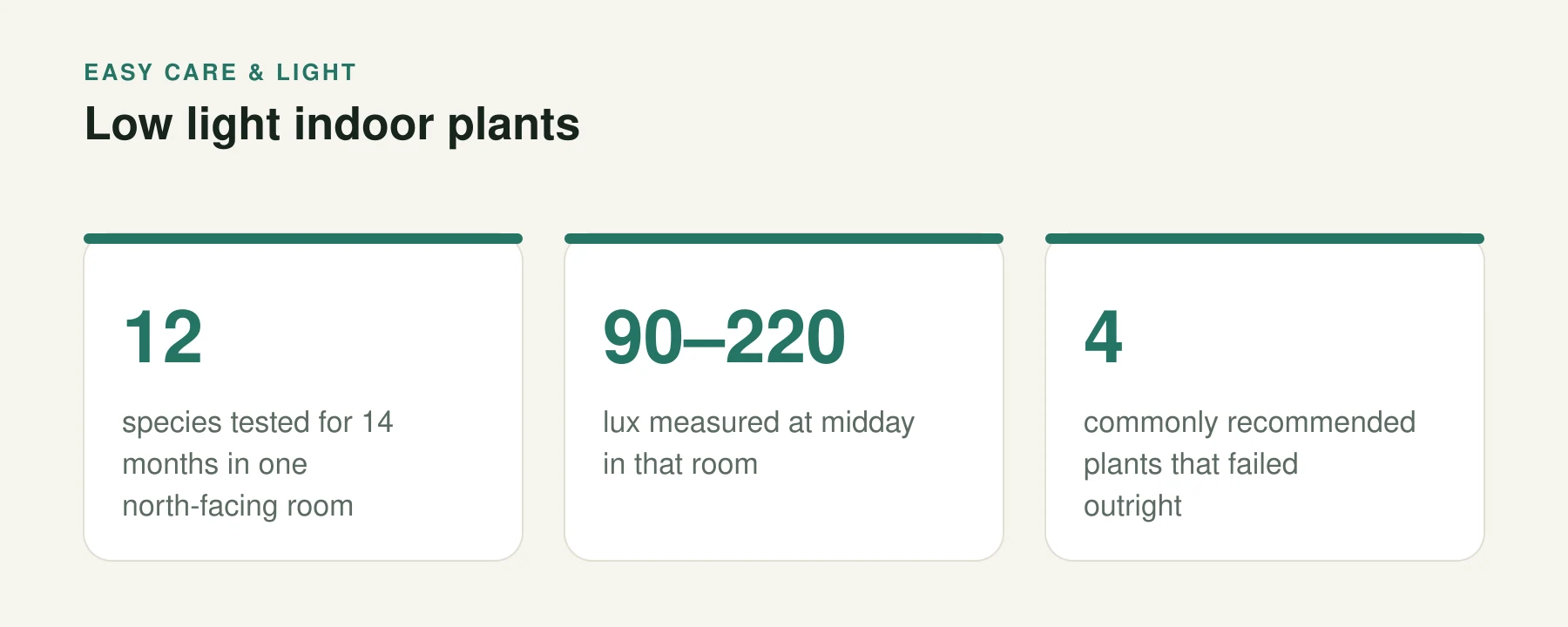
Almost every list of low light plants is written from a plant label, not from a dark room. I ran this one differently: twelve species, one north-facing room in a ground-floor flat measuring 90–220 lux at midday, no grow lights, watched for fourteen months. Four of the plants commonly recommended for shade failed outright. The twelve below did not.
#How to measure the light you have
- Install any free lux meter app and hold the phone at the plant's position, sensor facing the window.
- Measure at midday on an overcast day — that is your realistic baseline, not a sunny afternoon.
- Under 250 lux: choose from the top six below. 250–1000 lux: all twelve work. Over 1000 lux: you do not have a low light problem.
- The shadow test without an app: hold your hand 30 cm above white paper. A sharp shadow means bright light, a soft grey outline means moderate, and no visible shadow means low.
#The six that thrive under 250 lux
1. ZZ plant (Zamioculcas zamiifolia)
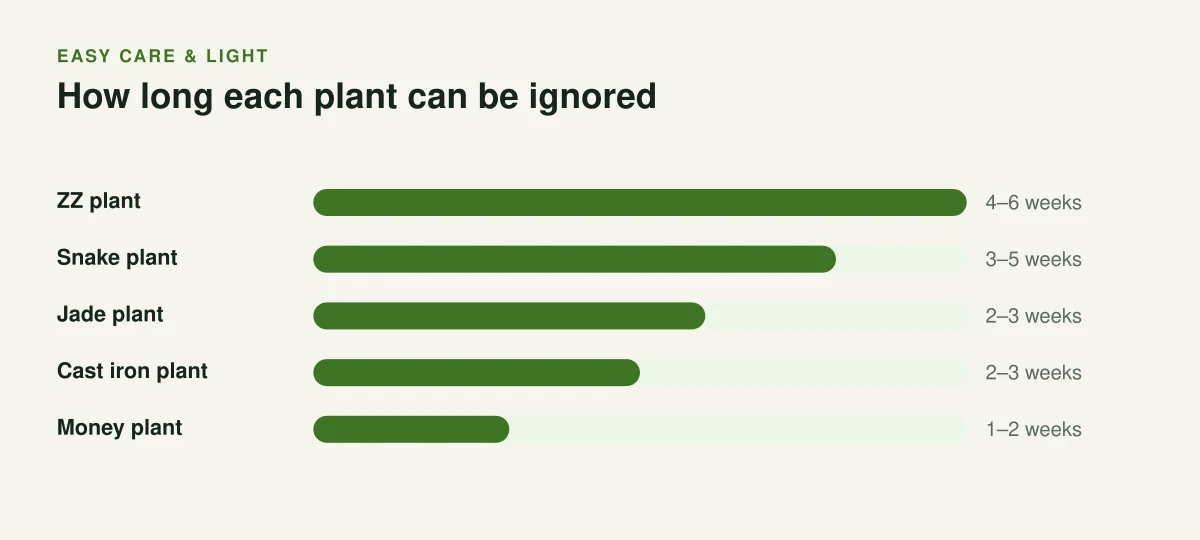
The most shade-tolerant plant sold. Underground rhizomes store water and energy, so it can coast for months. In my test room it put out three new stems in fourteen months and lost nothing. Water every four to six weeks in low light — and treat the top of that range as normal, not neglect.
2. Snake plant (Dracaena trifasciata)
Uses crassulacean acid metabolism, opening its stomata at night, which makes it unusually efficient in poor light. Grows slowly in shade and keeps its architecture indefinitely. The main failure mode is water: in a dark corner, once a month is plenty, and its base turns soft and mushy if you do more.
3. Pothos (Epipremnum aureum)
The plain green form is the shade specialist. Variegated cultivars such as 'Marble Queen' have less chlorophyll per leaf, and in low light they revert to green or produce stunted leaves — buy the green one for a dark room. Vines will stretch with more space between leaves; prune back to keep it full.
4. Cast iron plant (Aspidistra elatior)
Named for exactly this. It carried Victorian hallways lit by gaslight and it will carry your unlit stairwell. The cost is pace: one or two new leaves a year is a good result. Buy it at the size you want it.
5. Heartleaf philodendron (Philodendron hederaceum)
More forgiving than pothos about staying slightly damp and marginally faster in shade. Trailing or climbing, it holds its leaf size better in dim light than most vines. My test plant added about 40 cm of growth over the year.
6. Peace lily (Spathiphyllum)
The only reliable flowering plant for low light — with a caveat: it flowers less the darker it gets, and below about 150 lux it usually produces foliage only. It also wilts theatrically when thirsty and recovers within hours of watering, which makes it the easiest plant in the room to read.
#Six more for moderate shade (250–1000 lux)
| Plant | Why it works | Watch out for |
|---|---|---|
| Chinese evergreen (Aglaonema) | Deep green cultivars handle real shade; pink ones need more light | Cold draughts below 15 °C |
| Spider plant (Chlorophytum) | Tough, fast, produces plantlets even in shade | Brown tips from fluoride in tap water |
| Parlour palm (Chamaedorea elegans) | A true understorey palm, evolved under canopy | Spider mites in dry air |
| Dracaena 'Janet Craig' | Holds dark green colour without bright light | Fluoride sensitivity; use filtered water |
| Philodendron 'Birkin' | Tolerates shade, though white striping fades | Loses variegation permanently under 200 lux |
| Maidenhair fern (Adiantum) | Native to shaded gorges, wants no direct sun at all | Dies fast if the soil ever dries out |
#What failed my test
- Fiddle leaf fig — dropped seven leaves in three months. It is sold everywhere and needs bright light. See the indoor plants for home guide for what it actually wants.
- Calathea — survived, but every new leaf came in smaller, and the plant never recovered its shape.
- Monstera deliciosa — alive after a year, but every leaf was solid, small and unfissured. Shade turns it into a different, sadder plant.
- Most succulents — etiolated badly, stretching pale and leggy toward the window within eight weeks.
#Caring for plants in low light
- Feed less. A quarter-strength balanced fertiliser once a month in summer only. A plant that is barely growing cannot use more, and unused salts accumulate in the soil.
- Dust the leaves monthly. A film of dust can cut light reaching the leaf by 20–30%, which matters far more when there is little to begin with.
- Rotate a quarter turn weekly to keep growth even, since light arrives from a single direction.
- Skip repotting unless roots are circling badly. Fresh, larger volumes of soil stay wet longer, which is the last thing a shaded plant needs.
#Moving a plant into a darker spot, step by step
Measure both positions first
Take a lux reading where the plant is now and where you want it to go, at midday on an overcast day. If the drop is more than about half, move it in stages.
Move it halfway for two weeks
Plants adjust their leaf chemistry to a light level. A sudden drop causes leaf drop; a staged move gives the plant time to rebalance.
Cut your watering immediately
The moment it moves somewhere darker it uses less water. Do not carry the old interval across — that is what kills plants in dark corners.
Expect one or two leaves to go
Some shedding in the first month is normal as the plant sheds foliage it can no longer support. Steady conditions, not intervention, is the fix.
Judge it by the next new leaf
If new growth appears at a reasonable size, the position works. If new leaves come through smaller each time, the spot is below that plant's tolerance.
#When to add a grow light instead
If the room measures under 50 lux — an interior bathroom, a windowless office — no plant on this list will hold indefinitely. A single 10–15 W full-spectrum LED bulb in an ordinary lamp fitting, 30–45 cm above the plant, on a timer for 12 hours a day, converts a dead corner into a workable one for a couple of pounds a year in electricity. Our grow lights guide covers what to buy, and the no-sunlight guide covers rooms with no window at all.
Frequently asked questions
What indoor plant survives with almost no light?
The ZZ plant (Zamioculcas zamiifolia) tolerates the least light of any common houseplant, holding condition at around 50–100 lux thanks to water and starch stored in its rhizomes. The cast iron plant is a close second.
Can indoor plants live in a room with no windows?
Not on daylight alone. A room with no window has effectively zero usable light. Add a full-spectrum LED bulb on a 12-hour timer and the low light plants on this list will grow normally.
Do low light plants need less water?
Yes, substantially. Less light means less transpiration, so soil dries far more slowly. Expect to water roughly half as often as the same plant in a bright room, and always check the soil first.
Which low light plants are safe for cats and dogs?
The spider plant, parlour palm, cast iron plant and maidenhair fern are all non-toxic. Pothos, philodendron, peace lily, ZZ plant and snake plant all contain calcium oxalate crystals and are best kept out of reach.
Why is my low light plant getting leggy?
Stretching with long gaps between leaves is etiolation — the plant reaching for light. It means the spot is below that species' tolerance. Move it closer to the window, add a grow light, and prune the stretched growth to encourage compact new shoots.
Sources and further reading
- Houseplants — Royal Horticultural Society. General indoor growing guidance, light and watering advice.
- Plant Finder — Missouri Botanical Garden. Botanical names, native range and cultural requirements.
- North Carolina Extension Gardener Plant Toolbox — NC State Extension. Species data, hardiness and toxicity cross-checks.
- Toxic and Non-Toxic Plants List — ASPCA Animal Poison Control. Toxicity status of every plant named, checked under its botanical name.
Related guides
Indoor Plants That Need No Sunlight: 10 for Rooms With No Windows
No plant grows in true darkness — but these 10 survive on ambient and artificial light alone, in windowless bathrooms, hallways and interior rooms.
Indoor Plants That Are Easy to Take Care Of (18 Genuinely Low Maintenance Picks)
Eighteen indoor plants that survive irregular watering, dry air and dim corners — ranked by how long each one can be ignored before it complains.
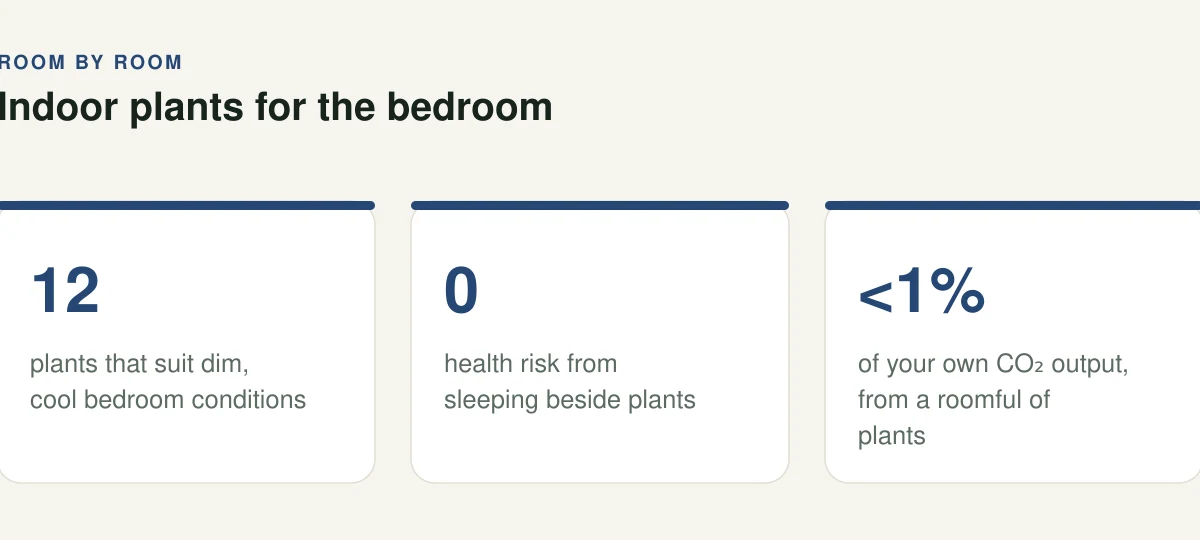
Indoor Plants for the Bedroom: 12 Best Picks (and the Sleep Myths Explained)
Bedrooms are dim, cool and often north-facing. These 12 indoor plants suit those conditions — plus an honest look at whether plants in a bedroom affect your sleep.