25 Best Indoor Plants for Home (With Names, Light Needs and Care)
The 25 indoor plants worth keeping at home, sorted by how much light you have and how much attention you can give — with names, pictures and honest difficulty ratings.
The short answer
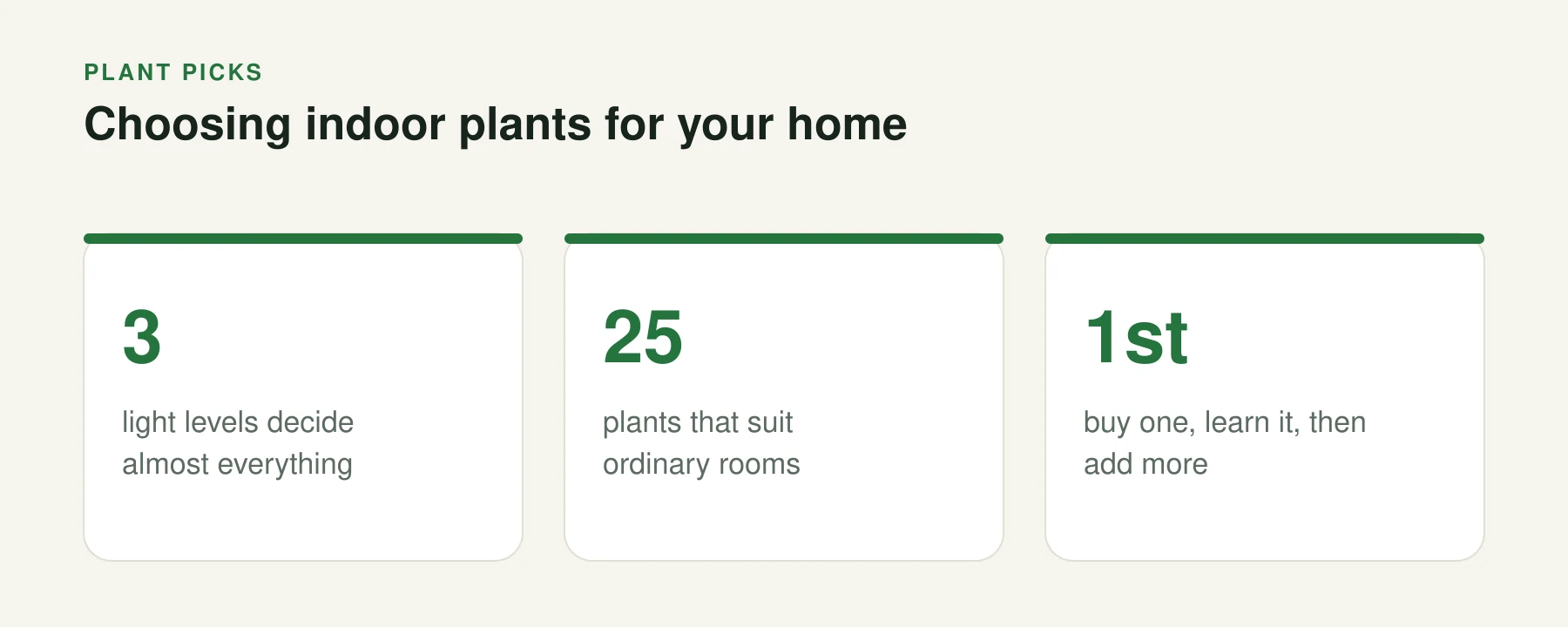
- Pick by the light in the room first — the plant name matters far less than where it will stand.
- For dim rooms: money plant, snake plant, ZZ plant. For bright indirect light: monstera, rubber plant, areca palm.
- Start with one plant, keep it alive for two months, then buy more.
Key takeaways
- Choose by light first — species comes second. A plant in the wrong light fails no matter how well you water it.
- Five plants cover most homes: money plant, snake plant, ZZ plant, areca palm and peace lily.
- Small pots dry out fast; start with 15–20 cm pots rather than tiny ones if you travel or forget.
- Buy one plant, keep it alive for two months, then buy more. That order saves a lot of money.
Most lists of indoor plants for the home are written from a catalogue. This one is sorted the way you actually end up choosing — by the light in the room where the plant is going to stand. Get that part right and almost any plant here will live for years. Get it wrong and even a snake plant gives up eventually, just more slowly than everything else.
#Best indoor plants for low light rooms
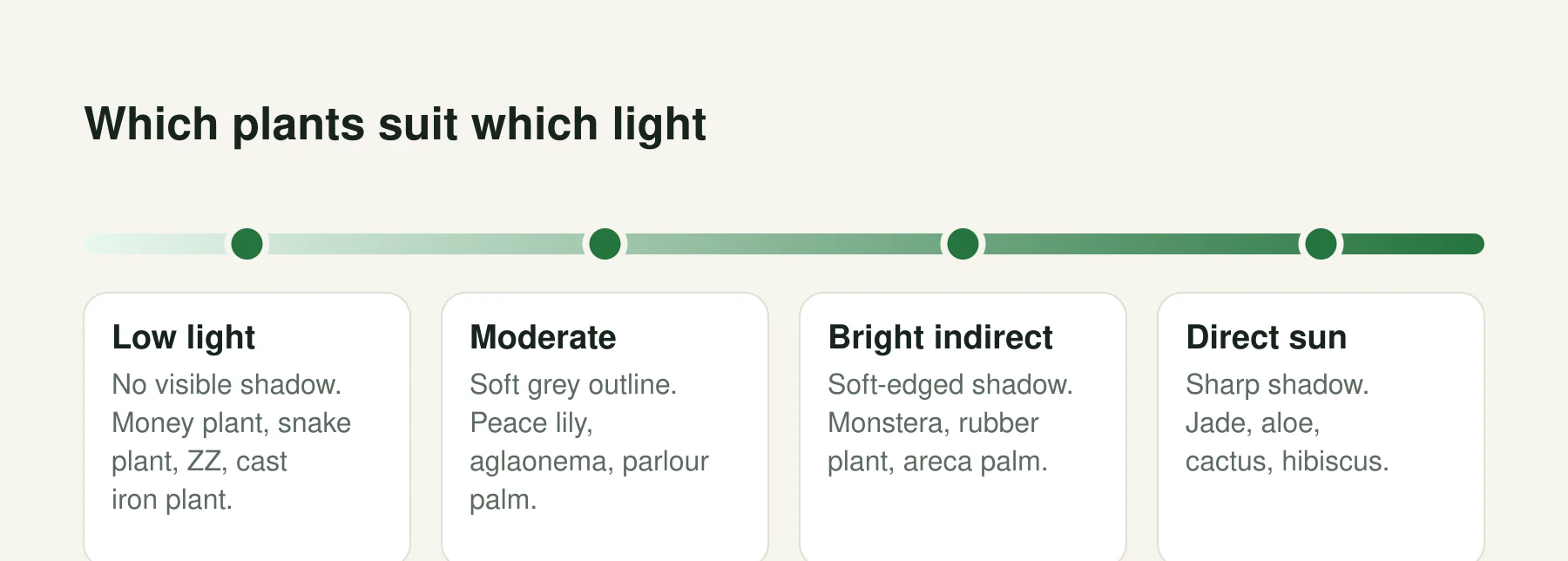
North-facing rooms, corridors, corners more than two metres from a window. These plants hold their shape for years in conditions where most houseplants slowly thin out.
| Plant name | Botanical name | Water | Difficulty |
|---|---|---|---|
| Money plant / pothos | Epipremnum aureum | Every 7–10 days | Very easy |
| Snake plant | Dracaena trifasciata | Every 2–3 weeks | Very easy |
| ZZ plant | Zamioculcas zamiifolia | Every 3–4 weeks | Very easy |
| Cast iron plant | Aspidistra elatior | Every 2 weeks | Very easy |
| Peace lily | Spathiphyllum wallisii | Every 5–7 days | Easy |
| Chinese evergreen | Aglaonema commutatum | Every 7–10 days | Easy |
| Lucky bamboo | Dracaena sanderiana | Water change weekly | Easy |
| Parlour palm | Chamaedorea elegans | Every 7 days | Easy |
#Best indoor plants for bright indirect light
The most common condition in a home: within a metre or two of an east or west window, or set back from a south window. This is where the plants people actually want will grow properly.
| Plant name | Botanical name | Water | Difficulty |
|---|---|---|---|
| Monstera | Monstera deliciosa | Every 7–10 days | Easy |
| Rubber plant | Ficus elastica | Every 7–10 days | Easy |
| Areca palm | Dypsis lutescens | Every 5–7 days | Moderate |
| Bird of paradise | Strelitzia nicolai | Every 7 days | Moderate |
| Spider plant | Chlorophytum comosum | Every 7 days | Very easy |
| Philodendron | Philodendron hederaceum | Every 7–10 days | Very easy |
| Croton | Codiaeum variegatum | Every 5–7 days | Moderate |
| Fiddle leaf fig | Ficus lyrata | Every 7–10 days | Difficult |
| Calathea | Goeppertia orbifolia | Every 5–7 days | Difficult |
#Best indoor plants for a sunny window
Direct sun for three hours or more. This is the one condition where succulents and cacti belong — and where most tropical foliage plants will scorch.
- Jade plant (Crassula ovata) — thick-leaved, lives for decades, water every 2–3 weeks.
- Aloe vera — useful and tough, but rots fast if the pot lacks drainage.
- Cactus (Echinopsis, Mammillaria) — water every 3–4 weeks in summer, almost never in winter.
- Ponytail palm (Beaucarnea recurvata) — stores water in its swollen base and forgives long absences.
- Hibiscus — one of the few plants that will actually flower indoors, given real sun.
#The five plants to start with
If you want a home that looks planted without a hobby attached to it, these five cover almost every room and between them ask for very little.
Money plant (pothos)
Grows in soil or in a bottle of water, tolerates dim corners, and every cutting roots. The cheapest way to fill a house with green.
Snake plant
Survives a month of being forgotten. Best plant for a bedroom, a hallway or a first-time owner who travels.
ZZ plant
Glossy, architectural and effectively indestructible in low light. Water it once a month and leave it alone.
Areca palm
The affordable way to get a large, soft, tree-like plant. Needs bright indirect light and consistent watering.
Peace lily
Flowers in modest light and wilts dramatically when thirsty, which makes it the easiest plant in the house to read.
#Small indoor plants for shelves and desks
Small pots dry out in a day or two on a warm shelf, so pick species that tolerate that: succulents such as haworthia and echeveria, syngonium, peperomia, small sansevieria cultivars, and pilea. Avoid ferns and calatheas in anything under 12 cm — they need consistent moisture that a small pot cannot hold.
#What to check before you buy
- Turn the pot over. Roots pouring out of the drainage holes mean the plant is stressed and will need repotting immediately.
- Look under the leaves. Fine webbing, white cotton-like spots or sticky residue means pests coming home with you.
- Check the soil is not soaking. A waterlogged nursery pot often hides rot that appears two weeks after purchase.
- Skip anything with no new growth. A plant with only old leaves has been sitting in a dark shop for months.
- Ask what light it was grown in. Moving a plant from bright nursery light to a dim room causes the leaf drop most people blame on themselves.
The pattern I see most often with new plant owners is the eight-plants-in-one-afternoon shop. Six weeks later most of them are struggling, and the owner concludes they cannot grow anything — when really they took on eight unfamiliar watering routines at once. Start with one plant that matches your light, keep it alive for two months, then add more. It is a slower start and a much better ending.
Frequently asked questions
Which indoor plant is best for home?
For most homes the money plant (pothos) is the best first choice: it grows in low or bright light, in soil or water, tolerates missed waterings, and propagates free of charge from cuttings. If you want something more sculptural, the snake plant or ZZ plant are equally forgiving.
What are the easiest indoor plants to keep alive?
Snake plant, ZZ plant, money plant, cast iron plant and spider plant. All five tolerate low light, irregular watering and dry indoor air, which are the three conditions that kill most houseplants.
How many indoor plants should I start with?
One or two. Care routines only become habits once you have watched a plant respond over several weeks, and a small collection lets you learn without losing much if something goes wrong.
Which indoor plants are safe for children and pets?
Spider plant, parlour palm, areca palm, peperomia, Boston fern and money tree are all non-toxic. Money plant, philodendron, peace lily, ZZ plant and snake plant contain irritant compounds and are better placed out of reach.
Do indoor plants need direct sunlight?
Most do not. The majority of popular houseplants evolved on rainforest floors and prefer bright indirect light. Only succulents, cacti and flowering plants such as hibiscus genuinely want hours of direct sun.
Sources and further reading
- Houseplants — Royal Horticultural Society. General indoor growing guidance, light and watering advice.
- Plant Finder — Missouri Botanical Garden. Botanical names, native range and cultural requirements.
- North Carolina Extension Gardener Plant Toolbox — NC State Extension. Species data, hardiness and toxicity cross-checks.
- Toxic and Non-Toxic Plants List — ASPCA Animal Poison Control. Toxicity status of every plant named, checked under its botanical name.
Related guides
Indoor Plants That Are Easy to Take Care Of (18 Genuinely Low Maintenance Picks)
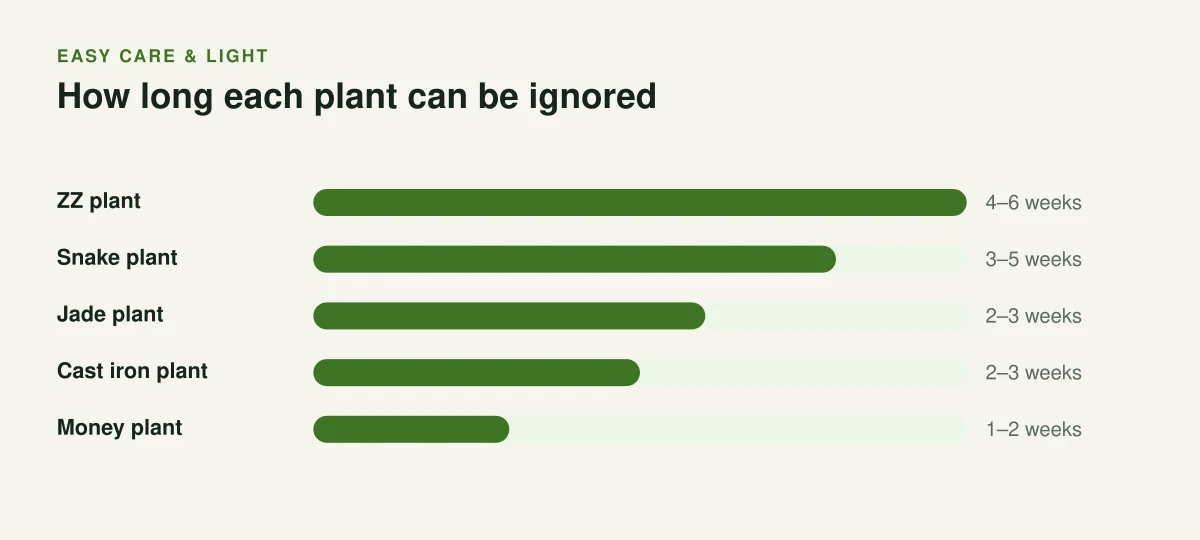
Eighteen indoor plants that survive irregular watering, dry air and dim corners — ranked by how long each one can be ignored before it complains.
Indoor Flowering Plants: 14 That Actually Bloom Inside a House
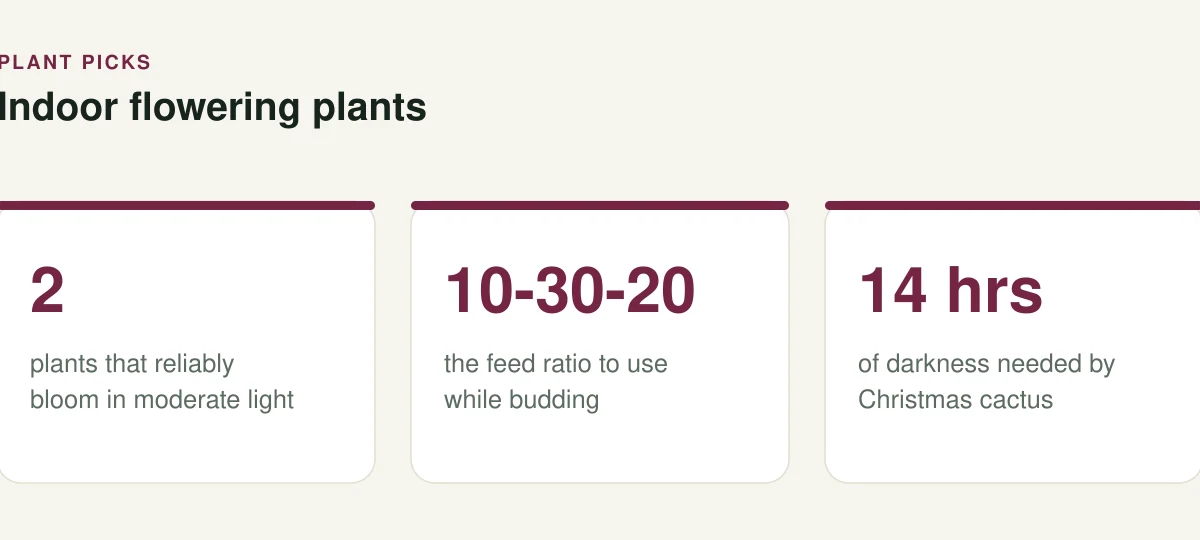
Most indoor flower plants stop blooming within weeks of coming home. These 14 keep flowering indoors — with the light each one needs to set buds at all.
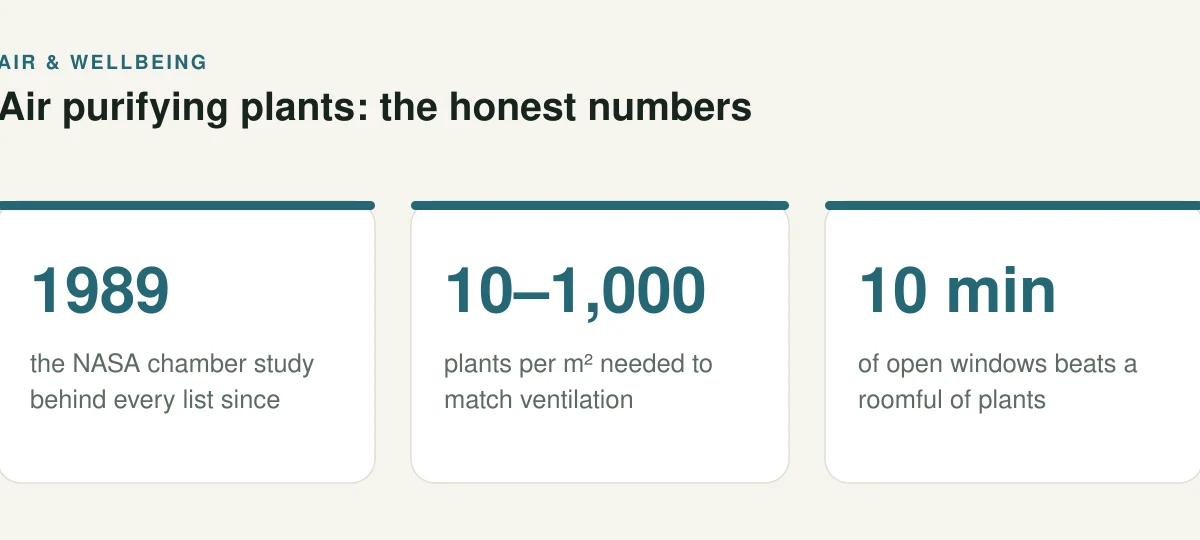
Air Purifying Indoor Plants: What the NASA Study Really Found
The 12 plants from NASA's clean air study, what they actually remove, and the honest arithmetic on how many you would need to change the air in a real room.