Indoor Plant Fertilizer: What the Numbers Mean and How Often to Feed
NPK explained without the jargon, how often to feed indoor plants, the difference between liquid and slow-release feeds, and how to spot overfeeding.
The short answer
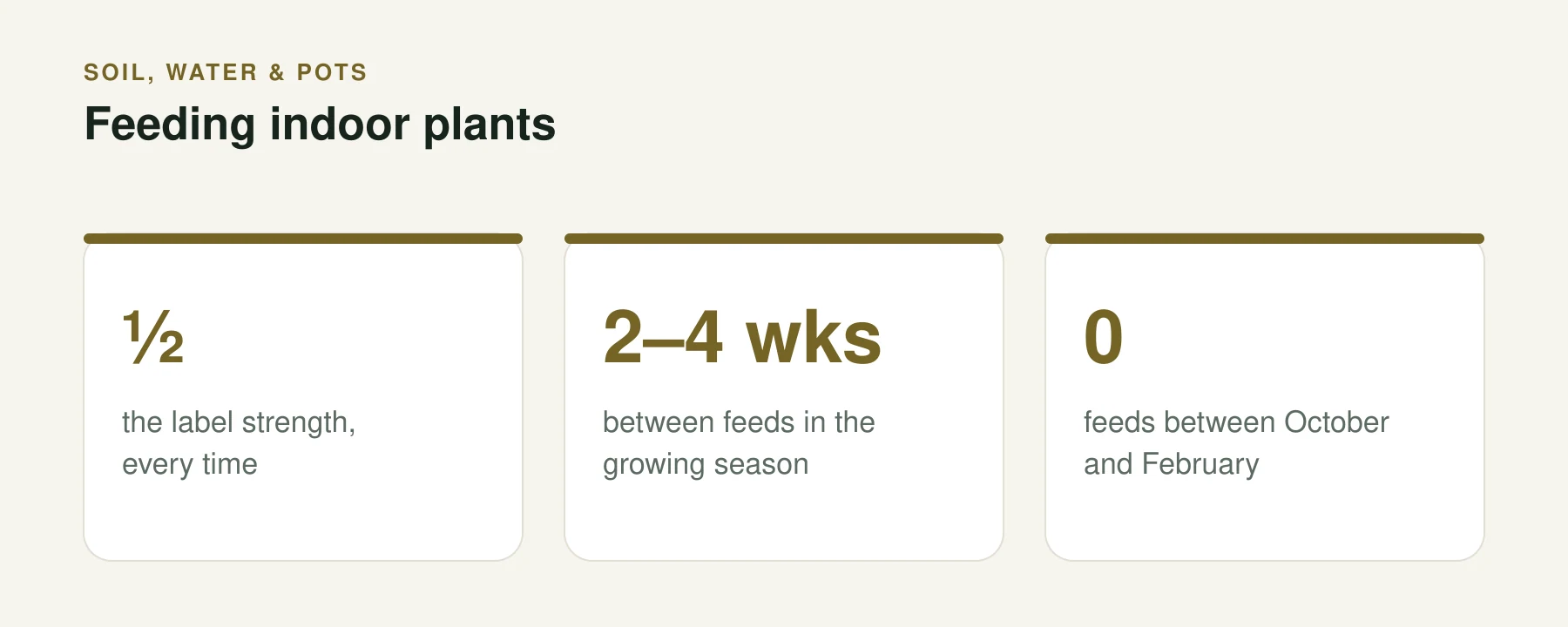
- Feed at half the label strength every two to four weeks from spring to late summer.
- Do not feed in winter, after repotting, or when a plant is struggling — fertiliser is food, not medicine.
- White crust on the soil means salt buildup: flush the pot rather than feeding more.
Key takeaways
- Half the label strength, twice as often, beats full strength — houseplants are fed for pot life, not field agriculture.
- Do not feed in winter, and do not feed a sick plant; fertiliser is food, not medicine.
- White crust on the soil or pot rim means salt buildup — flush the pot rather than feeding more.
- Fresh potting mix already contains three to six months of nutrients, so skip feeding after repotting.
A plant in a pot has one fixed, finite volume of soil and nothing else. Every watering washes some nutrients out of the drainage hole, and the plant steadily eats the rest. After roughly a year, ordinary potting mix is largely spent — and that is the point where feeding stops being optional and becomes the difference between a plant that grows and one that merely persists. Most 'my plant just stopped doing anything' messages I get are about a plant in two-year-old soil.
#What the three numbers mean
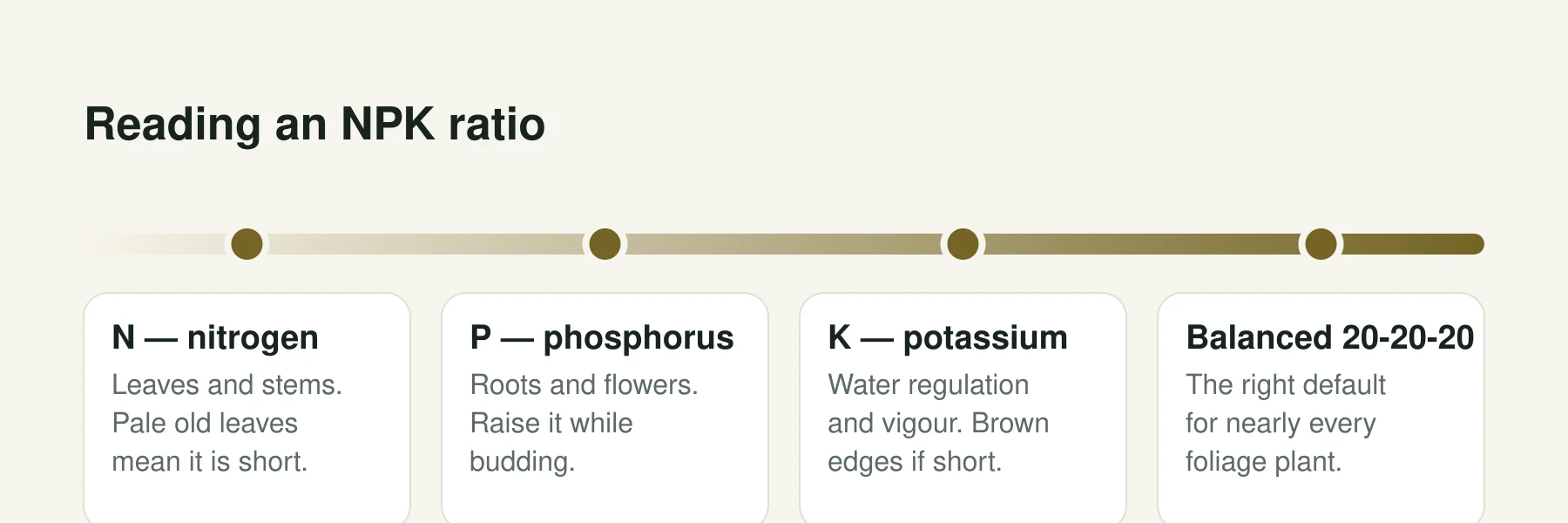
| Element | Symbol | What it does | Deficiency looks like |
|---|---|---|---|
| Nitrogen | N | Leaf and stem growth, green colour | Older leaves pale then yellow; small new leaves |
| Phosphorus | P | Root development, flowering, fruiting | Poor flowering; stunted roots; dull leaves |
| Potassium | K | Water regulation, disease resistance, overall vigour | Brown, scorched leaf edges; weak stems |
- Balanced (20-20-20 or 10-10-10) — the right default for almost every foliage houseplant.
- High nitrogen (e.g. 3-1-2, 24-8-16) — for large-leaved plants such as monstera, rubber plant and palms.
- High phosphorus (e.g. 10-30-20) — for flowering plants while they are budding.
- Low nitrogen (e.g. 2-7-7) — for cacti and succulents, which produce weak, stretched growth if overfed nitrogen.
#How often to feed
| Plant type | Growing season | Winter |
|---|---|---|
| Fast foliage plants (pothos, monstera, philodendron) | Half strength every 2 weeks | None |
| Slow plants (ZZ, snake plant, cast iron) | Half strength monthly | None |
| Flowering plants in bud | Bloom feed at half strength every 2 weeks | None unless winter-flowering |
| Cacti and succulents | Low-nitrogen feed 2–3 times a season | None |
| Plants under grow lights | Half strength every 2–3 weeks year round | Continue, growth does not stop |
| Recently repotted plants | None for 4–6 weeks | None |
#Liquid, slow release or organic?
| Type | How it works | Best for | Drawback |
|---|---|---|---|
| Liquid concentrate | Diluted into the watering can | Most houseplants; full control | You have to remember |
| Slow-release granules | Coated pellets release over 3–6 months | Large plants, people who forget | No control once applied |
| Fertiliser spikes | Pushed into the soil, dissolve slowly | Convenience | Uneven — concentrates near the spike |
| Worm castings | Mixed into soil or top-dressed | Gentle, organic feeding | Low, slow nutrient release |
| Seaweed extract | Diluted liquid, trace elements | General tonic alongside main feed | Not a complete fertiliser |
| Compost tea / home mixes | Variable | Enthusiasts | Unknown ratios; smell indoors |
#Signs you are overfeeding
- White or yellow crust on the soil surface or around the pot rim — accumulated fertiliser salts.
- Brown, crisp leaf tips and edges on a plant that is watered adequately.
- Sudden wilting despite moist soil, as high salt concentration draws water out of the roots.
- Weak, stretched, floppy growth — too much nitrogen producing soft tissue.
- A crust of salt at the drainage hole, or water that runs out cloudy.
The fix is the same in every case: flush the pot. Run water equal to three times the pot's volume slowly through the soil, let it drain completely, and do not feed again for a month. Then resume at half the strength you were using.
#How to flush a pot, step by step
Take the plant to a sink or bath
You need somewhere the runoff can drain away freely — this uses more water than a normal watering, and it comes out dirty.
Water slowly across the whole surface
Pour steadily rather than in one go, so the water moves through the soil instead of finding a channel down the side of the pot.
Use three times the pot's volume
For a 20 cm pot that is roughly six litres. This is what actually dissolves and carries out the accumulated salts.
Let it drain completely
Leave the pot in the sink for 20–30 minutes. Do not put it back in a cachepot until it has stopped dripping.
Wait a month before feeding again
Then resume at half the strength you were using before. Flushing removes the buildup; changing the dose stops it returning.
#When not to feed
- In winter, for plants without supplementary light — they are not growing and cannot use it.
- For 4–6 weeks after repotting — fresh potting mix already contains a starter charge of nutrients.
- On dry soil — always water first, then feed, or the concentrated solution burns the roots.
- On a struggling plant — a plant with root rot, pests or a light problem is not hungry. Feeding it makes things worse.
- On a newly bought plant for the first month, while it acclimatises to your conditions.
Frequently asked questions
How often should I fertilize indoor plants?
Every two to four weeks at half the label strength from spring through late summer, and not at all in winter. Fast growers like pothos and monstera take the shorter interval; slow plants such as ZZ and snake plants need only monthly.
What is the best fertilizer for indoor plants?
A balanced liquid fertiliser around 20-20-20 or 10-10-10, diluted to half strength, suits almost every foliage houseplant. Use a higher-phosphorus bloom feed for flowering plants and a low-nitrogen formula for cacti and succulents.
What do the numbers on fertilizer mean?
They are the percentages of nitrogen, phosphorus and potassium. Nitrogen drives leaf and stem growth, phosphorus supports roots and flowering, and potassium regulates water use and overall vigour.
Can you over fertilize a houseplant?
Yes, easily. Signs are white crust on the soil, brown crisp leaf tips, and wilting despite moist soil. Flush the pot with three times its volume of water, stop feeding for a month, then resume at half the previous strength.
Should I fertilize indoor plants in winter?
No, unless they are growing under supplementary lights. Low winter light slows growth to a near halt, so unused fertiliser accumulates in the soil as salts that damage the roots.
Sources and further reading
- Houseplants growing guide — Royal Horticultural Society. Potting, feeding and seasonal care practice.
- Houseplants — Royal Horticultural Society. General indoor growing guidance, light and watering advice.
- North Carolina Extension Gardener Plant Toolbox — NC State Extension. Species data, hardiness and toxicity cross-checks.
- Plant Finder — Missouri Botanical Garden. Botanical names, native range and cultural requirements.
Related guides
Potting Mix for Indoor Plants: Recipes for Every Plant Type
Why bagged potting soil is too dense for houseplants, what each amendment does, and five mixing recipes for aroids, succulents, ferns, palms and seedlings.
Indoor Water Plants: 14 That Grow in Water Without Any Soil
Which indoor plants grow permanently in water, how to set up a bottle or vase properly, and the feeding and water-change routine that stops them stalling.
Indoor Plant Pots: Choosing Size, Material and Drainage
How pot material and size change how often you water, why decorative pots without drainage kill plants, and how to use cachepots properly.