Potting Mix for Indoor Plants: Recipes for Every Plant Type
Why bagged potting soil is too dense for houseplants, what each amendment does, and five mixing recipes for aroids, succulents, ferns, palms and seedlings.
The short answer
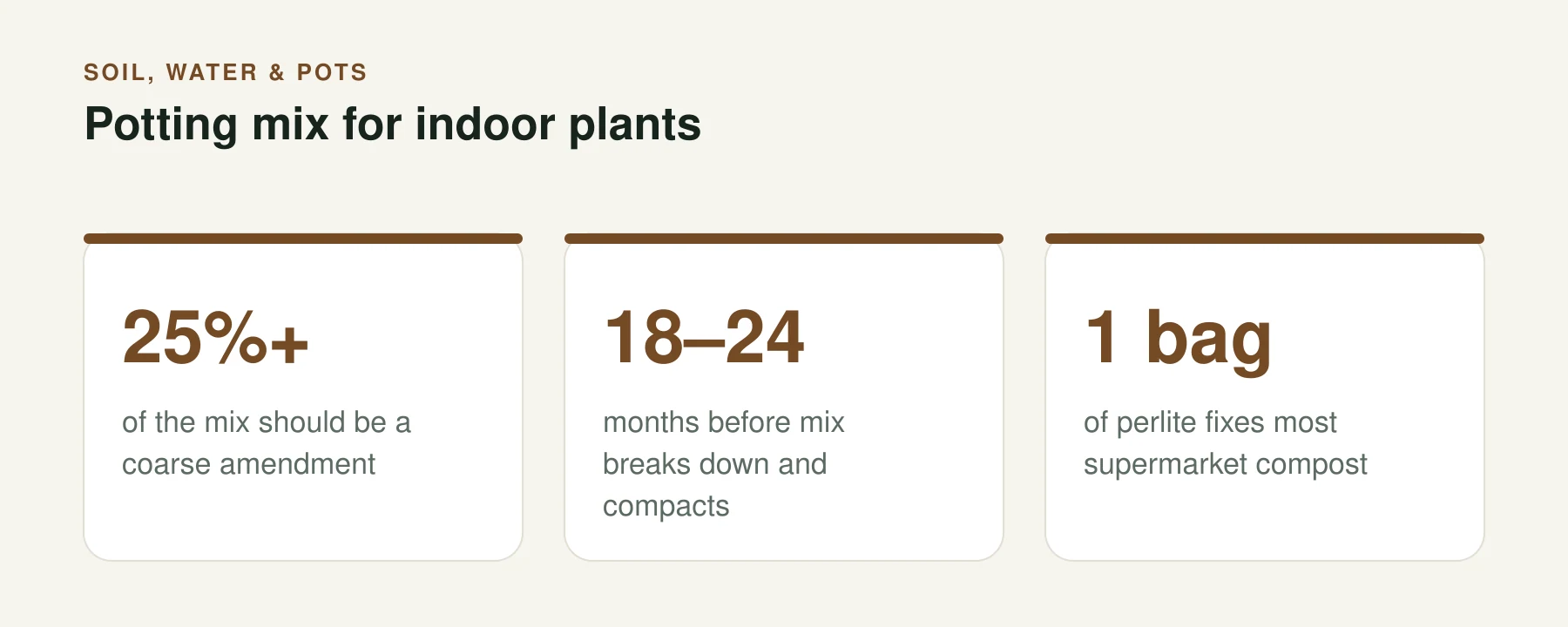
- Bagged potting soil alone is too dense for most houseplants — amend it with at least 25% perlite or bark.
- A reliable all-purpose mix is four parts soil, two parts perlite, one part bark or coir.
- Never use garden soil in pots, and skip the gravel 'drainage layer' — it makes things worse.
Key takeaways
- Roots need air as much as water — the point of every amendment is to hold air pockets open.
- Never use garden soil in pots; it compacts, drains badly and brings pests indoors.
- Skip the gravel 'drainage layer' — it raises the waterlogged zone rather than lowering it.
- Refresh mix every 18–24 months, since it breaks down and compacts over time.
Most houseplant deaths blamed on overwatering are really a soil problem wearing a disguise. Roots need oxygen, and they take it from the air pockets between soil particles. Dense, fine soil holds water in those pockets instead of air, the roots suffocate, and the owner — watching the plant decline — usually waters more. Getting the mix right widens your margin for error enormously, and it is a far cheaper fix than replacing plants.
#What each ingredient does
| Ingredient | Function | Notes |
|---|---|---|
| Potting soil / compost | Holds water and nutrients | The base; too dense on its own for most houseplants |
| Perlite | Creates air pockets, improves drainage | White volcanic glass; the single most useful amendment |
| Pumice | Same as perlite but heavier | Does not float to the surface; better for top-heavy plants |
| Orchid bark | Large air gaps, slow to break down | Essential for aroids and epiphytes |
| Coco coir | Holds moisture, resists compaction | Sustainable peat substitute; nutrient-poor on its own |
| Peat moss | Holds water, slightly acidic | Effective but environmentally contentious |
| Coarse sand | Drainage and weight | For succulents and cacti; must be coarse, not builder's sand |
| Worm castings | Slow-release nutrients | 5–10% of the mix is plenty |
| Horticultural charcoal | Absorbs impurities, keeps mix sweet | Optional; useful in closed containers |
#Five recipes
All-purpose indoor mix
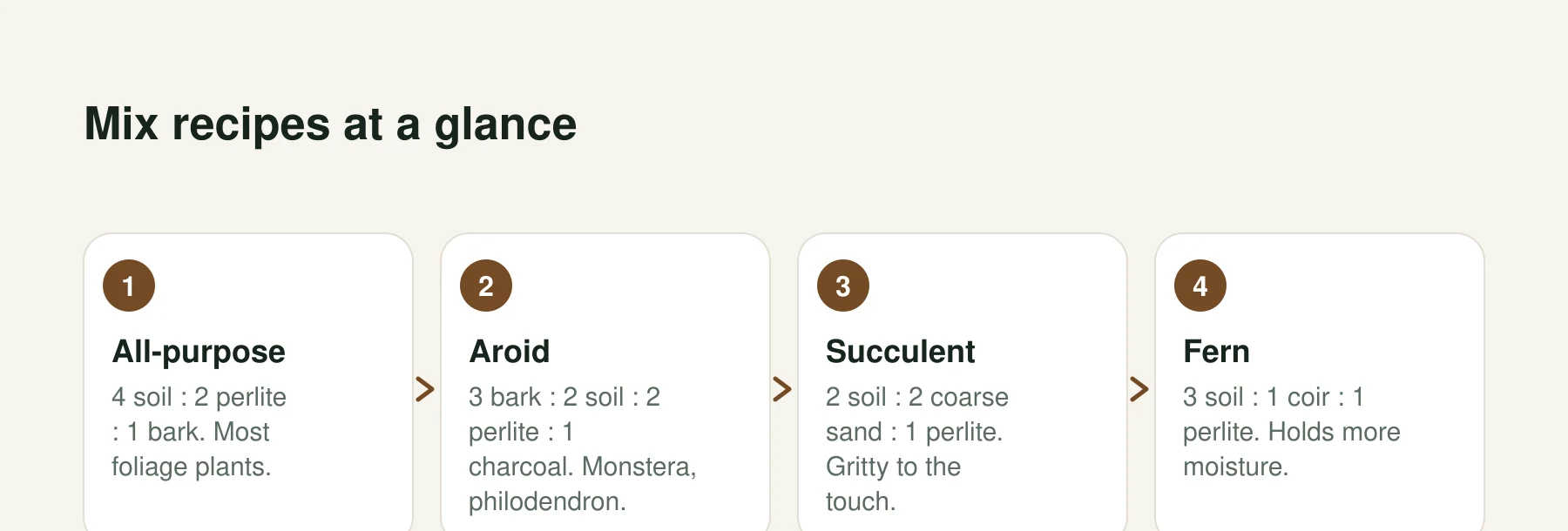
4 parts potting soil, 2 parts perlite, 1 part orchid bark or coco coir. Suits pothos, philodendron, rubber plant, dracaena, spider plant and most foliage houseplants.
Aroid mix (monstera, philodendron, anthurium)
3 parts orchid bark, 2 parts potting soil, 2 parts perlite, 1 part charcoal. Very chunky and fast-draining — these roots evolved on bark, not in soil.
Succulent and cactus mix
2 parts potting soil, 2 parts coarse sand or pumice, 1 part perlite. Should feel gritty and dry out within days.
Fern and calathea mix
3 parts potting soil, 1 part coco coir, 1 part perlite. Holds more moisture than the all-purpose mix while still admitting air.
Palm mix
3 parts potting soil, 1 part perlite, 1 part coarse sand. Free-draining but with enough body to support a heavy plant.
#Things to stop doing
- Never use garden soil in pots. It compacts to a solid block indoors, drains poorly, and carries fungus gnat larvae, weed seeds and pathogens.
- Skip the gravel drainage layer. It does not help. A layer of coarse material at the base raises the perched water table, meaning the saturated zone sits higher and closer to the roots than it would without it.
- Do not reuse old mix for a struggling plant. Used soil is compacted, depleted and may carry pests. Old mix is fine for outdoor beds.
- Avoid moisture-retentive 'water saving' composts indoors. They are designed for outdoor containers in full sun and stay far too wet in a living room.
- Do not press the mix down hard when potting. Tap the pot to settle it instead — compacting it by hand undoes the aeration you just built.
#When to change the mix
Potting mix degrades. Organic components break down into progressively finer particles, the structure collapses, and a mix that drained freely two years ago holds water like a sponge. Signs it is time: water pooling on the surface before it sinks in, water running straight down the inside of the pot without wetting the root ball, soil pulling away from the pot wall, or a persistently sour smell.
Refresh every 18–24 months for most plants, or every 3–4 years for slow growers such as ZZ plants, snake plants and cacti. For a large floor plant that cannot practically be repotted, top-dress instead: scrape off the top 5 cm of old mix each spring and replace it with fresh.
Frequently asked questions
What is the best potting mix for indoor plants?
A blend of four parts potting soil, two parts perlite and one part orchid bark or coco coir suits most foliage houseplants. The key is that at least a quarter of the mix should be a coarse amendment that keeps air pockets open.
Can I use garden soil for indoor plants?
No. Garden soil compacts into a dense block in a container, drains poorly, and brings fungus gnat larvae, weed seeds and pathogens indoors. Always use a potting mix formulated for containers.
Should I put rocks at the bottom of the pot for drainage?
No. A gravel layer raises the perched water table, so the saturated zone ends up closer to the roots. A pot with drainage holes and a well-aerated mix drains better without it.
How often should indoor plant soil be changed?
Every 18 to 24 months for most plants, or every three to four years for slow growers. Signs it is due include water pooling on the surface, soil pulling away from the pot wall, and a sour smell.
What soil do monstera and philodendron need?
A chunky aroid mix: three parts orchid bark, two parts potting soil, two parts perlite and one part charcoal. These plants are climbers whose roots evolved on bark and leaf litter, not in dense soil.
Sources and further reading
- Houseplants growing guide — Royal Horticultural Society. Potting, feeding and seasonal care practice.
- Houseplants — Royal Horticultural Society. General indoor growing guidance, light and watering advice.
- Plant Finder — Missouri Botanical Garden. Botanical names, native range and cultural requirements.
- North Carolina Extension Gardener Plant Toolbox — NC State Extension. Species data, hardiness and toxicity cross-checks.
Related guides
Indoor Plant Fertilizer: What the Numbers Mean and How Often to Feed
NPK explained without the jargon, how often to feed indoor plants, the difference between liquid and slow-release feeds, and how to spot overfeeding.
Indoor Plant Pots: Choosing Size, Material and Drainage
How pot material and size change how often you water, why decorative pots without drainage kill plants, and how to use cachepots properly.
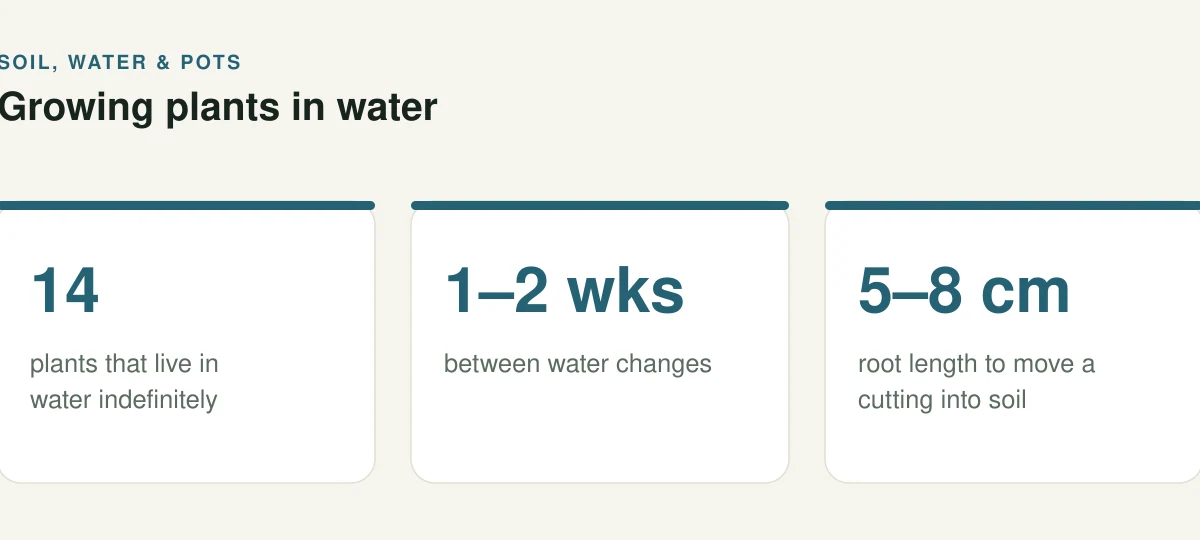
Indoor Water Plants: 14 That Grow in Water Without Any Soil
Which indoor plants grow permanently in water, how to set up a bottle or vase properly, and the feeding and water-change routine that stops them stalling.