Indoor Plants for the Living Room: 15 That Actually Suit the Space
Living rooms have big windows, big furniture and inconsistent heating. These 15 indoor plants match those conditions — from floor-standing trees to shelf fillers.
The short answer
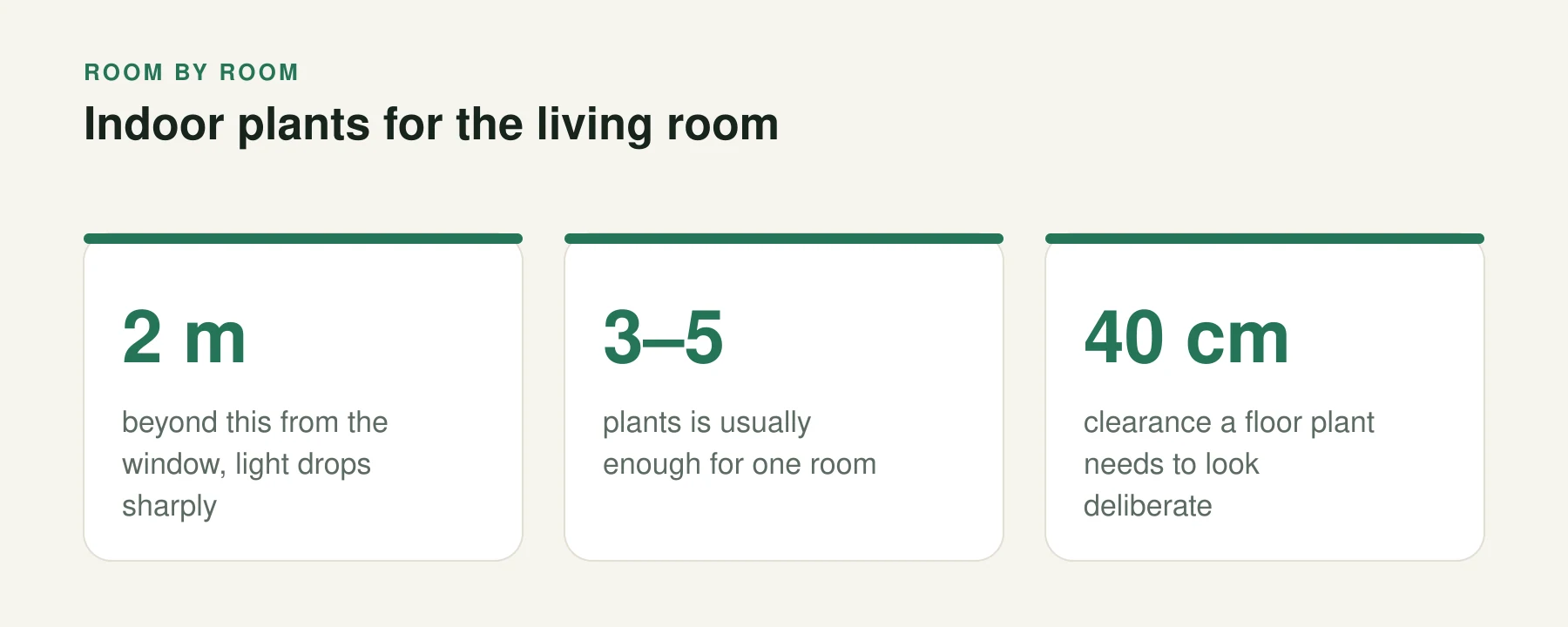
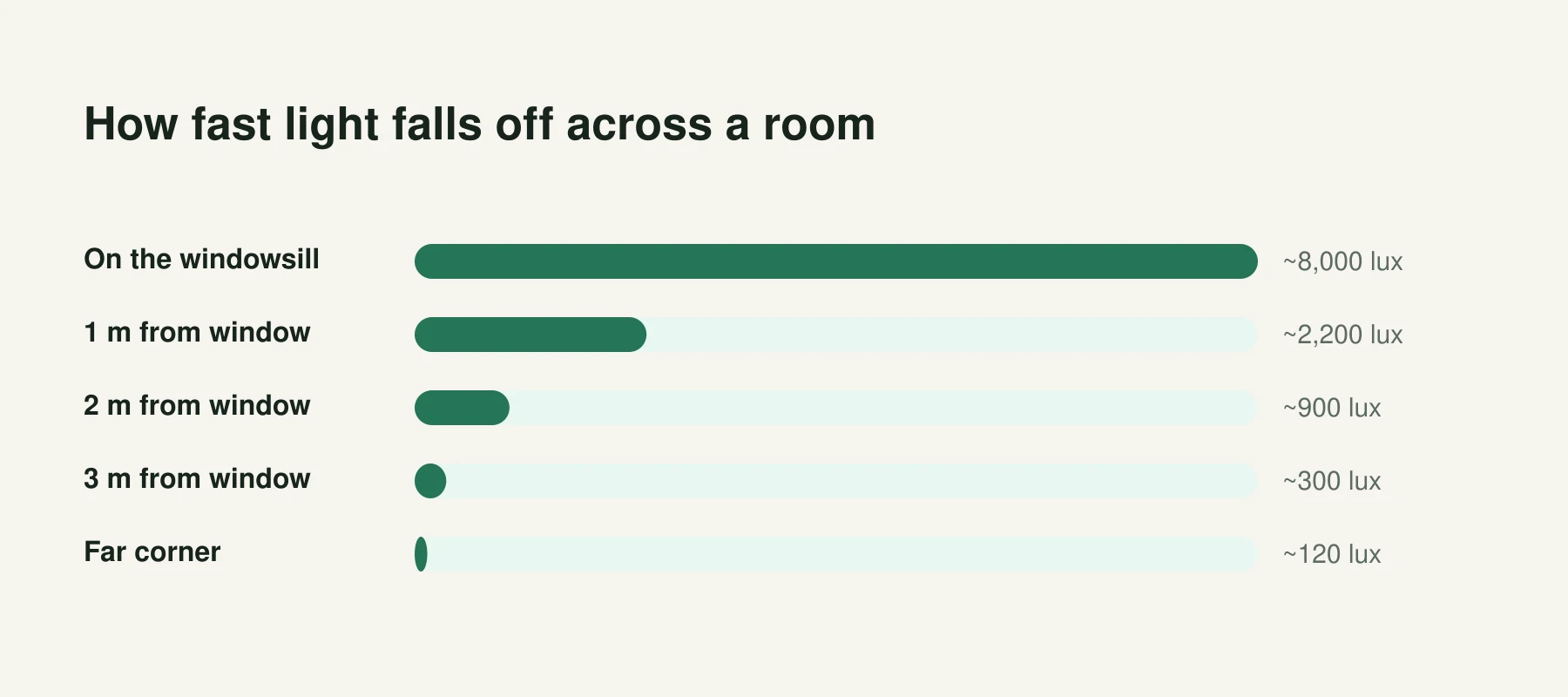
- Living rooms are bright at the window and much darker three metres in — measure before you buy.
- Floor corners: areca palm, kentia palm, rubber plant, monstera. Shelves: money plant, ZZ plant, snake plant.
- One large plant looks better and needs less attention than five small ones.
Key takeaways
- Light falls off fast: a plant two metres from the window gets a fraction of what one beside it gets.
- One large plant reads better in a living room than five small ones, and needs less attention.
- Buy a floor plant already close to the height you want — most grow 20–40 cm a year indoors.
- Keep plants away from radiators, air conditioning vents and the back of the TV.
A living room is usually the brightest room in the house and also the one with the most awkward plant positions — deep corners, the gap behind a sofa, shelves several metres from the glass. The mistake almost everyone makes, myself included for years, is buying for the corner you want to fill rather than for the light that corner actually gets. The plant then declines slowly enough that you blame yourself rather than the position.
#Big indoor plants for living room floors
These are the plants that do the actual decorating — 1.2 m and taller, in pots big enough to stand on the floor without looking lost.
| Plant | Mature indoor height | Light | Difficulty |
|---|---|---|---|
| Areca palm | 1.5–2.5 m | Bright indirect | Moderate |
| Bird of paradise | 1.5–2 m | Bright, some direct | Moderate |
| Rubber plant | 1.5–2.5 m | Bright indirect | Easy |
| Monstera deliciosa | 1.5–2.5 m wide | Bright indirect | Easy |
| Fiddle leaf fig | 1.5–2.5 m | Bright, near window | Difficult |
| Kentia palm | 1.5–2.5 m | Moderate to bright | Easy |
| Dracaena fragrans | 1.2–2 m | Low to moderate | Very easy |
| Yucca | 1–2 m | Bright to direct | Very easy |
For a dim corner more than three metres from the window, the honest options narrow to the kentia palm, dracaena and cast iron plant — or a floor lamp fitted with a full-spectrum LED bulb, which changes what is possible in that corner entirely. Our grow light guide covers what to buy and how high to hang it.
#Shelf, table and sideboard plants
- Money plant / pothos — trails from a high shelf and tolerates the low light that shelves usually get.
- ZZ plant — glossy and upright, ideal for a sideboard away from the window.
- Snake plant — vertical lines that contrast well with horizontal furniture.
- Philodendron 'Brasil' — brighter variegation than pothos, same easy temperament.
- Peace lily — the only reliable flowering option once you are a few metres from the glass.
- Aglaonema — pink and red cultivars add colour without needing a sunny position.
- String of hearts — long, delicate trails for a high shelf with good light.
#Arranging plants so the room looks composed
Work in odd numbers
Groups of three or five read as deliberate; pairs read as symmetry and need matching plants to work.
Vary the height, repeat the pot
Different plant heights with a consistent pot material or colour looks designed. Different pots with matching heights looks like a garden centre shelf.
Give the biggest plant space
A floor plant needs 40–50 cm of clearance to read as a specimen rather than as clutter behind the sofa.
Fill the vertical gaps
Trailing plants on top of a bookcase and a floor plant beside it frame the wall between them. That vertical spread is what makes a room feel planted.
#Living room conditions that damage plants
| Condition | What it does | Fix |
|---|---|---|
| Radiator underneath | Dries soil and crisps leaf edges | Move 1 m away or use a shelf above, not beside |
| Air conditioning draught | Cold shock, sudden leaf drop | Never position in the direct airflow |
| Behind the TV or speakers | Warm, dry, dark, dusty | Any of the low light plants above, dusted monthly |
| Between curtain and glass at night | Temperature drops sharply in winter | Move plants in front of the curtain overnight |
| Deep corner, no window | Slow decline over 3–6 months | Add a full-spectrum LED bulb on a 12-hour timer |
#Pots and stands for a living room
The practical arrangement is a plastic nursery pot with drainage holes, dropped inside a decorative ceramic or basket cover. You keep proper drainage, you can lift the inner pot to judge whether it needs water, and you can swap the plant without repotting. Add a saucer inside the cover, and check it after watering — a hidden reservoir at the bottom of a cachepot is the most common cause of root rot in large living room plants.
For floor plants, a stand raises the foliage into the eyeline and stops the pot disappearing behind the furniture. For big pots, put castors or a plant trolley underneath before you fill them — a 40 cm pot of moist soil is heavier than anyone expects, and you will want to move it for cleaning or for a wall repaint. Learning that after filling the pot is a job nobody enjoys twice. There is more on sizing and materials in our guide to indoor plant pots.
Frequently asked questions
Which plant is best for a living room?
The areca palm for most living rooms: it reaches 1.5–2.5 m, has a soft shape that suits furniture, is non-toxic to pets and children, and thrives in the bright indirect light a living room window provides. For a lower-light room, choose a kentia palm or dracaena instead.
How many plants should a living room have?
Three to five is usually enough for a normal-sized room: one floor plant as an anchor, one or two mid-height plants, and a trailing plant up high. More than that and the watering becomes a chore rather than a pleasure.
Where should plants be placed in a living room?
Within two metres of a window wherever possible, out of the direct path of radiators and air conditioning, and away from doors that open to the outside in winter. Corners more than three metres from a window need a low light species or a grow light.
What large indoor plants are low maintenance?
Dracaena fragrans, yucca, kentia palm and rubber plant. All four tolerate a week or two between waterings, handle moderate light, and hold their shape without pruning.
Are big indoor plants hard to look after?
Usually easier than small ones. A large pot holds far more water, so it dries slowly and is more forgiving of an irregular schedule. The real difficulty is physical — repotting and moving a big plant needs two people or a trolley.
Sources and further reading
- Houseplants — Royal Horticultural Society. General indoor growing guidance, light and watering advice.
- Houseplants: plant profiles — Royal Horticultural Society. Species-level profiles and cultivation notes.
- Plant Finder — Missouri Botanical Garden. Botanical names, native range and cultural requirements.
- Toxic and Non-Toxic Plants List — ASPCA Animal Poison Control. Toxicity status of every plant named, checked under its botanical name.
Related guides
Big Leaf Indoor Plants: 14 Large-Leaved Plants for Real Impact
Fourteen big leaf indoor plants — from monstera and elephant ear to banana and rubber plants — with the light, space and pot size each one needs to get large indoors.
Indoor Hanging Plants: 15 Trailing and Climbing Plants That Thrive
The best indoor hanging plants for baskets, shelves and ceiling hooks — including which cope with the hot, dry air that collects near a ceiling.
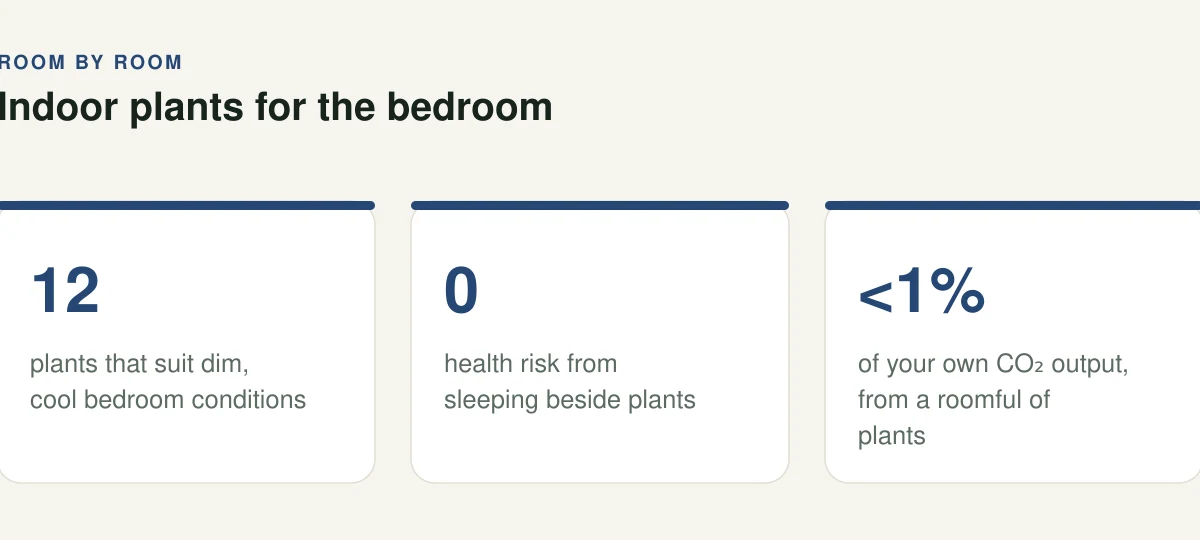
Indoor Plants for the Bedroom: 12 Best Picks (and the Sleep Myths Explained)
Bedrooms are dim, cool and often north-facing. These 12 indoor plants suit those conditions — plus an honest look at whether plants in a bedroom affect your sleep.