Red, Pink and Purple Leaf Indoor Plants: 16 Colourful Picks
Sixteen indoor plants with red, pink or purple foliage — and the light levels each one needs to keep its colour instead of fading back to green.
The short answer
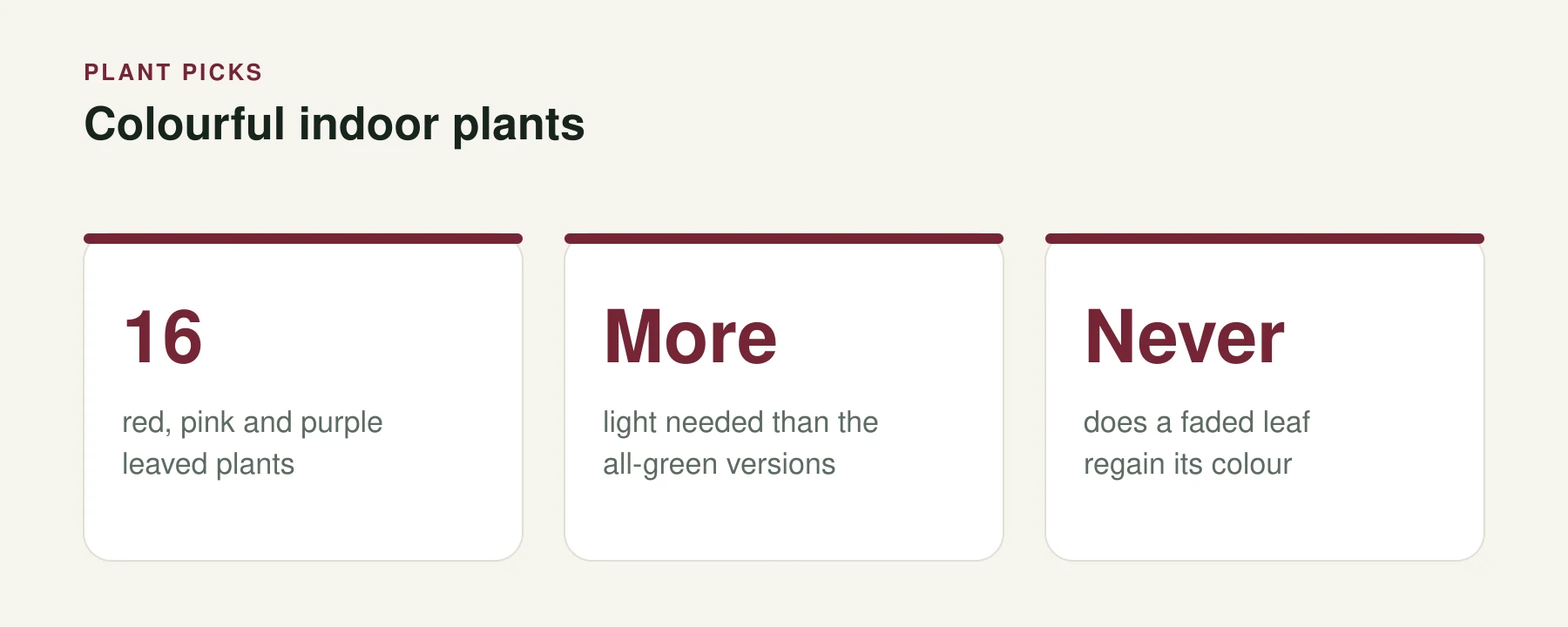
- Red, pink and purple leaves need more light than green ones — the pigments are made in response to it.
- A plant fading to green is telling you the position is too dark.
- Faded leaves never regain colour, so judge any change by the new growth.
Key takeaways
- Coloured leaves need more light than green ones — the pigments are made in response to it.
- A plant that fades to green is telling you it is in too dark a position.
- Coloured sections contain less chlorophyll, so these plants also grow more slowly.
- Existing faded leaves never regain colour; judge any change by the new growth.
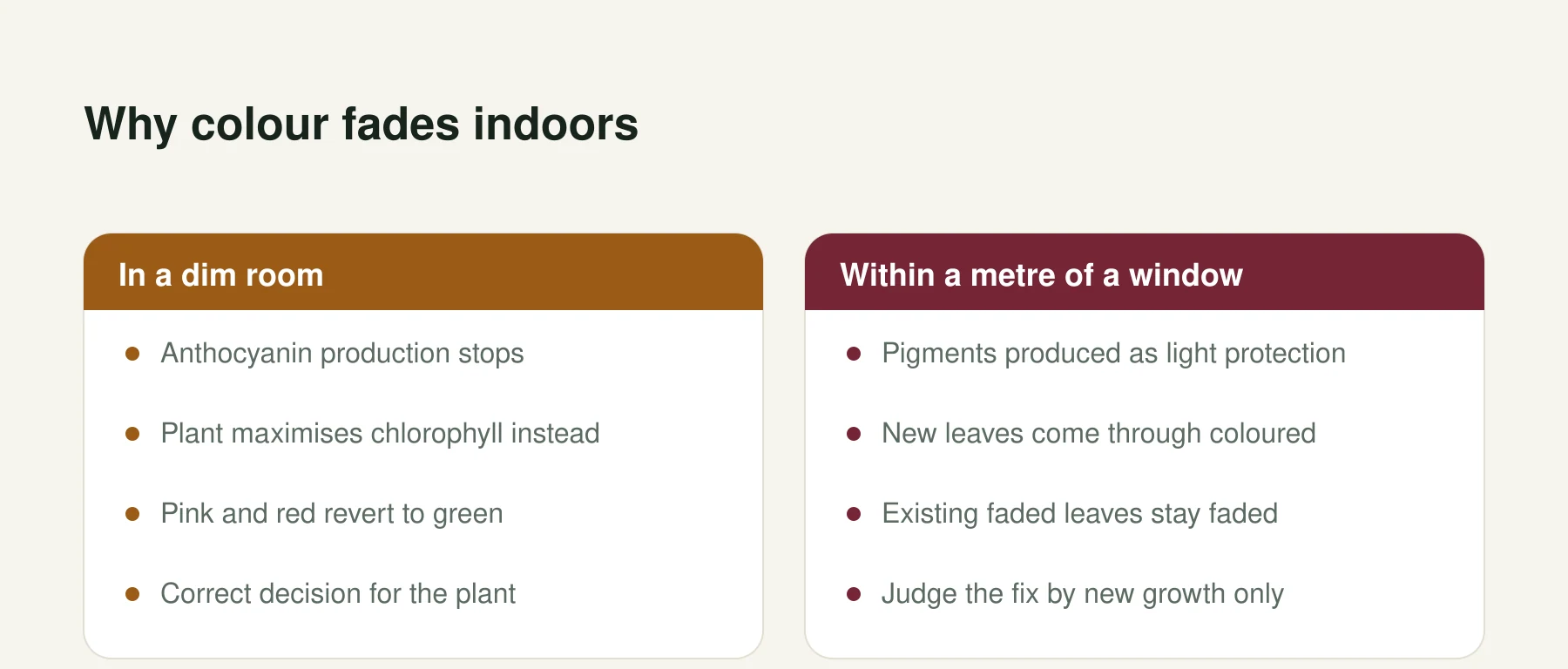
Red, pink and purple leaves come from anthocyanins and carotenoids — pigments a plant makes in addition to chlorophyll, often as protection against strong light. That one fact explains almost everything about growing these plants indoors. Producing those pigments costs energy and requires light, so a colourful plant in a dim corner quietly gives up on them and reverts to green. It is not dying, and you have not done anything wrong; it is economising.
#Red leaf indoor plants
| Plant | Colour | Light needed | Difficulty |
|---|---|---|---|
| Croton (Codiaeum variegatum) | Red, orange, yellow | Very bright, some direct | Moderate |
| Red aglaonema ('Siam Aurora') | Red-pink margins | Moderate to bright | Very easy |
| Rubber plant 'Ruby' | Pink-red variegation | Bright indirect | Easy |
| Poinsettia | Red bracts | Bright indirect | Difficult to rebloom |
| Coleus | Red, burgundy, lime | Bright indirect | Easy |
| Ti plant (Cordyline fruticosa) | Deep red-purple | Bright indirect | Moderate |
| Anthurium | Red flowers, dark leaves | Bright indirect | Easy |
#Pink leaf indoor plants
| Plant | Colour | Light needed | Difficulty |
|---|---|---|---|
| Pink princess philodendron | Pink variegated patches | Bright indirect | Moderate |
| Stromanthe 'Triostar' | Pink, cream and green | Moderate indirect | Difficult |
| Polka dot plant (Hypoestes) | Pink spots | Bright indirect | Easy |
| Syngonium 'Neon Robusta' | Soft pink leaves | Moderate to bright | Very easy |
| Caladium | Pink, white and green | Bright indirect | Moderate, dormant in winter |
| Calathea 'Rosy' | Pink centres | Moderate indirect | Difficult |
#Purple leaf indoor plants
- Purple heart (Tradescantia pallida) — the deepest purple of any easy houseplant; needs bright light or it turns green and leggy.
- Wandering dude (Tradescantia zebrina) — purple undersides with silver stripes; fast, trailing, almost impossible to kill.
- Oxalis triangularis — purple shamrock; folds its leaves at night and goes dormant periodically, which is normal.
- Persian shield (Strobilanthes) — iridescent purple, needs high humidity to look its best indoors.
#Getting the light right
| Symptom | Meaning | Action |
|---|---|---|
| Colour fading toward green | Not enough light | Move closer to a window |
| Bleached, pale patches | Too much direct sun | Move back or add a sheer curtain |
| Leggy growth with spaced leaves | Reaching for light | Move brighter and prune to force branching |
| Brown, crisp leaf edges | Dry air, common in crotons and calatheas | Raise humidity above 50% |
| Leaf drop after buying | Change in light levels from the nursery | Keep it in one place; expect a settling period |
#Bringing colour back, step by step
Confirm it is light, not a deficiency
Fading that starts on the newest leaves and spreads evenly is a light problem. Yellowing between green veins is a nutrient problem — a different fix entirely.
Measure the current spot
A free lux meter app, at midday. Most faded plants are sitting somewhere under 500 lux when they want well over 1,000.
Move it closer over two weeks
Half the distance to the window, wait a week, then the rest. Moving a shade-adapted plant into strong light in one step scorches the leaves.
Feed lightly through the growing season
Half-strength balanced fertiliser every two to three weeks in spring and summer. Pigment production costs the plant energy.
Judge only the new leaves
Existing faded foliage never regains its colour, so ignore it. If the next leaf comes through coloured, the position is right — then prune the plain ones away.
#The two most demanding
Croton is the plant most often returned as 'dead' within a month. It drops every leaf in protest at being moved, then regrows if given very bright light and stable conditions. Buy one, put it in the brightest spot you have, and do not move it again for three months.
Poinsettia is sold as a Christmas throwaway for a reason: reblooming requires 14 hours of complete, uninterrupted darkness every night for eight weeks in autumn, which in practice means putting it in a cupboard each evening. Most people keep it as a green foliage plant afterwards or replace it annually — both are reasonable choices.
#The easiest colourful plants
If you want colour without difficulty, three stand out. Red aglaonema holds its pink-red margins in moderate light and tolerates neglect like the tough green aglaonemas it is bred from. Syngonium 'Neon Robusta' is soft pink, grows fast, and roots from any cutting. Tradescantia zebrina is purple, trails beautifully from a shelf, and is so vigorous that pruning it is the only real maintenance task.
Frequently asked questions
Which indoor plant has red leaves?
The croton has the most vivid red, orange and yellow foliage, though it needs very bright light. For an easier option, red aglaonema cultivars such as 'Siam Aurora' hold pink-red colouring in moderate light and tolerate neglect.
Why are my plant's coloured leaves turning green?
Not enough light. Red, pink and purple pigments are produced in response to bright light, and a plant in a dim position stops making them and maximises chlorophyll instead. Move it brighter — new leaves come through coloured, but faded ones stay faded.
What is the easiest pink indoor plant?
Syngonium 'Neon Robusta'. It has soft pink leaves, grows quickly in moderate to bright indirect light, roots from any cutting, and tolerates irregular watering far better than calatheas or stromanthe.
Do colourful indoor plants need more light?
Yes. Coloured and variegated sections contain little chlorophyll, so the plant has less photosynthetic surface and needs brighter conditions than an all-green plant of the same species to grow at the same rate.
Which purple indoor plant is easiest to grow?
Tradescantia zebrina, the wandering dude. It has purple and silver striped leaves, trails readily, roots from cuttings in water within a week, and is one of the most vigorous houseplants available.
Sources and further reading
- Houseplants: plant profiles — Royal Horticultural Society. Species-level profiles and cultivation notes.
- Plant Finder — Missouri Botanical Garden. Botanical names, native range and cultural requirements.
- North Carolina Extension Gardener Plant Toolbox — NC State Extension. Species data, hardiness and toxicity cross-checks.
- Toxic and Non-Toxic Plants List — ASPCA Animal Poison Control. Toxicity status of every plant named, checked under its botanical name.
Related guides
Indoor Flowering Plants: 14 That Actually Bloom Inside a House
Most indoor flower plants stop blooming within weeks of coming home. These 14 keep flowering indoors — with the light each one needs to set buds at all.
Indoor Hanging Plants: 15 Trailing and Climbing Plants That Thrive
The best indoor hanging plants for baskets, shelves and ceiling hooks — including which cope with the hot, dry air that collects near a ceiling.
Big Leaf Indoor Plants: 14 Large-Leaved Plants for Real Impact
Fourteen big leaf indoor plants — from monstera and elephant ear to banana and rubber plants — with the light, space and pot size each one needs to get large indoors.