Indoor Palm Plants: 8 Types That Thrive Indoors (and 3 That Won't)
Areca, kentia, parlour and majesty palms all look similar in the shop and behave completely differently at home. Here is which indoor palm to buy and how to keep it green.
The short answer
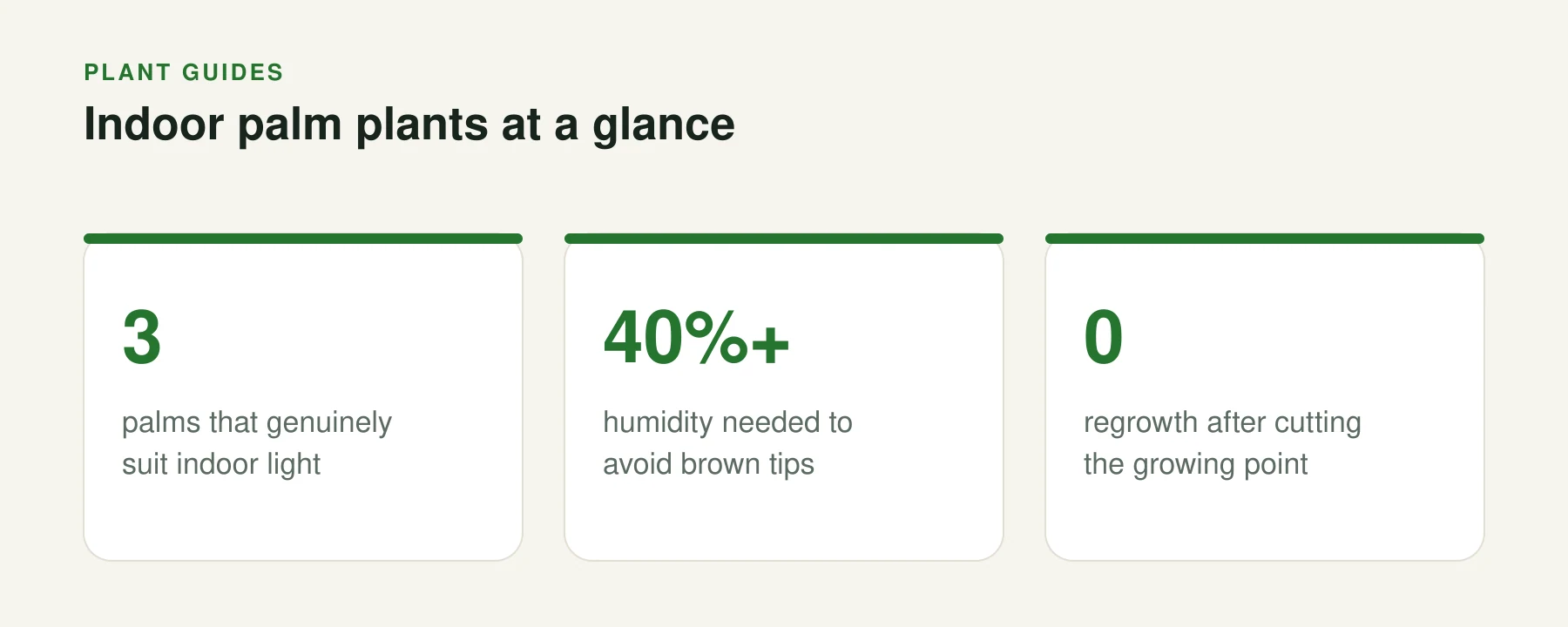
- Buy an understorey palm — areca, kentia or parlour. Sun-loving palms fail indoors whatever you do.
- Brown tips are almost always dry air, fluoride in tap water, or fertiliser salts.
- Never cut a palm's growing point: that stem cannot branch or regrow.
Key takeaways
- Buy an understorey palm — areca, kentia or parlour. Sun-loving palms fail indoors no matter how you treat them.
- Brown tips on a palm are almost always dry air, fluoride in tap water, or fertiliser salts.
- Palms cannot regrow a cut frond tip, so trim only for appearance and never cut the growing point.
- All the palms recommended here are non-toxic to cats and dogs.
Palms are sold as houseplants more than almost any other plant family, and a good share of them are simply the wrong species for a room. The distinction that decides everything is where the palm evolved — under a rainforest canopy in filtered shade, or out in open sun. Canopy palms adapt happily to a living room. Sun palms do not, and no amount of careful watering changes that. It is worth knowing which one is in the pot before you take it home.
#The palms that genuinely work indoors
| Palm | Botanical name | Height indoors | Light | Difficulty |
|---|---|---|---|---|
| Areca / butterfly palm | Dypsis lutescens | 1.5–2.5 m | Bright indirect | Moderate |
| Kentia palm | Howea forsteriana | 1.5–3 m | Moderate to bright | Easy |
| Parlour palm | Chamaedorea elegans | 0.6–1.2 m | Low to moderate | Very easy |
| Lady palm | Rhapis excelsa | 1–2 m | Low to moderate | Easy |
| Bamboo palm | Chamaedorea seifrizii | 1–2 m | Moderate | Easy |
| Ponytail palm* | Beaucarnea recurvata | 1–1.5 m | Bright to direct | Very easy |
| Sago palm* | Cycas revoluta | 0.5–1 m | Bright | Moderate |
| Fishtail palm | Caryota mitis | 1–2 m | Bright indirect | Moderate |
The ponytail palm and sago palm are not true palms at all — one is an asparagus relative, the other a cycad. They are sold as palms and behave very differently. The sago palm is also severely toxic to dogs*, causing liver failure; keep it out of a home with pets.
#Areca palm: the default choice
The areca is the palm most people mean when they picture an indoor palm — clustered, soft, feathery, and cheap because it grows quickly in nurseries. It wants bright indirect light within a metre or two of a window, evenly moist soil, and humidity above 40%. In darker rooms it survives but thins, dropping its lower fronds one by one.
- Water when the top 3–4 cm of soil is dry, roughly every 5–7 days in summer.
- Never let it sit in water — arecas rot readily, and root rot in a clumping palm spreads fast.
- Feed at half strength monthly through spring and summer only.
- Repot every two to three years; arecas actually prefer being slightly snug.
- Expect the oldest lower fronds to yellow and die over time. That is normal ageing, not a problem to solve.
#Kentia palm: the one for a darker room
If your room is not especially bright, buy a kentia. It grows naturally on Lord Howe Island under a canopy, tolerates moderate light without complaint, handles dry air better than an areca, and is famously slow — which is why it costs more. That slowness is an advantage indoors: it will hold its shape for years without outgrowing the corner.
#Parlour palm: the small one
The parlour palm survives in genuine low light, stays under 1.2 m, and is the palm to put on a desk, a shelf or in a bathroom. It is also the cheapest, usually sold several seedlings to a pot. Its weakness is dry air: spider mites find parlour palms quickly in a heated winter room, so check the undersides of the fronds monthly.
#Palms to avoid indoors
| Palm | Why it fails indoors |
|---|---|
| Majesty palm (Ravenea rivularis) | Needs full sun and permanently wet feet; declines within months in a living room |
| Coconut palm (Cocos nucifera) | Requires intense light and high humidity; sold as a novelty and rarely survives a year |
| Date palm (Phoenix dactylifera) | A desert sun species — etiolates and weakens in any indoor light |
| Queen palm (Syagrus) | Grows too fast and too large, and needs full sun |
#Why palm leaves go brown, and what to do
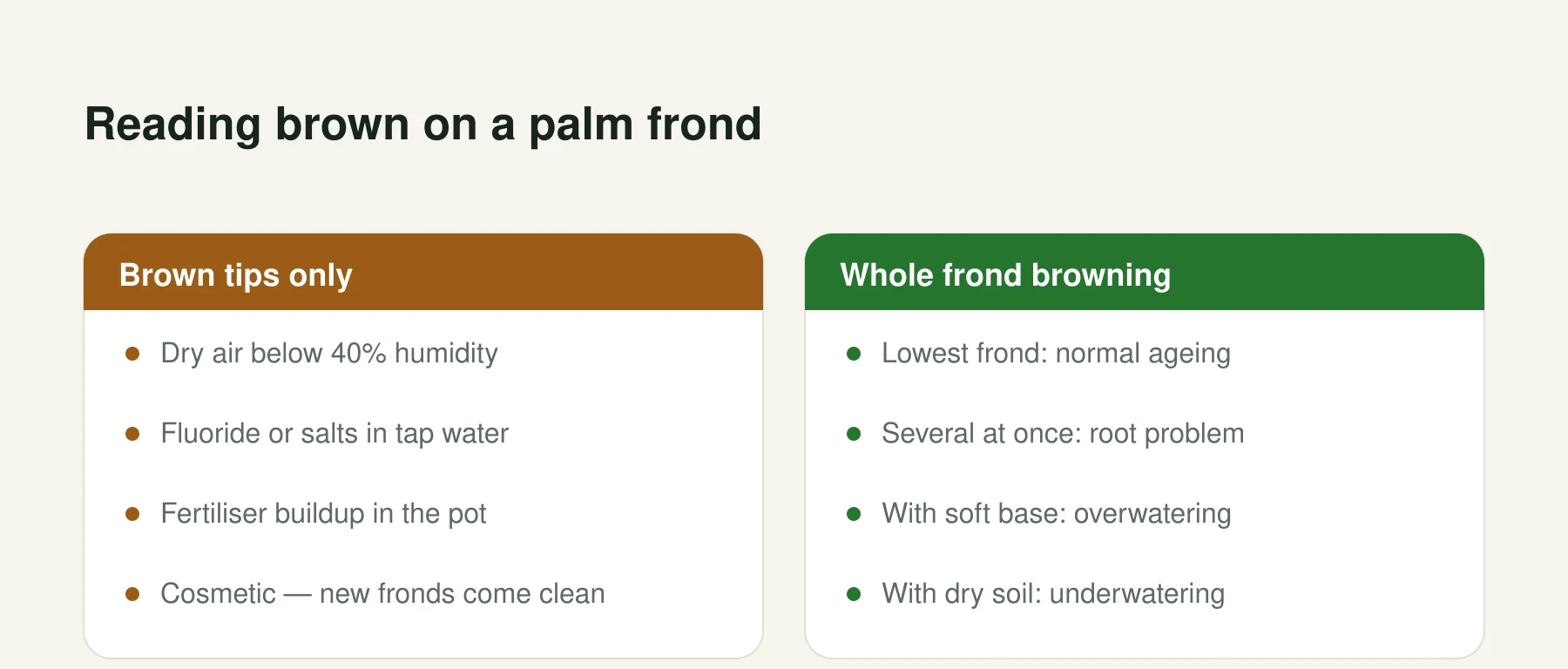
Brown, crispy tips on many fronds
Dry air is the usual cause. Group plants together, use a humidifier, or move the palm away from heating. Misting helps for minutes only.
Brown tips plus white crust on the soil
Fertiliser salt buildup. Flush the pot with water equal to three times its volume, then feed at half the previous strength.
Brown tips on a plant watered with tap water
Palms are sensitive to fluoride and boron. Switch to filtered or collected rainwater and judge by the new fronds.
A whole frond yellowing from the bottom up
If it is the lowest frond and the plant is otherwise growing, this is normal ageing. Cut it at the base.
Fine webbing between fronds
Spider mites. Rinse thoroughly in the shower, then treat with insecticidal soap every 5–7 days for three cycles.
One more practical note, learned the expensive way: palms are usually sold as several seedlings crammed into one pot to look full. Do not try to separate them into individual plants. The root systems are thoroughly intertwined, division sets every piece back badly, and the clump is what makes an indoor palm look good in the first place. If yours looks sparse, the answer is better light rather than more pots. For placement ideas, see our living room plant guide.
Frequently asked questions
Is the areca palm an indoor plant?
Yes. The areca palm (Dypsis lutescens) is one of the most widely grown indoor palms. It needs bright indirect light, evenly moist soil and moderate humidity, and it is non-toxic to cats and dogs.
Which palm is best for indoors?
The kentia palm for moderate light and the areca palm for a bright room. If the space is small or dim, the parlour palm is the better choice, staying under 1.2 m and tolerating genuine low light.
Why are my indoor palm leaves turning brown at the tips?
Most often dry air, then fluoride in tap water, then fertiliser salt buildup. Raise humidity, switch to filtered water, and flush the pot thoroughly every few months. Damaged tips never recover, so judge any fix by the new fronds.
How often should I water an indoor palm?
Every five to seven days in summer and every ten to fourteen days in winter, once the top 3–4 cm of soil is dry. Palms dislike both drought and standing water, so drain the saucer after every watering.
Do indoor palms need direct sunlight?
No. The palms suited to indoor life evolved under a forest canopy and prefer bright indirect light. Harsh direct sun through glass scorches their fronds, while palms that do need full sun, such as the majesty palm, are poor indoor plants.
Sources and further reading
- Houseplants: plant profiles — Royal Horticultural Society. Species-level profiles and cultivation notes.
- Plant Finder — Missouri Botanical Garden. Botanical names, native range and cultural requirements.
- Toxic and Non-Toxic Plants List — ASPCA Animal Poison Control. Toxicity status of every plant named, checked under its botanical name.
- Sago Palm poisoning in dogs — Pet Poison Helpline. Severity and symptoms of sago palm ingestion.
Related guides
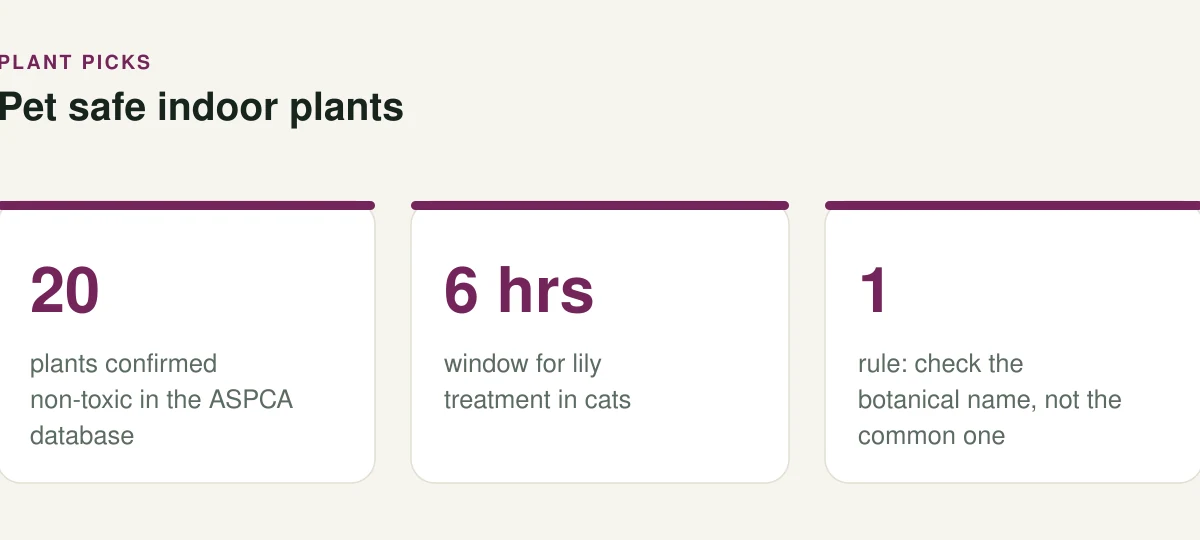
20 Pet Safe Indoor Plants (and the Popular Ones to Avoid)
Verified against the ASPCA toxic plant database: 20 houseplants that are non-toxic to cats and dogs, plus the common favourites that genuinely are not.
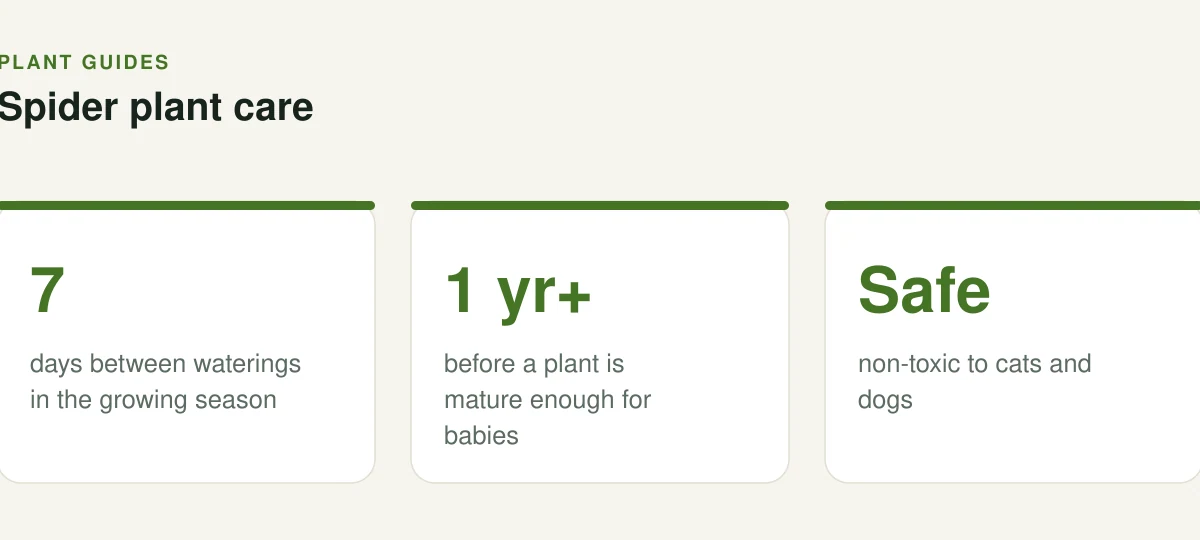
Spider Plant Indoor Care: Brown Tips, Babies and Why It's the Best Beginner Plant
How to grow a spider plant indoors, why the leaf tips go brown, how to root the plantlets, and how to get an established plant to produce babies.
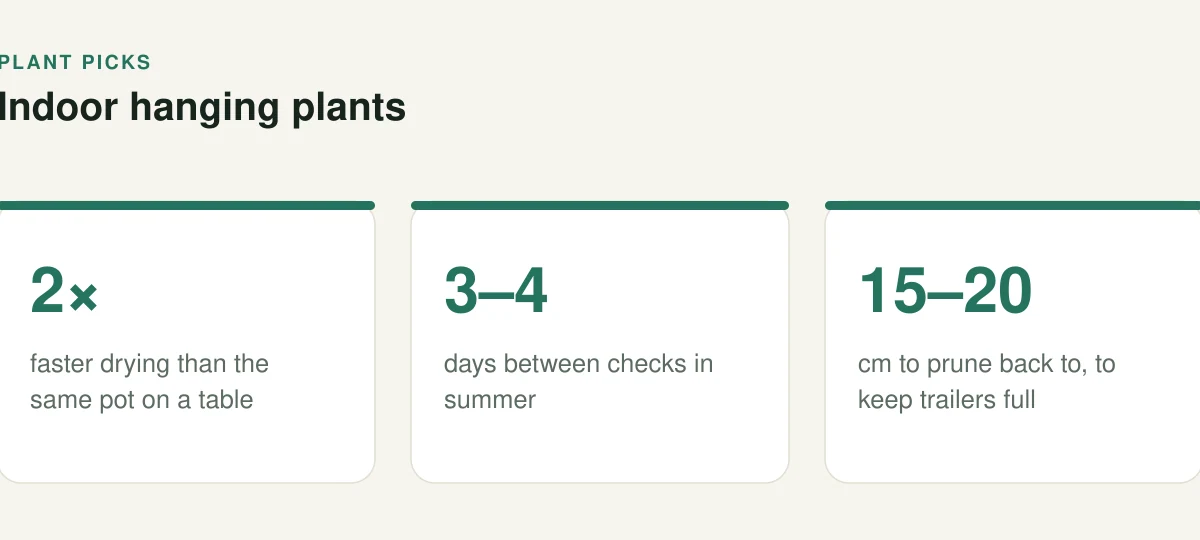
Indoor Hanging Plants: 15 Trailing and Climbing Plants That Thrive
The best indoor hanging plants for baskets, shelves and ceiling hooks — including which cope with the hot, dry air that collects near a ceiling.