Spider Plant Indoor Care: Brown Tips, Babies and Why It's the Best Beginner Plant
How to grow a spider plant indoors, why the leaf tips go brown, how to root the plantlets, and how to get an established plant to produce babies.
The short answer
- Brown tips are almost always fluoride in tap water, not a watering mistake.
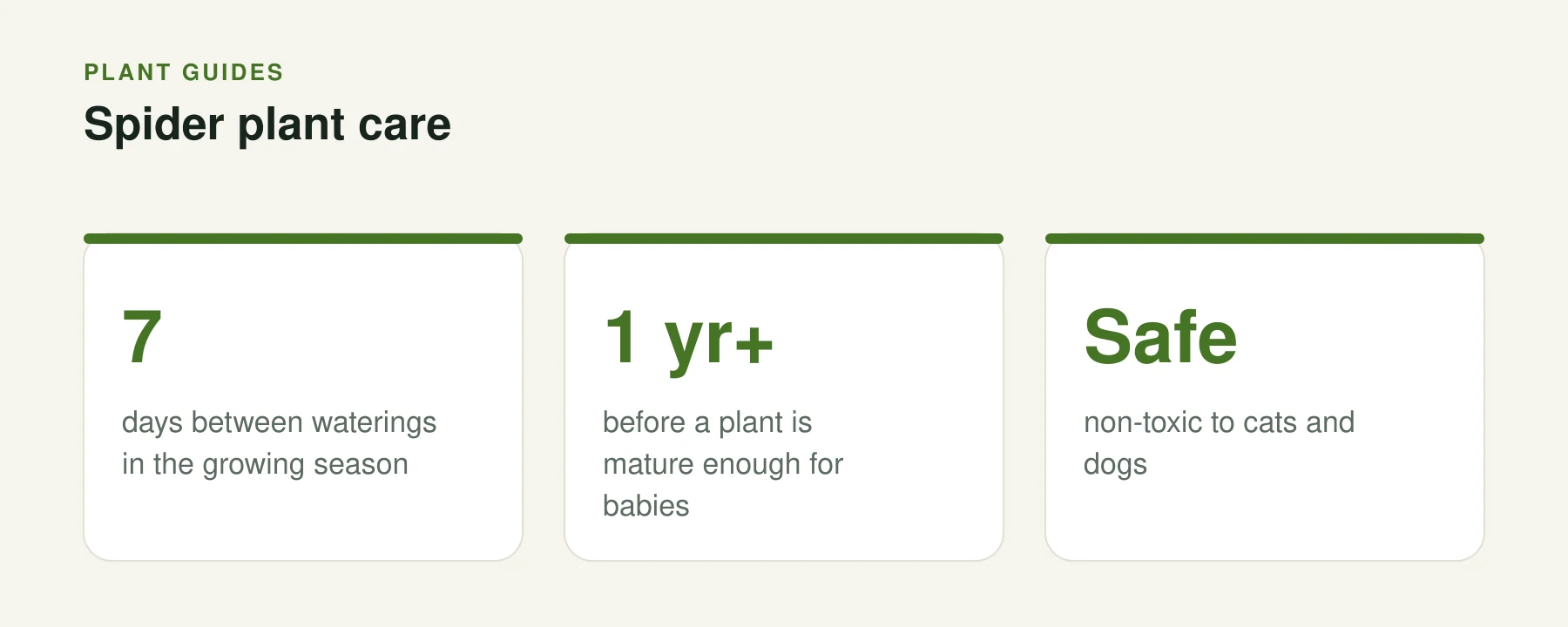
- Water about weekly in moderate to bright indirect light; its tuberous roots store water.
- Plantlets appear when the plant is slightly root-bound and gets genuinely dark nights.
Key takeaways
- Brown tips are almost always fluoride in tap water, not underwatering.
- It is non-toxic to cats and dogs — one of the few tough plants that is.
- Plantlets appear when the plant is slightly root-bound and gets uninterrupted darkness at night.
- Thick white tuberous roots store water, so it tolerates being forgotten for a week or two.
The spider plant (Chlorophytum comosum) is the plant most of us were handed as a student and somehow still have. It tolerates a wide range of light, stores water in thick tuberous roots, propagates itself without being asked, and is safe around cats and dogs — a combination almost no other tough houseplant manages. If you want one plant that forgives everything and gives you free plants back, this is it.
#Light, water and temperature
| Factor | What it wants | What happens otherwise |
|---|---|---|
| Light | Moderate to bright indirect | Low light: survives, but variegation fades and no plantlets |
| Water | Every 7 days; top 2–3 cm dry | Wrinkled, pale leaves when very dry; soft base when overwatered |
| Temperature | 15–25 °C | Damaged below 8 °C |
| Humidity | Average room is fine | Very dry air worsens brown tips |
| Feed | Half strength monthly, spring–summer | Overfeeding is a leading cause of brown tips |
Variegated forms — the white-striped 'Vittatum' and 'Variegatum' — need more light than the plain green species to keep their stripes. In a dim corner they gradually revert toward solid green, which is the plant prioritising chlorophyll over decoration.
#Why spider plants get brown tips
This is the single most asked question about the species, and the answer is usually water chemistry rather than watering habits. Spider plants are unusually sensitive to fluoride, and to a lesser degree chlorine and boron. Fluoridated tap water accumulates in the leaf tips, where it kills the tissue — producing the sharp brown points that appear even on plants watered perfectly.
Change the water
Use filtered water, collected rainwater, or tap water left to stand uncovered for 24 hours. Standing removes chlorine but not fluoride, so filtering is better if your supply is fluoridated.
Flush the pot
Every couple of months, run water equal to three times the pot's volume through the soil to wash out accumulated salts and minerals.
Feed less
Fertiliser salts cause identical damage. Half strength, monthly, and only in spring and summer.
Raise humidity a little
Grouping plants together or a pebble tray helps, particularly in a heated room in winter.
Trim on the diagonal
Existing brown tips never recover. Cut them off following the natural leaf shape with sharp scissors — a straight cut looks obviously trimmed.
#Getting a spider plant to make babies
The plantlets — 'spiderettes' — grow on long arching stems called stolons. A plant that has never produced any is usually too young, too comfortable in a large pot, or getting artificial light late into the evening.
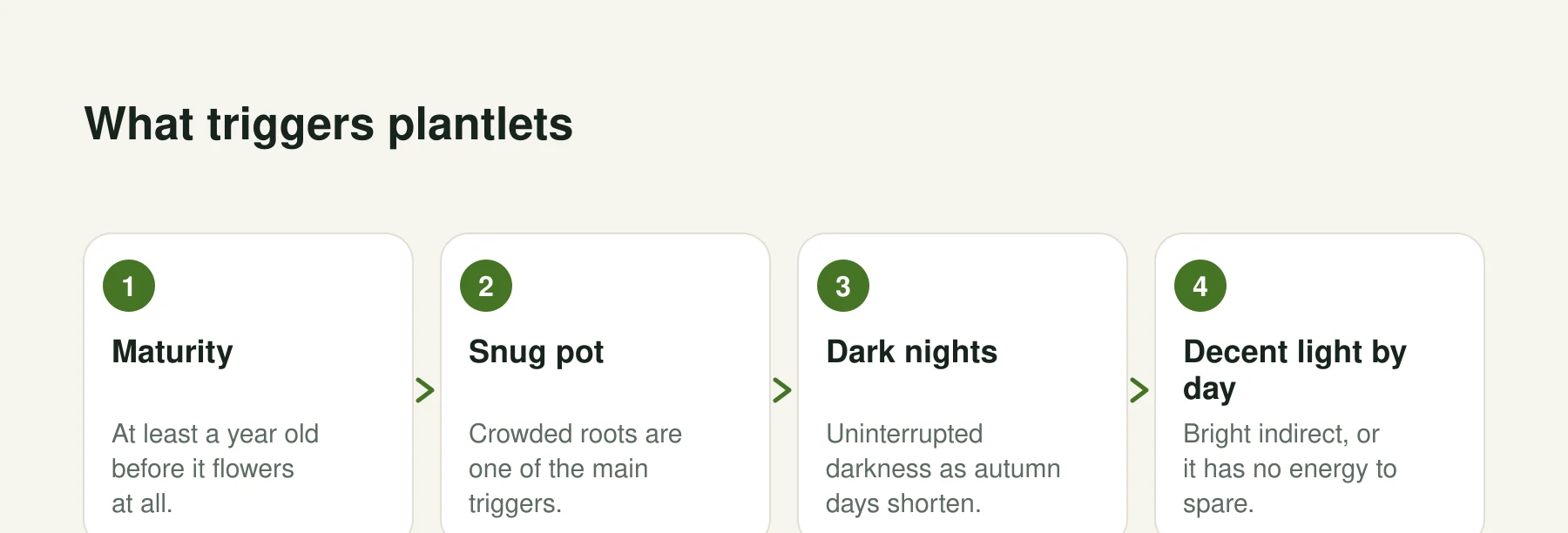
- Wait for maturity. Most plants need to be at least a year old before flowering and producing plantlets.
- Keep it slightly root-bound. A crowded pot is one of the main triggers. Repot only when roots are visibly pushing the plant upward.
- Give it real darkness. Spider plants set plantlets in response to shortening days. A plant in a room with lights on until midnight often never gets the signal.
- Provide decent light during the day. Bright indirect light gives the plant the energy to produce them in the first place.
- Do not overfeed. Excess nitrogen produces lush leaves at the expense of flowers and plantlets.
#Rooting the plantlets
Three methods, all reliable. In water: cut a plantlet off where it meets the stolon and stand its base in a glass of water; roots appear in one to two weeks. In soil, still attached: rest the plantlet on a small pot of damp mix beside the parent, keeping it attached until it roots, then cut the stolon — the highest success rate, since the parent keeps feeding it. Directly in soil: cut and plant into damp mix, keeping it slightly moist for two weeks. Plantlets that already show stubby aerial roots root fastest.
#Troubleshooting
| Symptom | Cause | Fix |
|---|---|---|
| Brown leaf tips | Fluoride, salts or dry air | Filtered water; flush the pot; feed less |
| Pale, washed-out leaves | Too much direct sun | Move back from the window |
| Fading stripes on variegated forms | Not enough light | Move brighter |
| Soft, mushy base | Overwatering | Let the soil dry; check for rot at the crown |
| No plantlets | Too young, too big a pot, or no true darkness | Keep root-bound; ensure dark nights in autumn |
| Wrinkled leaves | Prolonged drought | Water thoroughly; the tubers refill within days |
One practical note on pots: those water-storing tuberous roots expand with real force, and they will crack a thin ceramic pot or push the whole plant up out of its container. Repot every two years into something sturdy, going only 5 cm wider — a spider plant that gets too comfortable stops producing the babies that make it worth keeping in the first place. Our pot guide covers sizing and materials.
Frequently asked questions
Why does my spider plant have brown tips?
Almost always fluoride in tap water, sometimes chlorine or fertiliser salts. Switch to filtered or collected rainwater, flush the pot every couple of months, and feed at half strength. Existing brown tips never recover but new growth comes through clean.
How often should I water a spider plant?
About every seven days in the growing season, once the top 2–3 cm of soil is dry, and every ten to fourteen days in winter. Its tuberous roots store water, so it tolerates being forgotten better than most plants.
Why is my spider plant not producing babies?
It is either too young, in too large a pot, or not getting uninterrupted darkness at night. Plantlets form in response to shortening day length, so a plant in a room lit until late often never receives the trigger.
Are spider plants safe for cats?
Yes, spider plants are non-toxic to cats and dogs. Cats are often attracted to the arching leaves, which is harmless, though eating a large quantity may cause mild stomach upset as with any plant material.
How do I root spider plant babies?
Rest the plantlet on a pot of damp soil while still attached to the parent, and cut the stolon once it roots — this has the highest success rate. Alternatively cut it off and stand the base in water, where roots appear within one to two weeks.
Sources and further reading
- Houseplants: plant profiles — Royal Horticultural Society. Species-level profiles and cultivation notes.
- Toxic and Non-Toxic Plants List — ASPCA Animal Poison Control. Toxicity status of every plant named, checked under its botanical name.
- Plant Finder — Missouri Botanical Garden. Botanical names, native range and cultural requirements.
- North Carolina Extension Gardener Plant Toolbox — NC State Extension. Species data, hardiness and toxicity cross-checks.
Related guides
Money Plant Indoor Care: Water, Light, Vastu and Growing It in a Bottle
How to grow a money plant indoors — in soil or water — plus where vastu says to place it, why leaves turn yellow, and how to make a leggy vine bushy again.
Rubber Plant Indoor Care and Benefits (Indoor or Outdoor?)
Ficus elastica care indoors: light, watering, why leaves drop, how to make it branch instead of growing into a single pole, and whether it can live outside.
Jade Plant Indoor or Outdoor? Care, Placement and Vastu
Whether to keep a jade plant indoors or outside, how often to water it, why leaves drop or go soft, and where vastu and feng shui place it for prosperity.