Rubber Plant Indoor Care and Benefits (Indoor or Outdoor?)
Ficus elastica care indoors: light, watering, why leaves drop, how to make it branch instead of growing into a single pole, and whether it can live outside.
The short answer
- The rubber plant is an indoor plant in all but tropical climates, and far easier than a fiddle leaf fig.
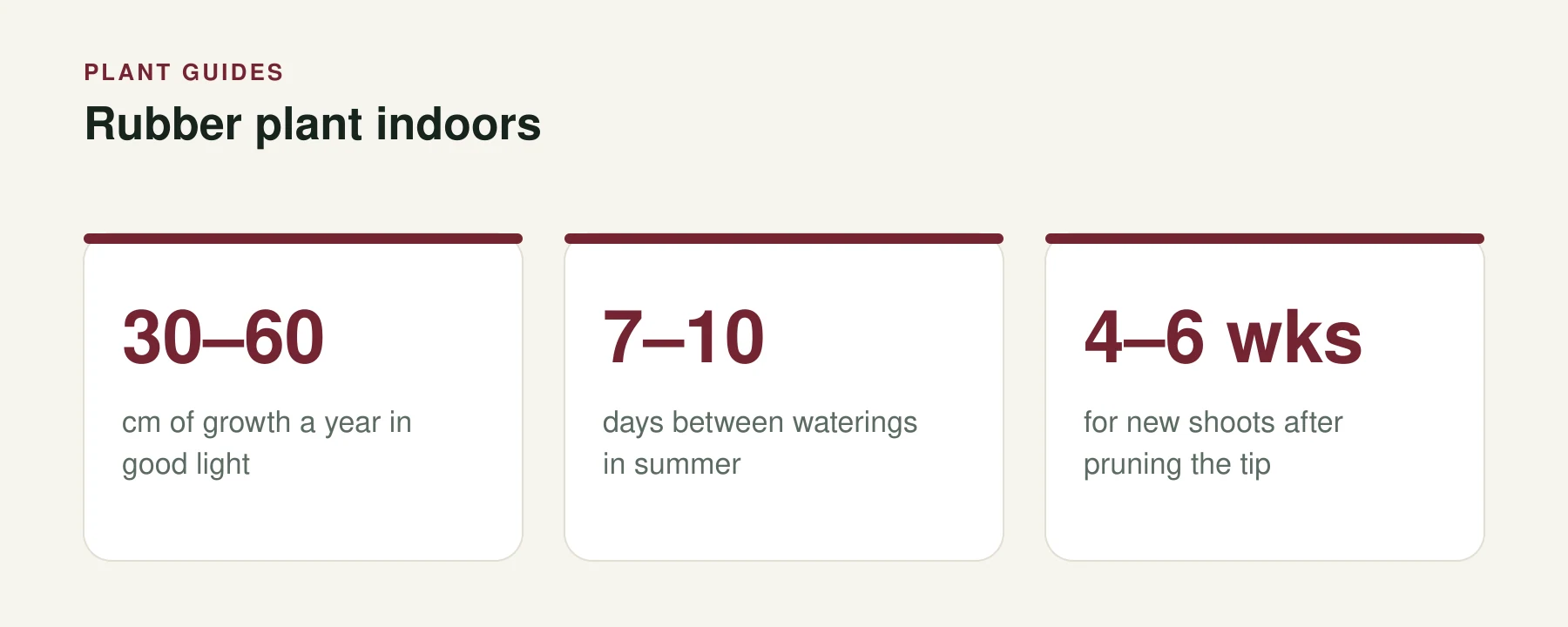
- Bright indirect light, water every 7–10 days, and a position you never move it from.
- Sudden leaf drop follows change — a move, a draught, a cold snap — not neglect.
Key takeaways
- It is far more forgiving than its cousin the fiddle leaf fig, and grows faster.
- Leaf drop follows change — a move, a draught, a temperature swing — not poor care.
- It will grow as a single unbranched pole unless you cut the top off.
- The milky sap is a skin irritant and mildly toxic to pets.
Ficus elastica is the large indoor plant to buy if the fiddle leaf fig has already defeated you — and it defeats a lot of people. Same family, same architectural presence, but with thick, glossy leaves that shrug off dry air, moderate light and an owner who is not especially consistent. It grows fast enough to feel rewarding, 30–60 cm a year in decent light, and a well-kept one lives for decades.
#Indoor or outdoor?
Indoors, in almost every climate. In its native South and Southeast Asia it becomes a 30-metre forest tree and can live outside year-round only where temperatures stay above 15 °C. Below 10 °C the leaves are damaged; frost kills it. In warm climates it can spend summer outdoors in bright shade — never straight into full sun, which scorches leaves grown indoors within days.
#Light, water, temperature
| Factor | What it wants | Warning signs |
|---|---|---|
| Light | Bright indirect, near an east or west window | Leggy growth, small leaves, lower leaf drop if too dark |
| Water | Every 7–10 days, when top 5 cm is dry | Yellow lower leaves if wet; drooping if bone dry |
| Temperature | 16–27 °C, stable | Sudden leaf drop below 10 °C or in a draught |
| Humidity | 40%+ preferred, tolerates less | Brown crisp edges in very dry air |
| Feed | Half strength every 2 weeks in spring/summer | Pale new leaves if underfed; brown tips if overfed |
Variegated forms — 'Tineke', 'Ruby' — need noticeably more light than the plain burgundy 'Abidjan' or dark green types, because the cream and pink sections contain no chlorophyll. In a dim room they lose their colouring and produce weak growth.
#Why rubber plants drop leaves
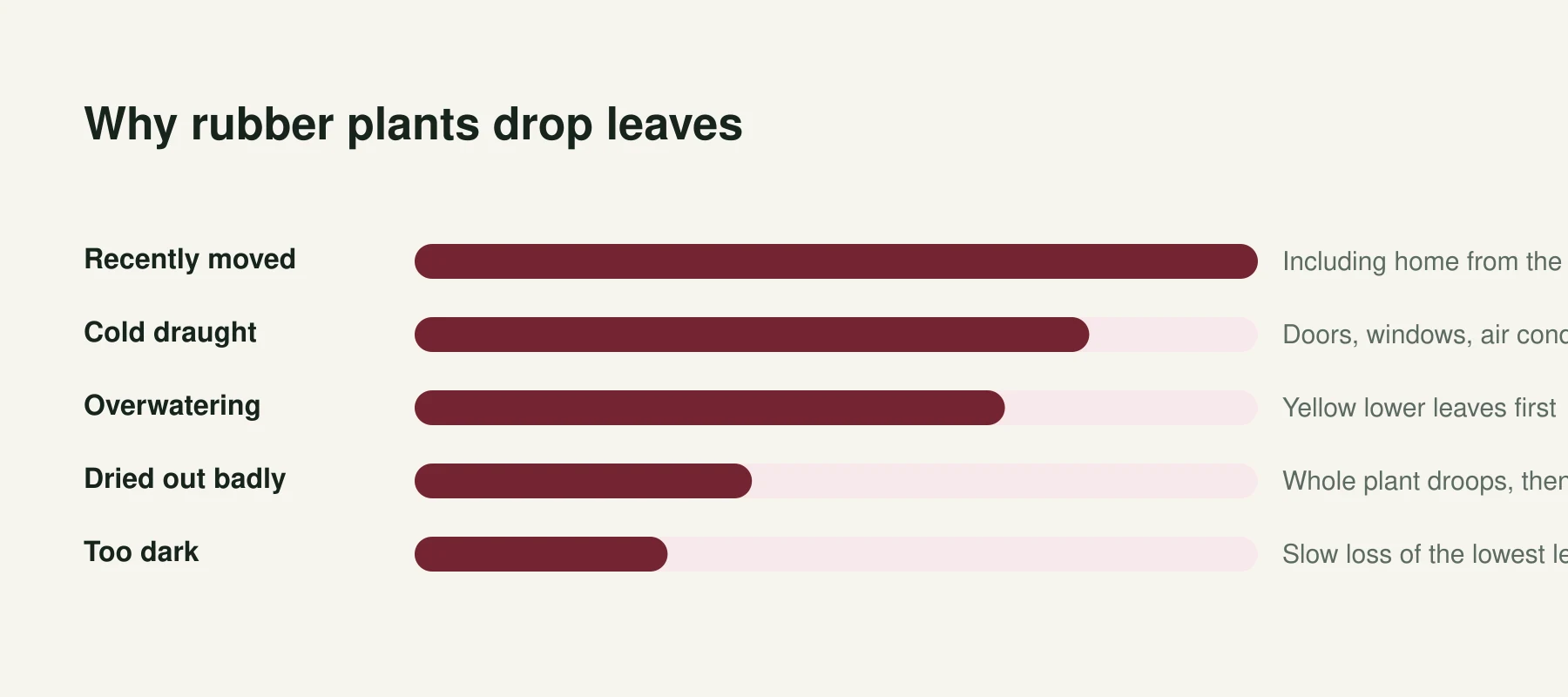
Ficus species react to change rather than to poor conditions. The plant has to re-balance its water use whenever light, temperature or humidity shifts, and it does that by shedding leaves. Nearly every case of sudden leaf drop traces back to one of five things.
- It was just moved — including home from the shop. Expect one or two leaves to drop in the first fortnight, then stability.
- A cold draught — an outside door, an open window in winter, or an air conditioning vent.
- Overwatering — yellow lower leaves first, then drop, with soil still damp several days after watering.
- Severe drying out — the whole plant droops, then sheds leaves to cut its water demand.
- A dark position — a slow version of the same, losing the lowest leaves month by month.
#Making it branch instead of growing as a pole
Left alone, a rubber plant grows as a single unbranched stem straight to the ceiling. Branching only happens when the growing tip is removed, which releases the dormant buds below it.
Prune in spring
Cut in early spring as growth resumes, when the plant will respond fastest. Decide the height where you want the canopy to start.
Cut above a node
Use clean, sharp secateurs and cut just above a leaf node — the ring-shaped mark on the stem where a leaf was attached.
Manage the sap
The cut weeps milky latex for a few minutes. Blot it with a paper towel, keep it off skin and floors, and wash your hands afterwards.
Wait 4–6 weeks
Two or three new shoots usually emerge below the cut. Nothing after eight weeks generally means the plant does not have enough light to push new growth.
Root the top
The removed top roots in water or damp perlite over six to eight weeks, giving you a second plant.
#Benefits of a rubber plant indoors
- Large leaf area for little effort — it is among the most productive common houseplants in terms of foliage per unit of care.
- Removed formaldehyde in NASA's chamber trials, though as with all such plants the effect in a ventilated room is negligible.
- Tolerates dry indoor air far better than palms, ferns or calatheas.
- Grows quickly enough to fill a corner within two or three years from a moderate-sized plant.
- Associated with wealth and abundance in feng shui, where it is placed in the south-east.
- Easy to propagate, so one plant becomes several at no cost.
#Soil, pot and routine care
Use a well-draining mix — three parts potting soil to one part perlite — in a pot with drainage holes, going up one size every 18–24 months. Wipe the leaves with a damp cloth monthly; those big glossy surfaces collect dust quickly and it measurably reduces the light reaching them. Rotate the pot a quarter turn each week so the stem grows straight rather than leaning toward the window.
Frequently asked questions
Is a rubber plant an indoor plant?
Yes, in almost every climate. It grows as a large tree outdoors only where temperatures stay above about 15 °C year-round. Indoors it wants bright indirect light and stable conditions, and it tolerates dry air better than most large houseplants.
What are the benefits of a rubber plant indoors?
It provides large leaf area with very little care, tolerates dry indoor air, grows fast enough to fill a corner in a few years, propagates easily, and removed formaldehyde in NASA's chamber studies — though that last effect is negligible in a real room.
Why is my rubber plant dropping leaves?
Rubber plants shed leaves in response to change: a recent move, a cold draught, a temperature swing, or overwatering. Yellow lower leaves with damp soil point to watering; sudden drops of green leaves point to a draught or a move.
How do I make my rubber plant bushy?
Cut off the growing tip in spring, just above a leaf node. This releases the dormant buds below and usually produces two or three new shoots within four to six weeks. Without pruning it grows as a single unbranched stem.
How often should I water a rubber plant?
Every seven to ten days in the growing season, once the top 5 cm of soil has dried, and roughly every two weeks in winter. Water thoroughly until it drains and empty the saucer — soggy soil causes yellowing lower leaves.
Sources and further reading
- Houseplants: plant profiles — Royal Horticultural Society. Species-level profiles and cultivation notes.
- Plant Finder — Missouri Botanical Garden. Botanical names, native range and cultural requirements.
- Interior landscape plants for indoor air pollution abatement — NASA Technical Reports Server, 1989. The original 1989 sealed-chamber study behind every air-purifying plant list.
- Toxic and Non-Toxic Plants List — ASPCA Animal Poison Control. Toxicity status of every plant named, checked under its botanical name.
Related guides
Monstera Indoor Plant Care: Light, Water and Getting the Splits
Complete monstera deliciosa care indoors — how much light it needs, watering intervals, why leaves have no holes, and how to make it climb instead of sprawl.
Jade Plant Indoor or Outdoor? Care, Placement and Vastu
Whether to keep a jade plant indoors or outside, how often to water it, why leaves drop or go soft, and where vastu and feng shui place it for prosperity.
Spider Plant Indoor Care: Brown Tips, Babies and Why It's the Best Beginner Plant
How to grow a spider plant indoors, why the leaf tips go brown, how to root the plantlets, and how to get an established plant to produce babies.