Monstera Indoor Plant Care: Light, Water and Getting the Splits
Complete monstera deliciosa care indoors — how much light it needs, watering intervals, why leaves have no holes, and how to make it climb instead of sprawl.
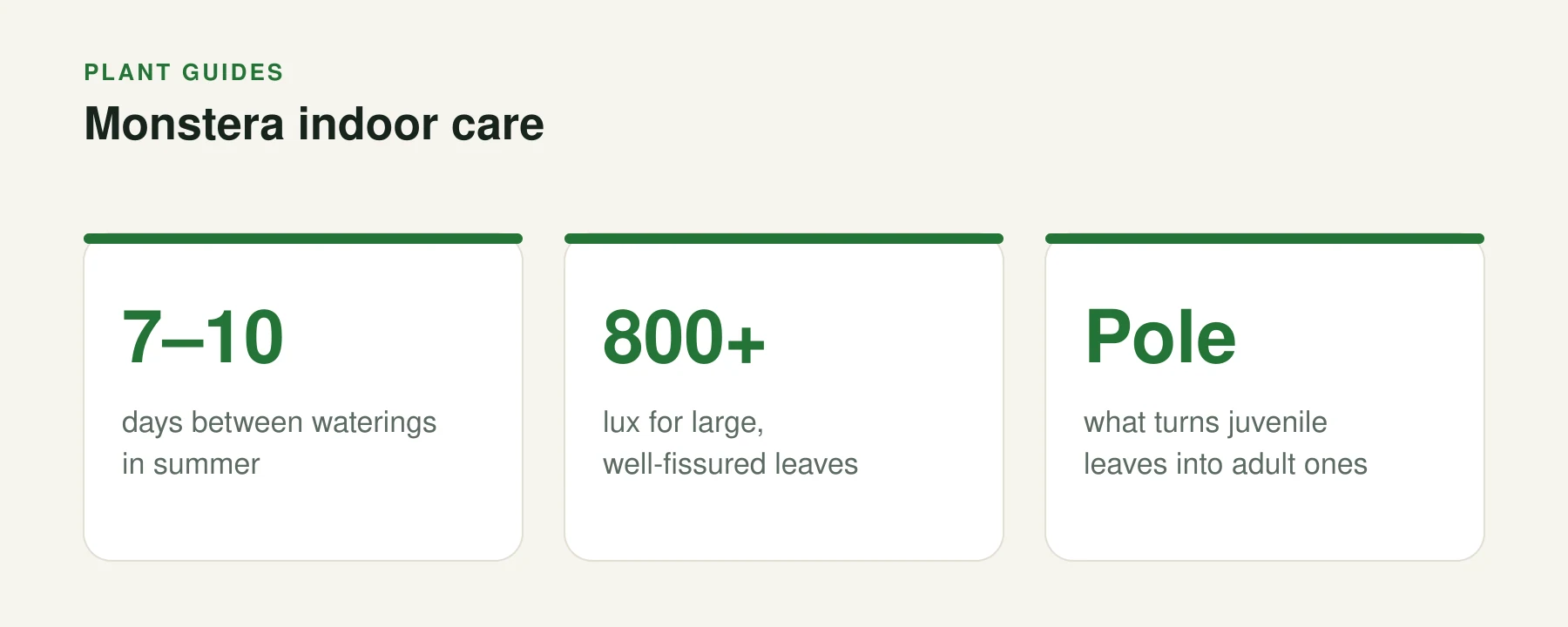
The short answer
- Bright indirect light, within a metre or two of a window, and water every 7–10 days.
- No splits means the plant is too young or in too little light — nothing else causes it.
- Give it a moss pole to climb; that is what triggers large, fissured adult leaves.
Key takeaways
- No splits means the plant is either too young or in too little light — nothing else causes it.
- Monstera is a climber; giving it a pole changes leaf size dramatically.
- Aerial roots are normal and should not be cut off; tuck them into the pole or the pot.
- It needs a chunky, bark-heavy mix — ordinary potting soil compacts and suffocates the roots.
Monstera deliciosa turned a whole generation into houseplant owners, and it is genuinely easy to grow — with one condition that almost everyone misses. In the wild it germinates on the forest floor, finds a tree trunk, and climbs it. Everything about how it behaves indoors follows from that one fact: it wants filtered light, something to climb, and a coarse, airy root run rather than dense soil. Once you see it as a climber rather than a shelf plant, its behaviour stops being mysterious.
#Light
Bright indirect light. In practice: within one to two metres of an east or west window, or a few metres back from a south window. It tolerates lower light without dying, but the plant it becomes there is a different one — small, solid, unsplit leaves on long, stretching stems.
| Light | What you get |
|---|---|
| Low (under 250 lux) | Survives; small leaves, no splits, long gaps between leaves |
| Moderate (250–800 lux) | Steady growth; some splits on mature leaves |
| Bright indirect (800–2,000 lux) | The target — large leaves, deep fissures, fast growth |
| Direct midday sun | Bleached patches and scorched edges within days |
#Watering
- Water when the top 5 cm of soil is dry — roughly every 7–10 days in summer, every 14–18 in winter.
- Water thoroughly until it runs from the drainage hole, then empty the saucer completely.
- Yellow lower leaves on damp soil means overwatering; this is the most common monstera complaint by far.
- Drooping with dry, shrunken soil means it is thirsty and recovers within hours of a soak.
- In a large pot, test with a wooden skewer pushed to the bottom — the surface tells you nothing about the root zone.
#Why your monstera has no holes
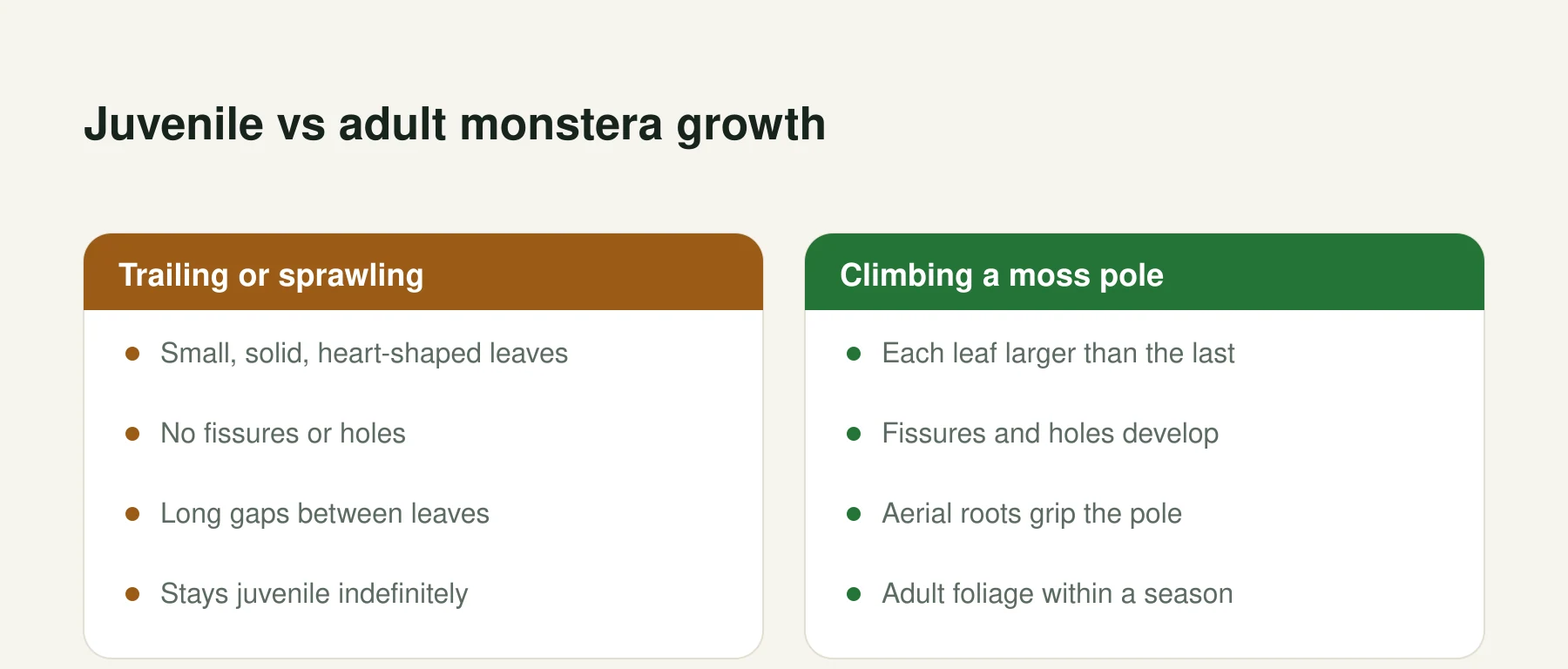
Two causes, and only two. Juvenility: young monsteras produce solid, heart-shaped leaves for their first year or two regardless of care, and a small plant from a garden centre is often only a rooted cutting. Light: fenestration is expensive, and a plant without surplus energy does not bother. The prevailing botanical explanation is that the holes let light through to leaves lower down the same plant and reduce wind resistance in a canopy — both only worth doing when the plant is climbing and mature.
#Moss poles and climbing
Choose the support
A moss pole, coir pole or wooden plank all work. Moss holds moisture, which the aerial roots grip best; a plank is easier to extend as the plant grows.
Place it at repotting time
Push the pole into the pot behind the main stem, ideally when repotting so you do not sever roots pushing it in.
Tie the stem loosely
Use soft plant ties or velcro strips to hold the stem against the pole. The plant does the rest once the aerial roots make contact.
Keep the pole damp
Mist or pour a little water down the pole when you water the plant. Dry moss gives the aerial roots nothing to attach to.
Extend upward each year
Add a section to the pole as the plant grows. Every extension keeps the adult foliage coming rather than the plant flopping and reverting.
#Soil, pot and repotting
Monsteras are epiphytic climbers whose roots run through loose leaf litter and over bark, not through dense soil. Use a chunky mix: two parts potting soil, one part perlite or pumice, one part orchid bark. Repot every 18–24 months in spring, one pot size up. If the plant dries out within two days of watering and roots are circling the pot, it is overdue.
#Feeding and pruning
Feed a balanced liquid fertiliser at half strength every second or third watering from spring through summer, and stop entirely from late autumn until new growth resumes. Prune only to control size or remove damaged leaves — cut the petiole cleanly close to the main stem. Any cutting with a node and an aerial root roots readily in water or damp sphagnum, which is how most people end up with a second monstera.
#Common problems
| Symptom | Likely cause | Fix |
|---|---|---|
| Yellow lower leaves, damp soil | Overwatering | Extend the interval; check roots if the stem base is soft |
| Brown crispy edges | Dry air or salt buildup | Raise humidity; flush the pot with plain water |
| Small unsplit new leaves | Too little light, or not climbing | Move brighter and add a moss pole |
| Long bare stems | Reaching for light | Move brighter, prune back, propagate the cuttings |
| Black spots spreading from the centre | Root rot | Unpot, cut away rot, repot in an airy mix |
| Fine webbing under leaves | Spider mites in dry air | Rinse thoroughly, treat weekly for three cycles |
Monstera is toxic to cats and dogs, containing calcium oxalate crystals that cause painful oral irritation if chewed — our pet safe plant list has non-toxic alternatives if that matters in your home. For the soil it actually wants, see our potting mix recipes.
Frequently asked questions
How much light does a monstera need indoors?
Bright indirect light — within one to two metres of an east or west window. It survives in lower light but produces small, solid leaves without splits, and scorches in direct midday sun through glass.
Why doesn't my monstera have splits?
Either the plant is still juvenile, or it does not have enough light. Fenestration develops on mature foliage produced by a plant with surplus energy. Move it brighter and give it a moss pole to climb — climbing is what triggers adult leaves.
How often should I water a monstera?
Every seven to ten days in summer and every two weeks or so in winter, once the top 5 cm of soil has dried. Always check the soil rather than following a fixed schedule, and empty the saucer after watering.
Should I cut the aerial roots off my monstera?
No. Aerial roots let the plant climb and absorb moisture. Guide them onto a moss pole or into the pot instead. Removing them will not kill the plant but takes away its anchoring and support system.
Do monsteras need a moss pole?
They do not need one to survive, but they need one to reach their potential. Monstera is a climber, and contact with a vertical support triggers larger, more fissured adult foliage. Without it the plant stays juvenile and sprawls.
Sources and further reading
- Houseplants: plant profiles — Royal Horticultural Society. Species-level profiles and cultivation notes.
- Plant Finder — Missouri Botanical Garden. Botanical names, native range and cultural requirements.
- North Carolina Extension Gardener Plant Toolbox — NC State Extension. Species data, hardiness and toxicity cross-checks.
- Toxic and Non-Toxic Plants List — ASPCA Animal Poison Control. Toxicity status of every plant named, checked under its botanical name.
Related guides
Rubber Plant Indoor Care and Benefits (Indoor or Outdoor?)
Ficus elastica care indoors: light, watering, why leaves drop, how to make it branch instead of growing into a single pole, and whether it can live outside.
Big Leaf Indoor Plants: 14 Large-Leaved Plants for Real Impact
Fourteen big leaf indoor plants — from monstera and elephant ear to banana and rubber plants — with the light, space and pot size each one needs to get large indoors.
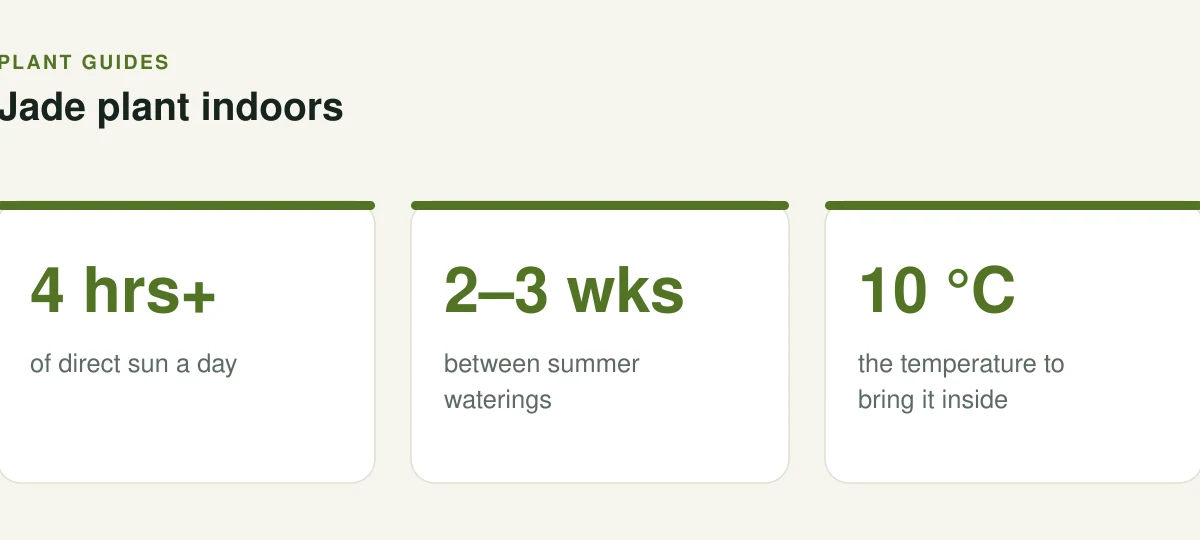
Jade Plant Indoor or Outdoor? Care, Placement and Vastu
Whether to keep a jade plant indoors or outside, how often to water it, why leaves drop or go soft, and where vastu and feng shui place it for prosperity.