Jade Plant Indoor or Outdoor? Care, Placement and Vastu
Whether to keep a jade plant indoors or outside, how often to water it, why leaves drop or go soft, and where vastu and feng shui place it for prosperity.

The short answer
- Jade is a sun-loving succulent — the brightest windowsill in the house is the right place.
- Water every 2–3 weeks in summer, monthly or less in winter, letting the soil dry completely.
- Soft, translucent leaves and sudden leaf drop both mean too much water, not too little.
Key takeaways
- Jade is a sun-loving succulent — the brightest windowsill in the house is the right place.
- Leaf drop and soft, translucent leaves both mean too much water, not too little.
- It lives for decades and becomes a small tree; a heavy pot stops it toppling.
- Water deeply but rarely — every 2–3 weeks in summer, monthly or less in winter.
The jade plant (Crassula ovata) is one of the longest-lived houseplants there is — well-kept specimens genuinely do get handed down through families — and one of the easiest, provided you can resist the urge to water it. That last part is the whole trick. It is a succulent from the dry scrub of South Africa, and everything it needs follows from that single fact. Treat it like a tropical foliage plant and you will lose it within a year.
#Indoor or outdoor?
Indoors for most people, on the brightest windowsill available. Jade tolerates outdoor life only where winters stay above about 10 °C, and it must never be exposed to frost — the water-filled leaves freeze, burst and turn to mush overnight.
| Situation | Verdict |
|---|---|
| South or west windowsill indoors | Ideal — 4+ hours of sun, stable temperature |
| Outdoors in summer, frost-free climate | Excellent; acclimatise gradually to avoid sunburn |
| Outdoors year-round, mild climate above 10 °C | Fine, in free-draining soil under cover from heavy rain |
| Outdoors in a climate with frost | No — bring it inside before temperatures approach 10 °C |
| Dim indoor corner | Survives but stretches, and leaves thin and drop |
| Monsoon or heavy rain outdoors | Poor — waterlogged roots rot quickly |
#Watering — the only thing that kills it
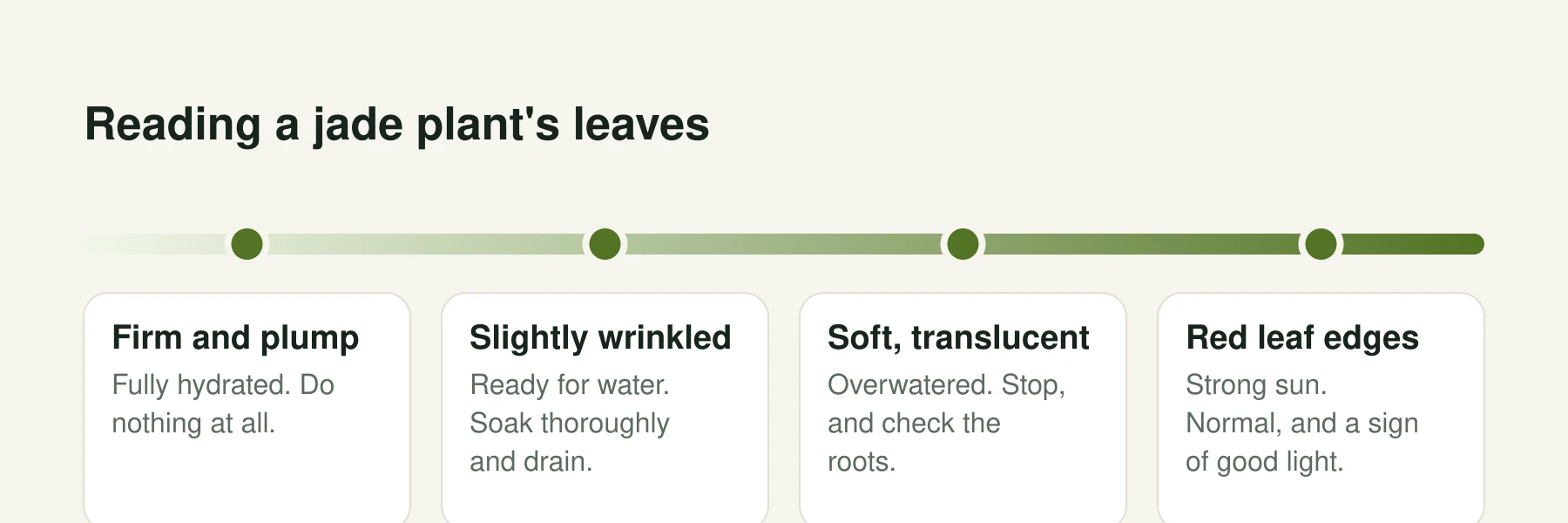
Water deeply, then let the soil dry out completely before watering again. In practice that means every two to three weeks in summer and every four to six weeks in winter, less in a cool or dim room. The leaves are the gauge: plump and firm means fully watered; slightly soft and wrinkled means it is ready for more.
| Leaf sign | Meaning | Action |
|---|---|---|
| Firm, plump, glossy | Well hydrated | Do nothing |
| Slightly wrinkled, softening | Ready for water | Water thoroughly and drain |
| Soft, translucent, yellowing | Overwatered | Stop watering; check for root rot |
| Dropping suddenly, lots at once | Overwatering, or cold shock | Check soil moisture and position |
| Shrivelled and thin, dry soil | Genuinely underwatered | Soak thoroughly; recovers in days |
| Red edges on leaves | Bright sun — normal and desirable | Nothing; it indicates good light |
#Soil and pot
- Use a cactus and succulent mix, or ordinary potting soil cut with 50% coarse sand, perlite or pumice.
- Terracotta is genuinely better here — its porosity pulls moisture out of the mix and widens your margin for error.
- Drainage holes are non-negotiable. A jade in a sealed cachepot rots with no visible warning.
- Choose a heavy, wide pot. Mature jades become top-heavy small trees and will tip a light plastic pot over.
- Repot every 3–4 years at most. It is slow-growing and flowers better when snug.
#Pruning and shaping
Jade responds well to pruning and it is how you get the classic thick-trunked tree shape. Cut just above a leaf pair in spring; the plant branches into two shoots below the cut. Remove lower leaves along the main stem to expose the trunk as it thickens. Every piece you cut off roots easily: let the cutting dry and callus for two to three days, then push it into barely damp cactus mix and leave it unwatered for another week.
#Taking a jade cutting, step by step
Choose a healthy stem in spring
A branch 8–10 cm long with several pairs of plump leaves. Spring gives the cutting a full growing season to establish.
Cut cleanly just above a leaf pair
Use sharp, sterilised snips. The parent plant will branch into two shoots below the cut, so you improve its shape at the same time.
Let it callus for two or three days
Leave the cutting on a dry windowsill until the cut end forms a dry skin. Planting a fresh wet cut straight into soil is how cuttings rot.
Push it into barely damp cactus mix
About 3 cm deep, in a small pot. Do not water it in — the soil should be only just moist to the touch.
Wait a week, then water sparingly
Roots form over two to four weeks. Tug very gently after three weeks; resistance means it has rooted and can join the normal watering routine.
#Getting a jade to flower
Mature jades produce clusters of small white or pink star-shaped flowers in winter, but only under specific conditions: the plant must be several years old, root-bound, kept in strong light, and given a cool, dry autumn — around 10–13 °C at night with almost no water for six weeks. Most indoor jades never get that treatment and never flower, which is not a fault in your care.
#Jade in vastu and feng shui
Both traditions treat the jade plant as a prosperity plant, largely because of its round, coin-like leaves. Feng shui places it in the south-east — the wealth sector — or near the entrance so it is seen on arrival, and specifically not in the bathroom or bedroom. Vastu similarly favours the south-east or a position near the main door.
Both placements happen to work horticulturally, provided the spot is genuinely bright. A south-east window in the northern hemisphere gets strong morning light, which is exactly what a jade wants — a rare case where tradition and botany agree without any compromise. See our vastu plant guide and feng shui guide for the full picture, and the lucky plants list for the rest of the prosperity plants.
Frequently asked questions
Is a jade plant indoor or outdoor?
Both, depending on climate. Indoors it needs the brightest windowsill you have; outdoors it thrives only where temperatures stay above about 10 °C and rain does not waterlog it. It must be brought inside before any frost.
How often should I water a jade plant indoors?
Every two to three weeks in summer and every four to six weeks in winter, letting the soil dry out completely in between. Slightly soft, wrinkling leaves are the signal to water; soft translucent leaves mean you already watered too much.
Why is my jade plant dropping leaves?
Most often overwatering, which makes leaves soft and translucent before they fall. Sudden drops can also follow cold shock or a move to a much darker position. Check the soil first — if it is damp, stop watering and inspect the roots.
How much sun does a jade plant need?
Four or more hours of direct sun a day. A south or west facing windowsill is ideal. In lower light it stretches, its stems weaken and it drops leaves, though it will survive for a long time before doing so.
Where should a jade plant be placed for good luck?
Feng shui and vastu both place the jade plant in the south-east corner, associated with wealth, or near the main entrance. Both traditions avoid bedrooms and bathrooms. Fortunately a bright south-east position also suits the plant.
Sources and further reading
- Houseplants: plant profiles — Royal Horticultural Society. Species-level profiles and cultivation notes.
- Plant Finder — Missouri Botanical Garden. Botanical names, native range and cultural requirements.
- North Carolina Extension Gardener Plant Toolbox — NC State Extension. Species data, hardiness and toxicity cross-checks.
- Toxic and Non-Toxic Plants List — ASPCA Animal Poison Control. Toxicity status of every plant named, checked under its botanical name.
Related guides
Rubber Plant Indoor Care and Benefits (Indoor or Outdoor?)
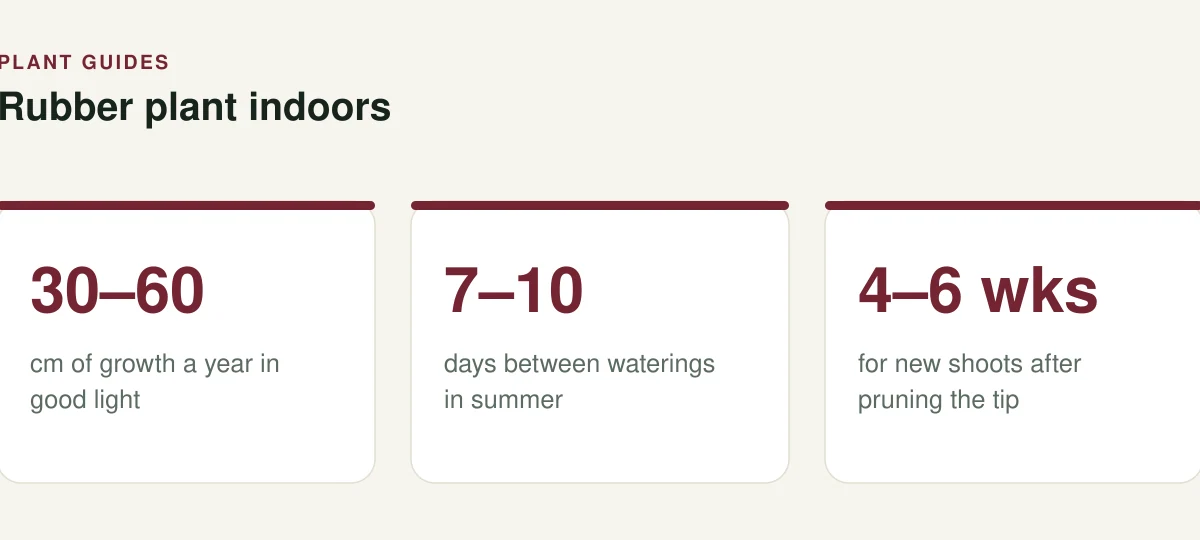
Ficus elastica care indoors: light, watering, why leaves drop, how to make it branch instead of growing into a single pole, and whether it can live outside.
Spider Plant Indoor Care: Brown Tips, Babies and Why It's the Best Beginner Plant
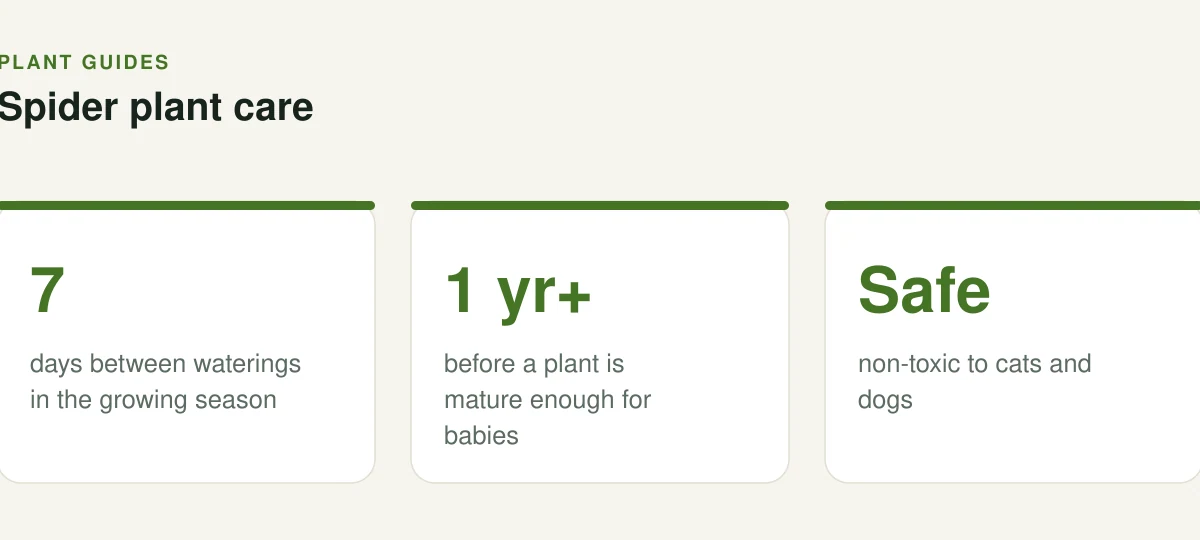
How to grow a spider plant indoors, why the leaf tips go brown, how to root the plantlets, and how to get an established plant to produce babies.
Monstera Indoor Plant Care: Light, Water and Getting the Splits
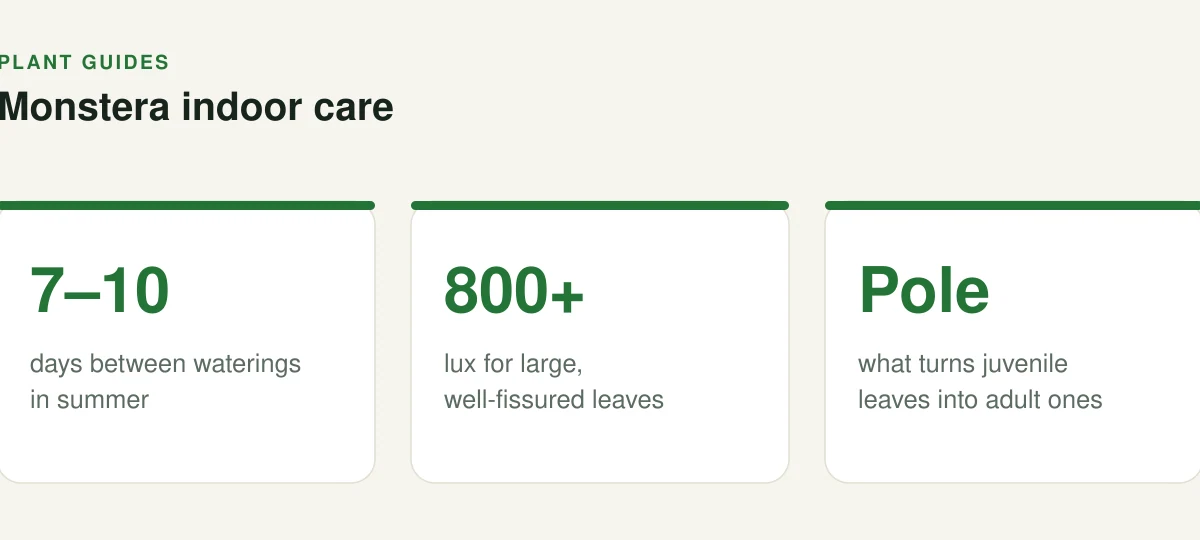
Complete monstera deliciosa care indoors — how much light it needs, watering intervals, why leaves have no holes, and how to make it climb instead of sprawl.