20 Pet Safe Indoor Plants (and the Popular Ones to Avoid)
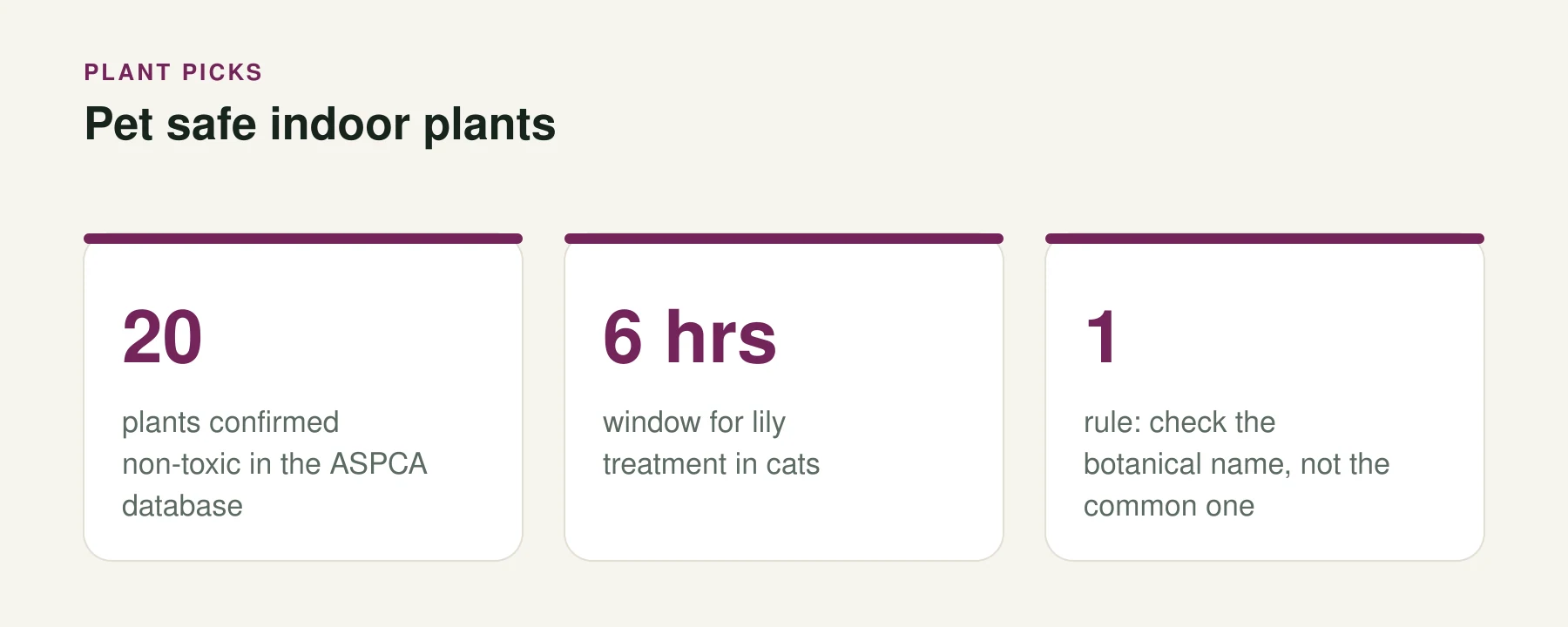
Verified against the ASPCA toxic plant database: 20 houseplants that are non-toxic to cats and dogs, plus the common favourites that genuinely are not.
The short answer
- Spider plant, parlour palm, calathea, peperomia, Boston fern and orchids are non-toxic to cats and dogs.
- Pothos, philodendron, monstera, peace lily, ZZ and snake plant all cause painful mouth irritation if chewed.
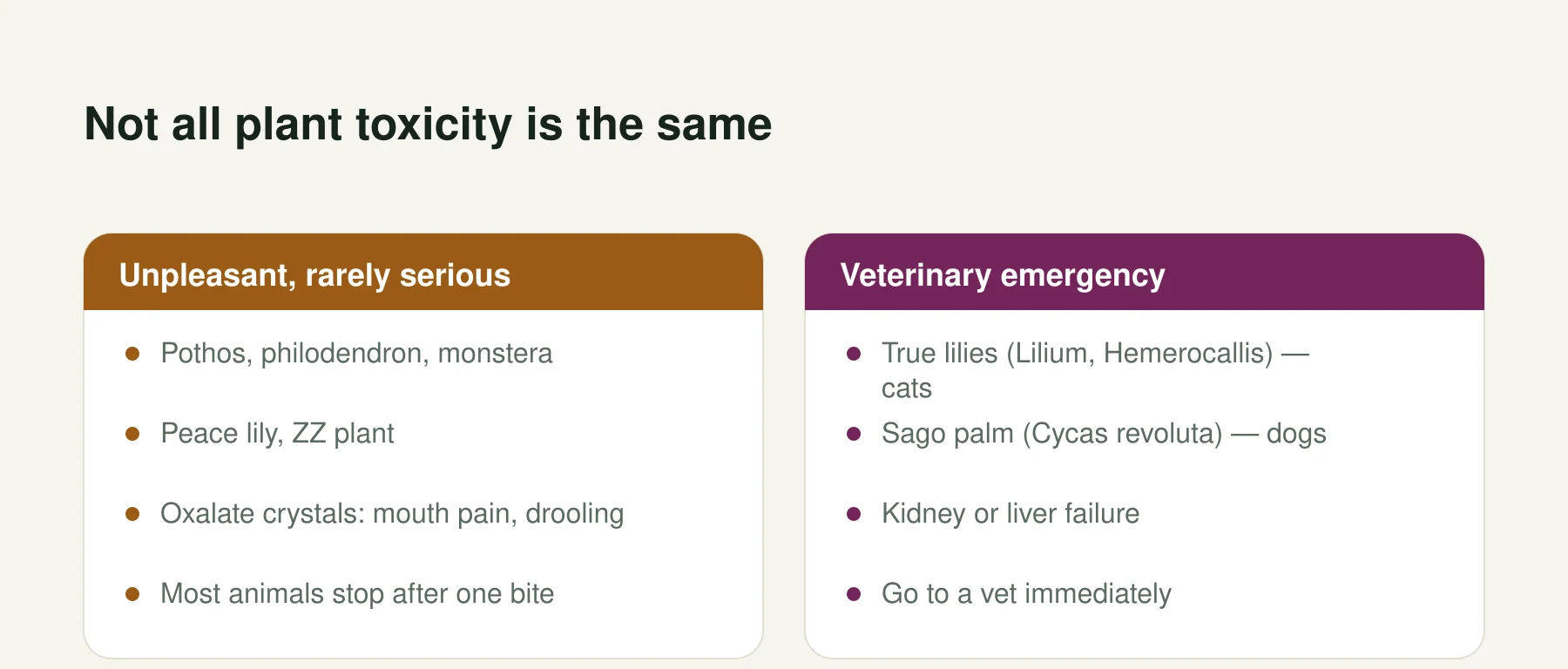
- True lilies and the sago palm are genuine emergencies — go straight to a vet.
Key takeaways
- 'Non-toxic' means no poisoning risk, not that eating a lot of it causes no upset stomach at all.
- Most houseplant poisonings in cats involve calcium oxalate crystals, which cause painful oral irritation rather than systemic harm.
- True lilies (Lilium and Hemerocallis) are the genuine emergency — they cause acute kidney failure in cats from tiny exposures.
- Check any plant by its botanical name, not its common name, since several unrelated plants share names.
Plant toxicity lists online are copied from each other and frequently wrong, mostly because common names are ambiguous — half a dozen unrelated species are sold as 'palm', and only some are safe. Every plant below has been checked against the ASPCA's toxic and non-toxic plant database under its botanical name. That is the reference vets use, and it is the one to trust.
#20 plants that are safe for cats and dogs
| Common name | Botanical name | Light | Difficulty |
|---|---|---|---|
| Spider plant | Chlorophytum comosum | Low to bright | Very easy |
| Parlour palm | Chamaedorea elegans | Low to moderate | Easy |
| Areca palm | Dypsis lutescens | Bright indirect | Moderate |
| Boston fern | Nephrolepis exaltata | Moderate indirect | Moderate |
| Bird's nest fern | Asplenium nidus | Low to moderate | Easy |
| Maidenhair fern | Adiantum raddianum | Moderate, no direct sun | Difficult |
| Calathea / prayer plant | Goeppertia and Maranta spp. | Moderate indirect | Moderate |
| Peperomia | Peperomia spp. | Moderate to bright | Easy |
| Cast iron plant | Aspidistra elatior | Low | Very easy |
| Money tree | Pachira aquatica | Bright indirect | Easy |
| Ponytail palm | Beaucarnea recurvata | Bright | Very easy |
| Moth orchid | Phalaenopsis spp. | Bright indirect | Moderate |
| African violet | Streptocarpus ionanthus | Bright indirect | Moderate |
| Christmas cactus | Schlumbergera | Bright indirect | Easy |
| Haworthia | Haworthiopsis spp. | Bright | Easy |
| Echeveria | Echeveria spp. | Direct sun | Easy |
| Burro's tail | Sedum morganianum | Bright | Easy |
| Polka dot plant | Hypoestes phyllostachya | Bright indirect | Easy |
| Baby rubber plant | Peperomia obtusifolia | Moderate to bright | Very easy |
| Friendship plant | Pilea involucrata | Moderate indirect | Easy |
#Popular houseplants that are toxic
| Plant | Toxic principle | Typical effect |
|---|---|---|
| Pothos, philodendron, monstera | Insoluble calcium oxalate | Intense oral pain, drooling, swelling, vomiting |
| Peace lily (Spathiphyllum) | Insoluble calcium oxalate | Oral irritation, drooling, difficulty swallowing |
| ZZ plant (Zamioculcas) | Insoluble calcium oxalate | Oral irritation, stomach upset |
| Snake plant (Dracaena trifasciata) | Saponins | Nausea, vomiting, diarrhoea |
| Dieffenbachia | Calcium oxalate + proteolytic enzyme | Severe oral swelling; airway risk in small animals |
| Dracaena, corn plant | Saponins | Vomiting (sometimes with blood in cats), dilated pupils |
| Aloe vera | Anthraquinone glycosides | Vomiting, lethargy, diarrhoea |
| Sago palm (Cycas revoluta) | Cycasin | Liver failure — often fatal, veterinary emergency |
| True lilies (Lilium, Hemerocallis) | Unidentified nephrotoxin | Acute kidney failure in cats — emergency |
The oxalate group — which covers most of the popular aroids — sounds alarming but is rarely dangerous. The crystals are needle-shaped and embed in the mouth on the first bite, which hurts immediately and stops most animals from eating any more. Serious cases are uncommon; distressing ones are not.
#If your pet eats a plant
- Take the plant away and rinse the animal's mouth gently with water if it will tolerate it.
- Identify the plant by botanical name — photograph the label or the plant itself.
- Call your vet, or an animal poison line, and describe the plant, the amount and the time.
- Do not induce vomiting unless a vet instructs you to. With oxalate plants it forces the crystals back through already-irritated tissue.
- Watch for drooling, pawing at the mouth, vomiting, lethargy or loss of appetite over the following 24 hours.
#Checking a plant before you buy it, step by step
Find the botanical name on the label
Not the common name. 'Palm' covers both the harmless parlour palm and the sago palm, which causes liver failure in dogs.
Search that exact name in the ASPCA database
It is the reference vets use, and it covers cats, dogs and horses separately. A search takes about ten seconds on your phone in the shop.
Photograph the label
Nursery labels get lost or fade within months. A photo means you can identify the plant later if an animal ever chews it.
Decide the position before you pay
If it is toxic, know now whether you have a hook or a high shelf genuinely out of a cat's jumping range. Buying first and improvising later rarely works.
Keep the vet's number where you can find it
Along with an animal poison line. For lilies and sago palm, the first hours matter more than anything else you do.
#Living with plants and a determined cat
- Give the cat its own grass. A pot of cat grass (oat or wheat) redirects most chewing away from your other plants.
- Use height selectively. It stops dogs and some cats; an athletic cat treats a high shelf as a destination.
- Hang the toxic ones. Pothos and philodendron are ideal trailing plants for ceiling hooks well away from furniture.
- Cover the soil with large pebbles. It deters digging and litter-box use, and reduces fungus gnats as a bonus.
- Skip repellent sprays on foliage. Most are ineffective, and citrus oils are themselves irritating to cats.
If you have a chewer, build the collection from the safe list and treat the toxic favourites as hanging or high-shelf plants. That combination is what actually works long term — not hoping the cat loses interest, which in my experience it never does. Our hanging plants guide covers which trailing species are safe and how high is high enough.
Frequently asked questions
Are pothos toxic to cats?
Yes. Pothos (Epipremnum aureum) contains insoluble calcium oxalate crystals that cause immediate oral pain, drooling and swelling if chewed. It is rarely life-threatening but is genuinely painful, so keep it hanging or out of reach.
What is the safest indoor plant for cats?
The spider plant (Chlorophytum comosum) is non-toxic, extremely tough and tolerant of most light levels. Cats are often attracted to it, which is harmless — though it can cause mild stomach upset if a cat eats a large amount.
Is a snake plant poisonous to dogs?
Mildly. Snake plants contain saponins, which cause nausea, vomiting and diarrhoea if eaten. It is not considered dangerous, but it is not a pet-safe choice for a dog that chews.
Which houseplant is most dangerous to pets?
The sago palm (Cycas revoluta) for dogs, causing liver failure that is frequently fatal, and true lilies (Lilium and Hemerocallis) for cats, causing acute kidney failure from very small exposures. Both are veterinary emergencies.
How do I know if a plant is safe before I buy it?
Look up its botanical name — not its common name — in the ASPCA toxic and non-toxic plant database. Common names are shared between unrelated species, which is how sago palms end up in homes labelled simply as palms.
Sources and further reading
- Toxic and Non-Toxic Plants List — ASPCA Animal Poison Control. Toxicity status of every plant named, checked under its botanical name.
- Sago Palm poisoning in dogs — Pet Poison Helpline. Severity and symptoms of sago palm ingestion.
- North Carolina Extension Gardener Plant Toolbox — NC State Extension. Species data, hardiness and toxicity cross-checks.
- Plant Finder — Missouri Botanical Garden. Botanical names, native range and cultural requirements.
Related guides
Indoor Palm Plants: 8 Types That Thrive Indoors (and 3 That Won't)
Areca, kentia, parlour and majesty palms all look similar in the shop and behave completely differently at home. Here is which indoor palm to buy and how to keep it green.
Indoor Hanging Plants: 15 Trailing and Climbing Plants That Thrive
The best indoor hanging plants for baskets, shelves and ceiling hooks — including which cope with the hot, dry air that collects near a ceiling.
Big Leaf Indoor Plants: 14 Large-Leaved Plants for Real Impact
Fourteen big leaf indoor plants — from monstera and elephant ear to banana and rubber plants — with the light, space and pot size each one needs to get large indoors.