Money Plant Indoor Care: Water, Light, Vastu and Growing It in a Bottle
How to grow a money plant indoors — in soil or water — plus where vastu says to place it, why leaves turn yellow, and how to make a leggy vine bushy again.
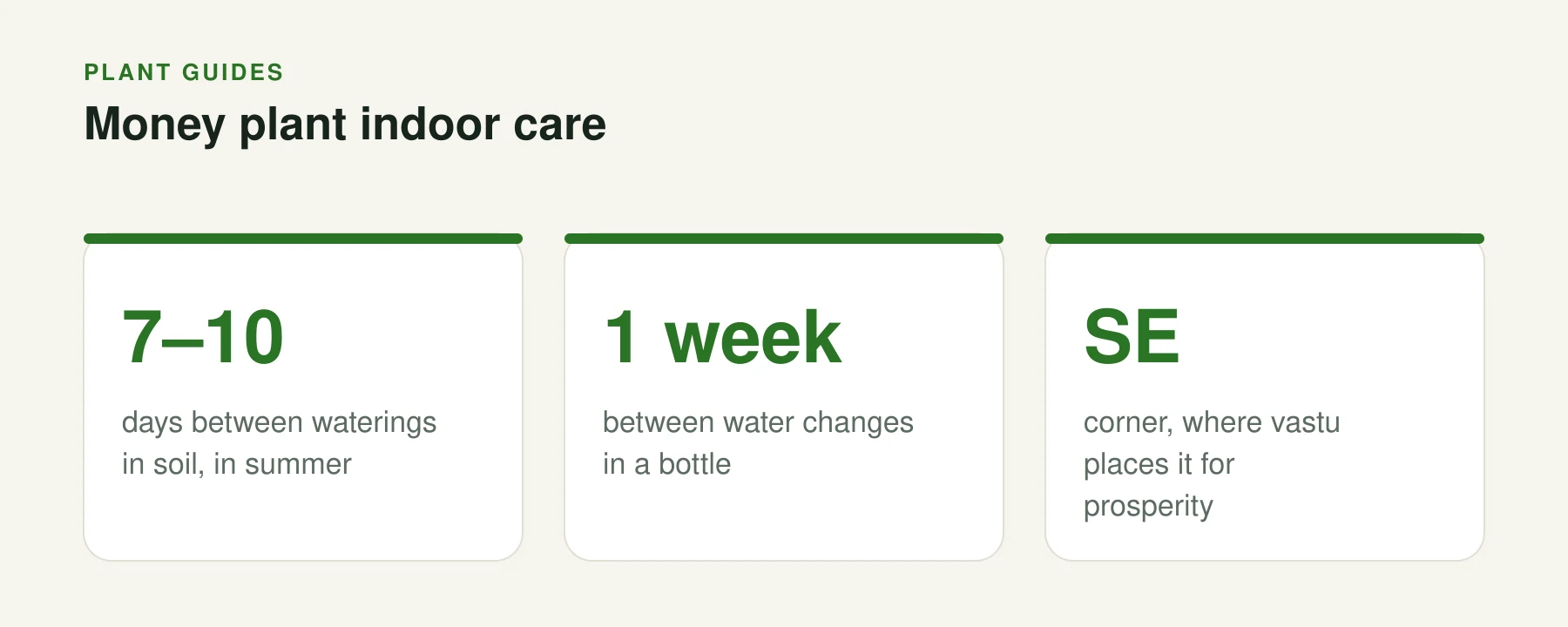
The short answer
- Money plant is an indoor plant — direct outdoor sun scorches its leaves within days.
- Grow it in soil, watering every 7–10 days, or permanently in a bottle of water changed weekly.
- Long bare vines mean too little light, not too little water.
Key takeaways
- Money plant is indoor by preference — direct outdoor sun scorches its leaves within days.
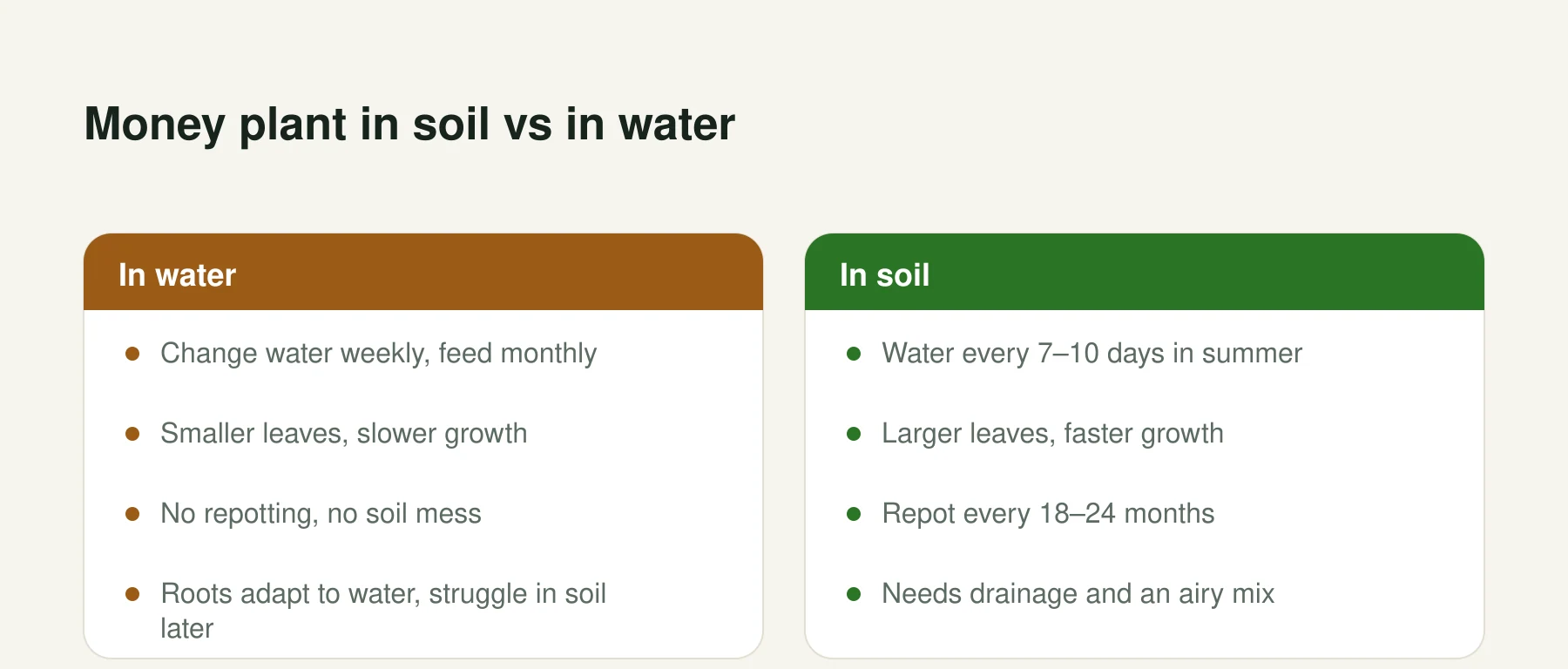
- It grows equally well in soil or in a bottle of plain water; the water version simply grows smaller leaves.
- Long bare vines mean too little light, not too little water.
- Every cutting with a node roots, which makes it the cheapest way to fill a home with greenery.
The money plant — Epipremnum aureum, sold elsewhere as pothos or devil's ivy — is the most widely grown indoor plant in the world for good reasons: it tolerates low light, forgives missed waterings, roots from any cutting, and grows in a bottle of tap water if you cannot be bothered with soil.
#Is the money plant indoor or outdoor?
Indoor, in nearly every home. In the wild it is a rainforest climber growing up tree trunks in filtered shade, and that is exactly what a bright indoor room reproduces. Placed in direct outdoor sun, the leaves bleach and scorch within days. It can live outdoors year-round only in a shaded, frost-free, humid position — and even then it grows so vigorously that in several countries it is classed as an invasive weed.
#Light
| Light level | What happens |
|---|---|
| Low light (under 250 lux) | Survives well; slow growth, leaves stay small, variegation fades |
| Bright indirect (500–2,000 lux) | The sweet spot — fast growth, large leaves, strong variegation |
| Direct sun through glass | Pale, bleached patches; leaf edges scorch |
| Outdoor full sun | Rapid burn, usually within a week |
Golden and marbled varieties need more light than the plain green form to keep their pattern. In a dim corner they slowly revert to green — the plant sacrificing decoration for chlorophyll.
#Watering a money plant
- In soil: water when the top 5 cm is dry, roughly every 7–10 days in summer and every 14–18 days in winter.
- Water thoroughly until it runs from the drainage hole, then empty the saucer.
- Yellow lower leaves with damp soil means overwatering — the most common problem by far.
- Limp leaves with dry, shrunken soil means it is thirsty; it recovers within hours of a proper soak.
- In winter, roughly halve the frequency. Less light means less water use, whatever the calendar says.
#Growing a money plant in water
Cut below a node
Take a vine section 15–20 cm long and cut 1–2 cm below a node — the small brown bump where a leaf joins the stem and an aerial root often protrudes. Only the node produces roots.
Strip submerged leaves
Remove any leaf that would sit below the waterline. A submerged leaf rots, fouls the water, and takes the cutting with it.
Use a clear bottle
Fill with room-temperature tap water so the nodes are covered and the leaves are not. A clear glass bottle lets you watch the roots and spot cloudy water early.
Change the water weekly
Fresh water carries dissolved oxygen, which roots need. This is the step people skip and the reason bottle-grown money plants stall.
Feed monthly
Add two or three drops of liquid fertiliser at quarter strength once a month. Plain water contains almost no nutrients, so a permanent water plant slowly starves without it.
#Making a leggy money plant bushy
Long bare vines with leaves only at the ends are the plant stretching toward light. Two fixes, used together: move it somewhere brighter, then prune. Cut each long vine back to within 15 cm of the pot, just above a node. The plant branches at the cut, and the pieces you removed root in water within a fortnight and can go straight back into the same pot to thicken it. Four or five cuttings sharing one pot is exactly how nurseries produce those full, dense plants — there is no special variety involved. Our water propagation guide covers the method.
#Money plant and vastu
In vastu shastra the money plant is associated with prosperity and is usually placed in the south-east corner of a room — the direction linked to Venus and wealth — and specifically not in the north-east, which is reserved for open, uncluttered space. It is commonly kept indoors, often near an entrance or in the living room, and traditionally should not be allowed to trail along the floor.
Horticulturally, a south-east position in the northern hemisphere gets gentle morning light, which suits this plant well, so the tradition and the plant agree here. Where they conflict — a dark corner chosen for auspicious reasons — the plant loses. See our vastu plant guide for the full direction-by-direction breakdown.
#Common problems
| Problem | Cause | Fix |
|---|---|---|
| Yellow leaves, soil damp | Overwatering | Let the top 5 cm dry fully before watering again |
| Brown crispy edges | Dry air or fertiliser salts | Raise humidity; flush the pot with plain water |
| Long vines, few leaves | Not enough light | Move brighter and prune back to force branching |
| Variegation fading to green | Too little light | Move within a metre of a window |
| Black stems at soil level | Root rot | Cut back to firm tissue, repot in fresh airy mix |
| Small flies around the pot | Fungus gnats in constantly damp soil | Let the top layer dry; treat with BTI |
Frequently asked questions
Is money plant an indoor plant?
Yes. The money plant is a shade-tolerant rainforest climber and grows best indoors in bright indirect light. Outdoors it scorches in direct sun and, in warm climates, spreads aggressively.
Can a money plant grow in water permanently?
Yes, indefinitely. Change the water weekly, keep the nodes submerged and the leaves above the surface, and add a few drops of dilute liquid fertiliser monthly. Growth is slower and leaves stay smaller than in soil.
Where should a money plant be placed as per vastu?
Vastu shastra places the money plant in the south-east corner of a room, associated with prosperity, and avoids the north-east. It should be kept indoors, ideally trailing upward rather than along the floor.
Why are my money plant leaves turning yellow?
Overwatering, in most cases. Check whether the soil is still damp several days after watering, and whether the lowest leaves are the ones yellowing. Less common causes are insufficient light and, on old plants, exhausted soil.
How do I make my money plant grow faster and bushier?
Give it brighter indirect light, prune every long vine back to within 15 cm of the pot just above a node, and replant the rooted cuttings into the same pot. Feed at half strength every two to three weeks through spring and summer.
Sources and further reading
- Houseplants: plant profiles — Royal Horticultural Society. Species-level profiles and cultivation notes.
- Plant Finder — Missouri Botanical Garden. Botanical names, native range and cultural requirements.
- North Carolina Extension Gardener Plant Toolbox — NC State Extension. Species data, hardiness and toxicity cross-checks.
- Toxic and Non-Toxic Plants List — ASPCA Animal Poison Control. Toxicity status of every plant named, checked under its botanical name.
Related guides
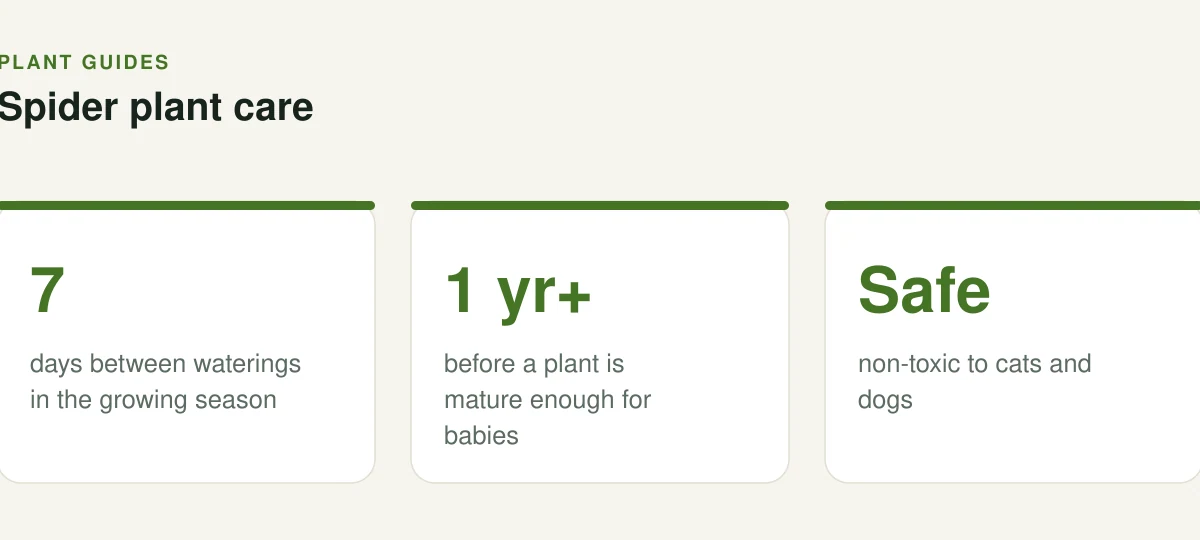
Spider Plant Indoor Care: Brown Tips, Babies and Why It's the Best Beginner Plant
How to grow a spider plant indoors, why the leaf tips go brown, how to root the plantlets, and how to get an established plant to produce babies.
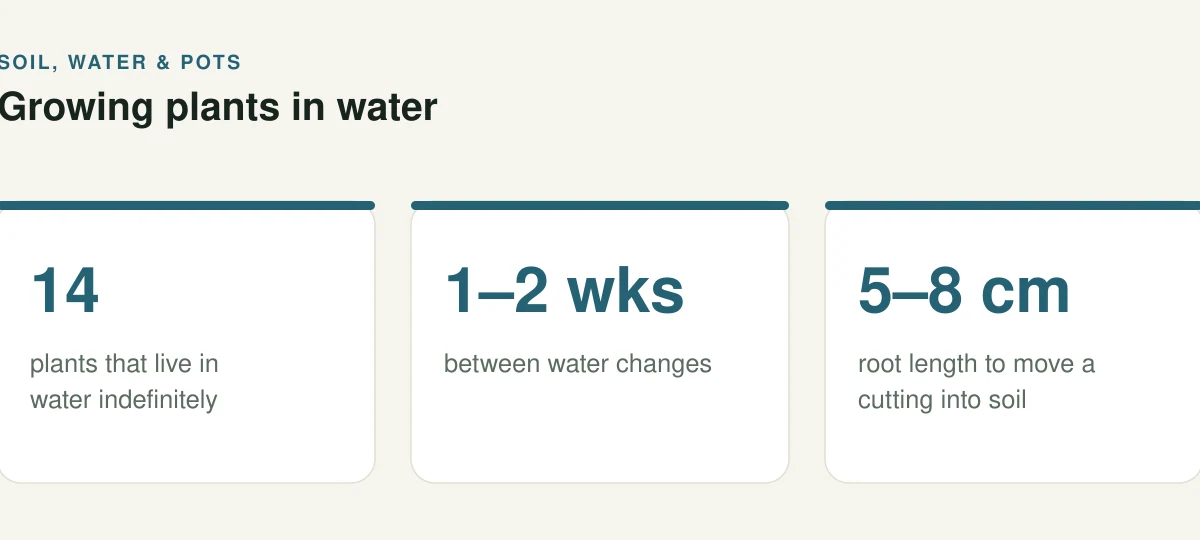
Indoor Water Plants: 14 That Grow in Water Without Any Soil
Which indoor plants grow permanently in water, how to set up a bottle or vase properly, and the feeding and water-change routine that stops them stalling.
Rubber Plant Indoor Care and Benefits (Indoor or Outdoor?)
Ficus elastica care indoors: light, watering, why leaves drop, how to make it branch instead of growing into a single pole, and whether it can live outside.