Grow Lights for Indoor Plants: What to Buy and How to Use One
How to choose a grow light for houseplants — wattage, spectrum, distance and run time — and why an ordinary full-spectrum LED bulb is usually enough.
The short answer
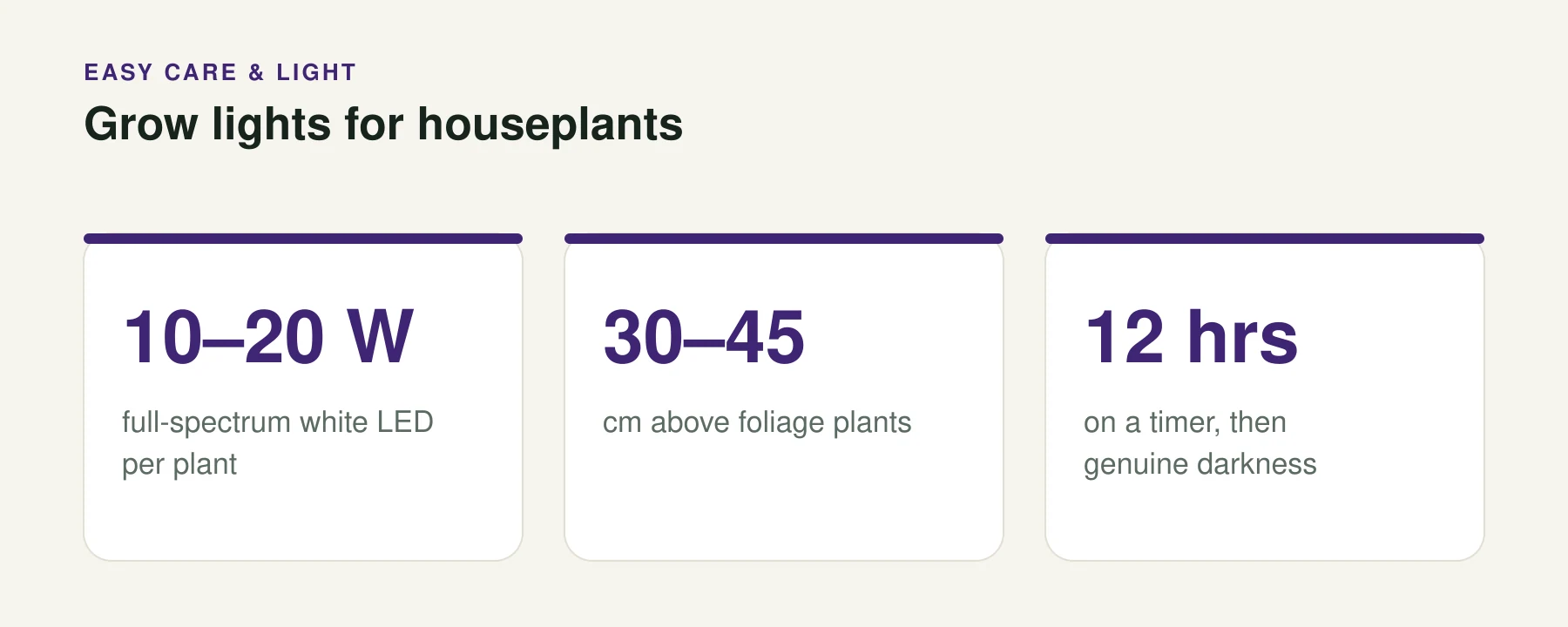
- A 10–20 W full-spectrum white LED bulb in a normal lamp is enough for houseplants.
- Hang it 30–45 cm above the plant and run it 12 hours a day on a timer.
- Skip the purple panels — they are for commercial growing and make a room unpleasant to sit in.
Key takeaways
- White full-spectrum LEDs work as well as purple ones for foliage plants and look far better in a home.
- Distance matters more than wattage — light intensity falls off with the square of the distance.
- Twelve hours on, twelve hours off. Plants need genuine darkness to respire and to set buds.
- A plant under a grow light grows year-round, so keep feeding and watering it through winter.
A grow light is the single purchase that most changes what is possible in a dark home. It turns a windowless corner into a real position, keeps plants growing through a dim winter, and lets you keep species that would otherwise slowly decline. It is also a category buried in unnecessary complexity — almost all of it written for growing vegetables and cannabis, not for keeping a monstera happy in a hallway. You need far less equipment than the internet suggests.
#What you actually need
| Specification | For houseplants | Why |
|---|---|---|
| Type | Full-spectrum white LED | Efficient, cool-running, and looks like normal light |
| Wattage | 10–20 W per plant | Enough for foliage plants; more is for fruiting crops |
| Colour temperature | 4000–6500 K | Balanced white light covering the useful range |
| Distance | 30–45 cm above the plant | Closer scorches; further and intensity drops sharply |
| Run time | 10–14 hours daily | Twelve is a safe default for almost everything |
| Fitting | Standard E27 bulb in a lamp | Cheapest and least obtrusive option |
#Positioning
Light intensity falls off with the square of the distance, which means a bulb at 60 cm delivers roughly a quarter of the light of the same bulb at 30 cm. This is the single most important variable and the one people get wrong — a powerful light mounted too far away does very little.
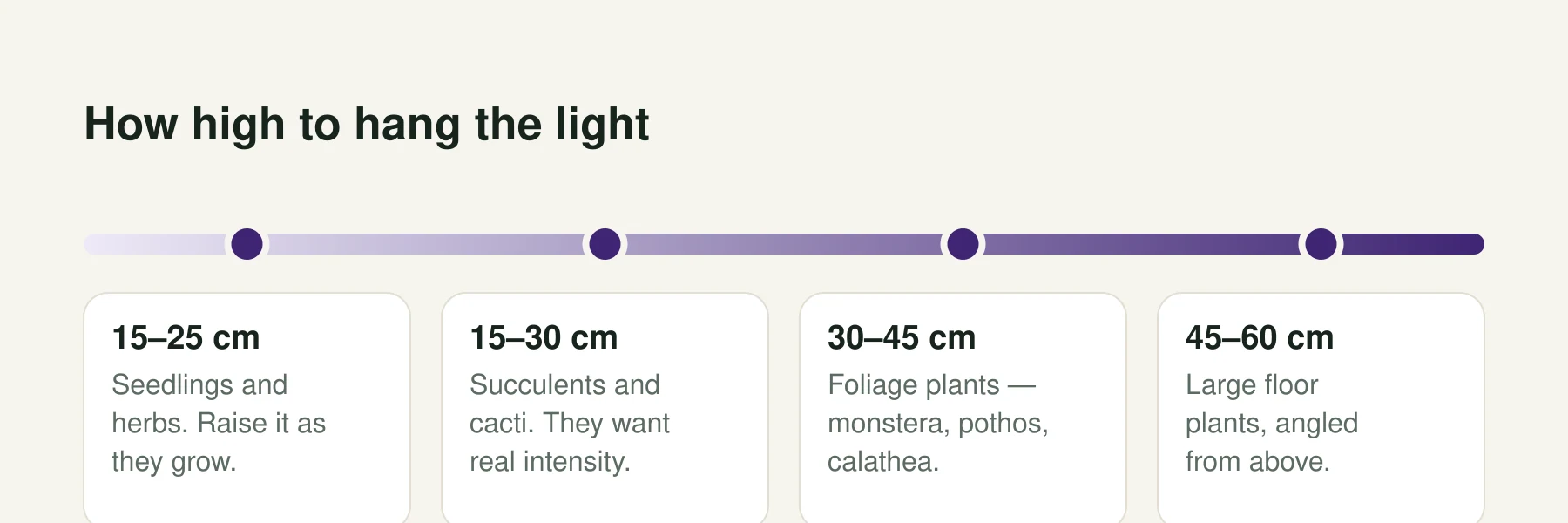
- Foliage plants (pothos, monstera, calathea): 30–45 cm above the top leaves.
- Succulents and cacti: 15–30 cm — they want far more intensity than foliage plants.
- Seedlings and herbs: 15–25 cm, raised as they grow.
- Large floor plants: a clip-on or floor lamp angled from above at 45–60 cm, or several bulbs.
- Check for scorching in the first week — pale, bleached patches on the leaves nearest the bulb mean move it up.
#How long to run it
Use a plug timer
Consistency matters more than exact hours, and nobody remembers reliably. A basic mechanical or smart plug timer costs very little and removes the decision.
Twelve hours on, twelve off
This suits nearly all foliage houseplants. Sixteen hours suits seedlings and herbs; succulents do well on ten to twelve.
Give real darkness
Plants respire at night and many set flower buds in response to night length. Running a light 24 hours a day does not double growth — it stresses the plant and prevents flowering in species such as Christmas cactus and poinsettia.
Match the season if you prefer
Some growers shorten to eight or ten hours in winter to give plants a natural rest. This is optional for foliage plants.
Run it during the day
Not because plants care, but because you will see the room lit normally rather than glowing at midnight.
#Care changes under a grow light
A plant under supplementary light is actively growing, including in December, and that changes its needs. Expect it to use more water — check more often, especially in winter when you would normally cut back. Keep feeding at half strength every two to three weeks year-round rather than stopping in autumn. And watch for the increase in growth rate to bring repotting forward: a plant that would have been repotted every two years may need it annually.
#Choosing between the formats
| Format | Best for | Cost | Drawback |
|---|---|---|---|
| E27 LED bulb in a lamp | One or two plants; the default choice | Low | Covers a small area |
| Clip-on gooseneck light | Desk plants, shelves, small groups | Low | Often underpowered; check wattage |
| LED strip under a shelf | Plant shelves and cabinets | Low–medium | Needs mounting and wiring |
| Panel light | A group of plants or a plant wall | Medium | Obtrusive in a living space |
| Track or spot lighting | Built-in, discreet whole-room solution | High | Requires installation |
One practical note for warm climates: LEDs run far cooler than the old fluorescent and HID lamps, but a panel close to foliage still adds heat and dries the soil faster than you expect. In a hot room, keep the light at the further end of the distance range and check watering more often. Our no-sunlight guide covers which plants to pair one with.
Frequently asked questions
Do indoor plants really need grow lights?
Only if the natural light is insufficient. Plants in bright rooms do not need them. For windowless rooms, dark corners and dim winters, a grow light is the only way to provide the energy a plant needs to grow rather than merely survive.
How far should a grow light be from plants?
About 30–45 cm above foliage plants, 15–30 cm for succulents and cacti, and 15–25 cm for seedlings. Intensity falls off with the square of the distance, so a light mounted too far away does very little.
How many hours a day should a grow light be on?
Twelve hours is a safe default for foliage houseplants, with sixteen for seedlings and herbs. Plants need genuine darkness to respire and to set flower buds, so never run a grow light continuously.
Are purple grow lights better than white ones?
Not for houseplants. Purple lights are more efficient per watt for commercial growing, but white full-spectrum LEDs provide everything foliage plants need, let you see the true colour of your plants, and are far pleasanter to live with.
Can a normal LED bulb work as a grow light?
A standard household LED provides some usable light but is usually too dim and too narrow in spectrum to drive real growth. A full-spectrum LED bulb rated 10–20 W costs little more and works properly in an ordinary lamp fitting.
Sources and further reading
- Growing plants with LEDs indoors — Michigan State University Extension. LED spectrum, intensity and duration for indoor growing.
- Houseplants — Royal Horticultural Society. General indoor growing guidance, light and watering advice.
- Plant Finder — Missouri Botanical Garden. Botanical names, native range and cultural requirements.
- North Carolina Extension Gardener Plant Toolbox — NC State Extension. Species data, hardiness and toxicity cross-checks.
Related guides
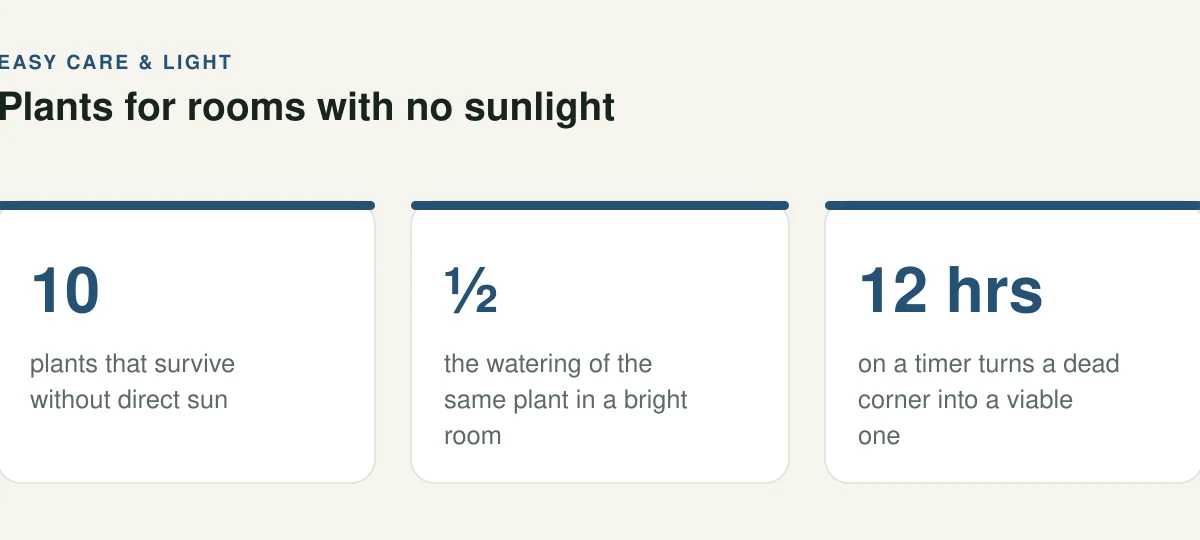
Indoor Plants That Need No Sunlight: 10 for Rooms With No Windows
No plant grows in true darkness — but these 10 survive on ambient and artificial light alone, in windowless bathrooms, hallways and interior rooms.
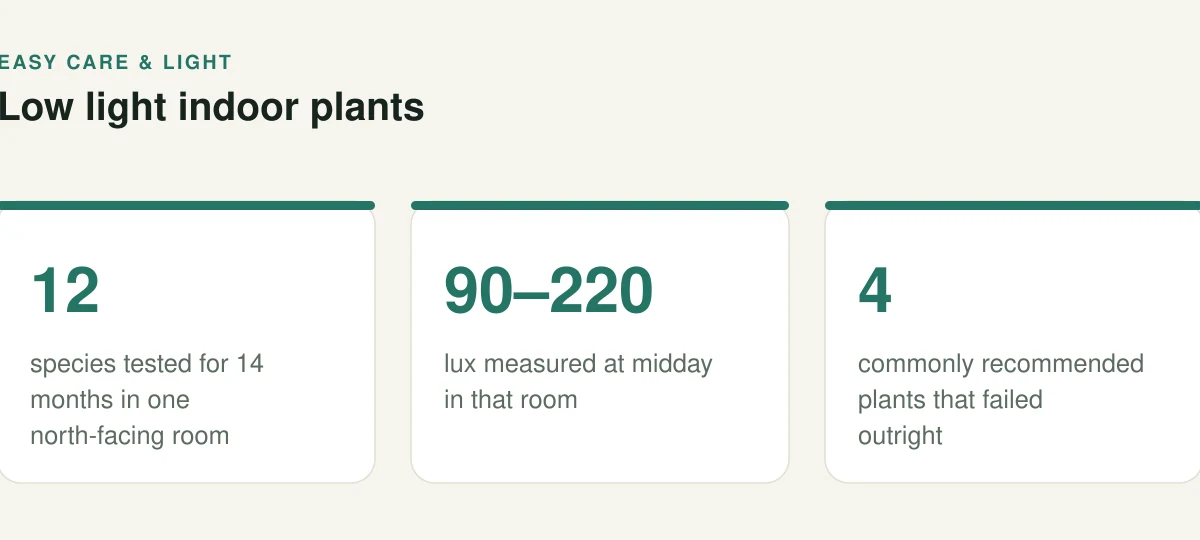
Low Light Indoor Plants: 12 That Genuinely Survive a Dark Room
North-facing room? These 12 houseplants genuinely tolerate low light — with the light levels each one needs, in lux, and honest notes on what they will not do.
Peace Lily Indoor Plant: Benefits, Care and Why It Stops Flowering
What a peace lily actually does for your home, how to care for one indoors, and the reasons it wilts, browns or refuses to flower — with fixes for each.