Indoor Plants That Need No Sunlight: 10 for Rooms With No Windows
No plant grows in true darkness — but these 10 survive on ambient and artificial light alone, in windowless bathrooms, hallways and interior rooms.
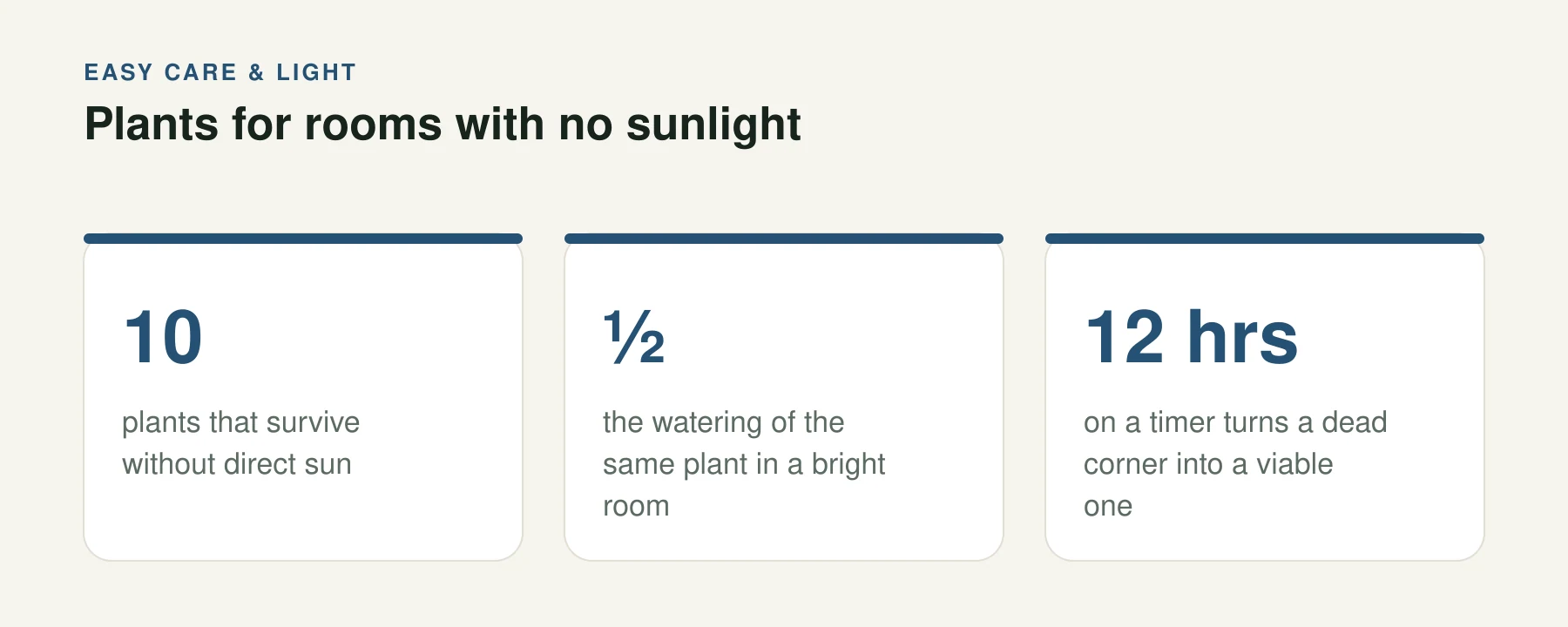
The short answer
- No plant grows in true darkness — 'no sunlight' means no direct sun, not no light at all.
- ZZ plant, cast iron plant, snake plant, pothos and lucky bamboo survive on ambient or artificial light.
- Halve your watering in a dark room; overwatering is what actually kills plants there.
Key takeaways
- 'No sunlight' means no direct sun — not no light. Every plant needs some light to survive.
- Ordinary room lighting counts, but only if it is on for 10–12 hours a day.
- Plants in dark rooms need dramatically less water; overwatering is what actually kills them.
- Rotating two plants between a dark room and a bright one every few weeks works well.
Let me be precise about the question first, because the honest answer matters more here than a longer list would. No plant grows without light at all — photosynthesis is how a plant makes its food, and light is the energy input. What people actually mean by 'needs no sunlight' is a plant that survives without direct sun: on ambient daylight from a north window, on borrowed light from a hallway, or on room lighting alone. That is a real and genuinely useful category, and these are the plants in it.
#10 plants for rooms with no direct sun
| Plant | Minimum light | Water | Notes |
|---|---|---|---|
| ZZ plant | Very low — ambient only | Every 4–6 weeks | The most shade-tolerant plant sold |
| Cast iron plant | Very low | Every 2–3 weeks | Named for exactly this |
| Snake plant | Low | Every 3–5 weeks | Holds its shape indefinitely |
| Pothos / money plant | Low | Every 10–14 days | Green forms only; variegated ones fade |
| Lucky bamboo | Low | Water change weekly | Grows in a vase; ideal for a dark shelf |
| Parlour palm | Low | Every 7–10 days | Non-toxic; the best pet-safe option |
| Philodendron | Low | Every 10–14 days | Faster than pothos in shade |
| Aglaonema (dark green cultivars) | Low | Every 10–14 days | Pink and red forms need more light |
| Dracaena 'Janet Craig' | Low | Every 2 weeks | Floor-standing height for a dim corner |
| Peace lily | Low-moderate | Every 5–7 days | Foliage only below about 150 lux |
#Does artificial light count?
Yes. Plants use light in the roughly 400–700 nm range, and ordinary LED and fluorescent bulbs emit within it. The issue is intensity and duration. A room lit to 200–300 lux for twelve hours a day genuinely supports the plants above; the same room lit for two hours in the evening does not. If the light is on during working hours, a windowless office corner is more viable than a windowless spare room nobody enters.
#Caring for plants in the dark
The most important adjustment is watering. A plant in low light transpires far less, so the soil stays wet much longer — and nearly every plant that dies in a dark corner is drowned rather than starved. Halve your normal frequency and always check the soil before watering.
- Water half as often, and check the top 5 cm with a finger every time.
- Feed a quarter strength, monthly in summer only. A plant that is barely growing cannot use fertiliser, and the unused salts accumulate.
- Dust the leaves monthly. Dust can cut the light reaching a leaf by 20–30%, which matters most where there is least.
- Skip repotting unless the plant is badly root-bound. A larger volume of fresh soil stays wet longer, which is the last thing a shaded plant needs.
- Rotate a quarter turn weekly if any light is directional.
- Do not expect growth. A healthy plant in low light holds its condition. One or two new leaves a year is a good result.
#The rotation method
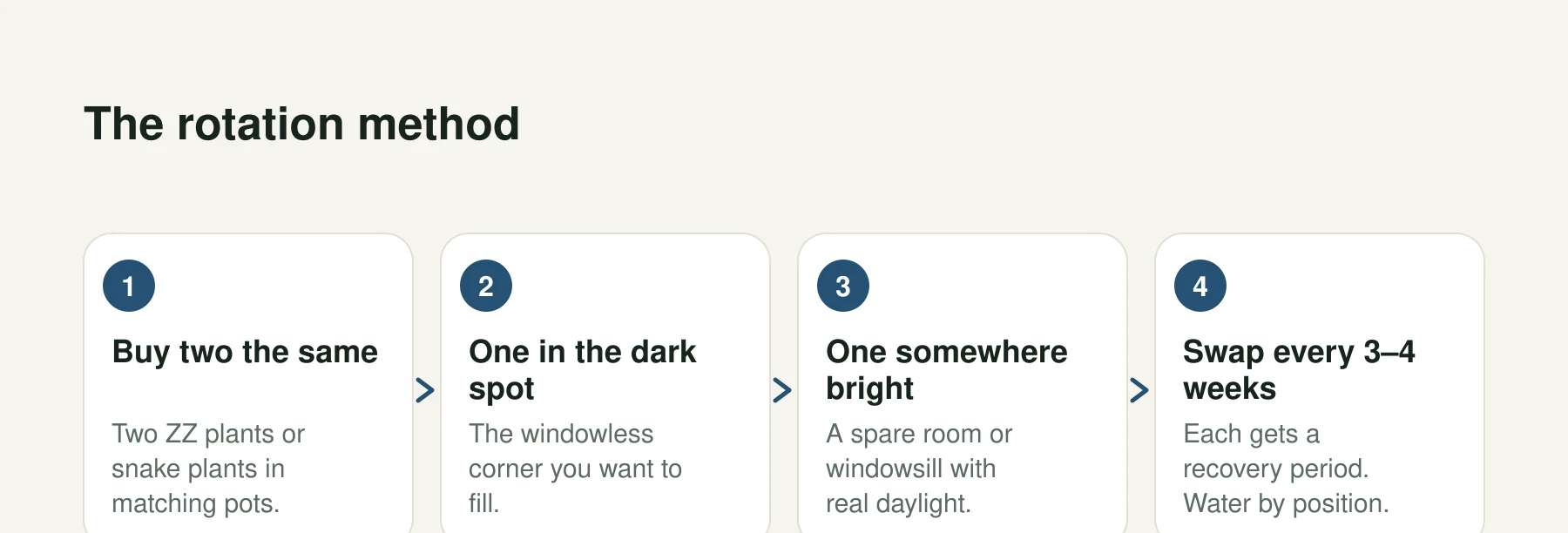
Buy two identical plants
Two ZZ plants, two snake plants, or two pothos in matching pots.
Put one in the dark room
The windowless bathroom, hallway or interior corner you want to fill.
Keep the other somewhere bright
A spare room, a windowsill, anywhere with real daylight.
Swap them every three to four weeks
Each plant gets a recovery period in good light, and the dark spot always has a healthy plant in it.
Water according to where each one is
The plant in the bright room drinks noticeably more. Check each in its current position rather than watering both on the same schedule.
#Flowering plants without sunlight
This is where the honest answer is least satisfying. Flowering costs a plant far more energy than producing leaves, so no plant blooms reliably in a genuinely dark room. The peace lily and anthurium come closest, flowering in low-to-moderate indirect light — but below about 150 lux both produce foliage only. If you want flowers in a windowless room, a grow light is the only real solution.
Frequently asked questions
Which indoor plants need no sunlight at all?
No plant survives in complete darkness, but the ZZ plant and cast iron plant come closest, holding condition on ambient or artificial light alone. Snake plant, pothos, lucky bamboo and parlour palm are close behind.
Can plants grow with artificial light only?
Yes. Ordinary LED and fluorescent bulbs emit usable light, but intensity and duration matter — the light needs to be on for ten to twelve hours a day. A dedicated full-spectrum LED bulb on a timer works far better than room lighting alone.
What plant can survive in a bathroom with no window?
The ZZ plant, cast iron plant or lucky bamboo. All three tolerate very low light, and the humidity of a bathroom suits them. If the bathroom light is only on briefly each day, rotate the plant to a brighter room every few weeks.
How often should I water plants in a dark room?
About half as often as the same plant in a bright room. Low light means low transpiration, so soil stays wet for much longer. Always check that the top 5 cm is dry before watering — overwatering is what kills most plants in dark corners.
Can flowering plants grow without sunlight?
Not reliably. Peace lilies and anthuriums flower in low to moderate indirect light, but below roughly 150 lux they produce leaves only. A full-spectrum grow light on a 12-hour timer is the only dependable way to get blooms in a windowless room.
Sources and further reading
- Houseplants — Royal Horticultural Society. General indoor growing guidance, light and watering advice.
- Growing plants with LEDs indoors — Michigan State University Extension. LED spectrum, intensity and duration for indoor growing.
- Plant Finder — Missouri Botanical Garden. Botanical names, native range and cultural requirements.
- Toxic and Non-Toxic Plants List — ASPCA Animal Poison Control. Toxicity status of every plant named, checked under its botanical name.
Related guides
Grow Lights for Indoor Plants: What to Buy and How to Use One
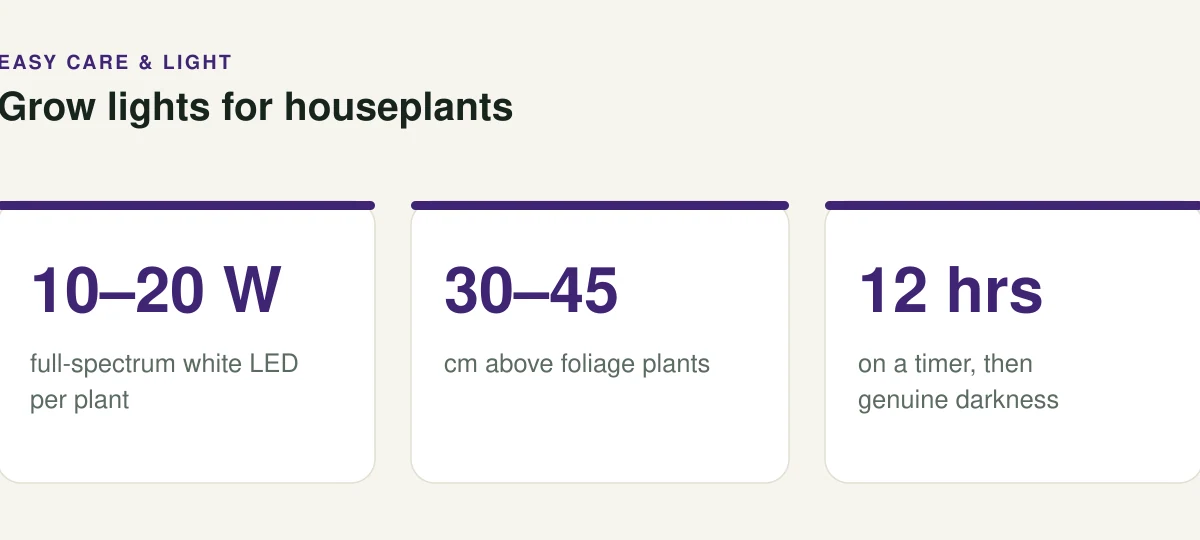
How to choose a grow light for houseplants — wattage, spectrum, distance and run time — and why an ordinary full-spectrum LED bulb is usually enough.
Low Light Indoor Plants: 12 That Genuinely Survive a Dark Room
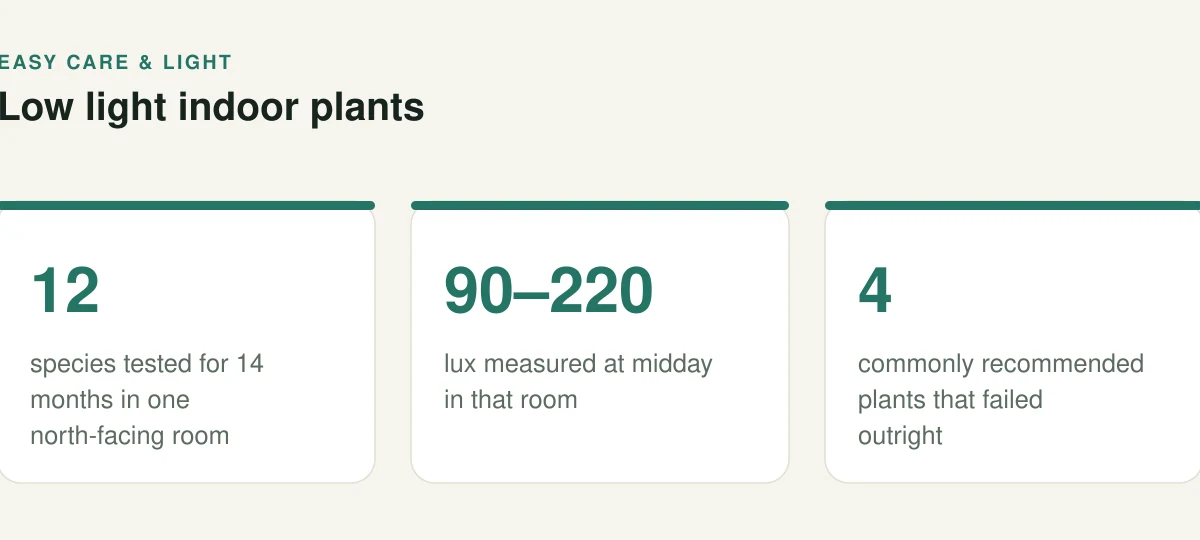
North-facing room? These 12 houseplants genuinely tolerate low light — with the light levels each one needs, in lux, and honest notes on what they will not do.
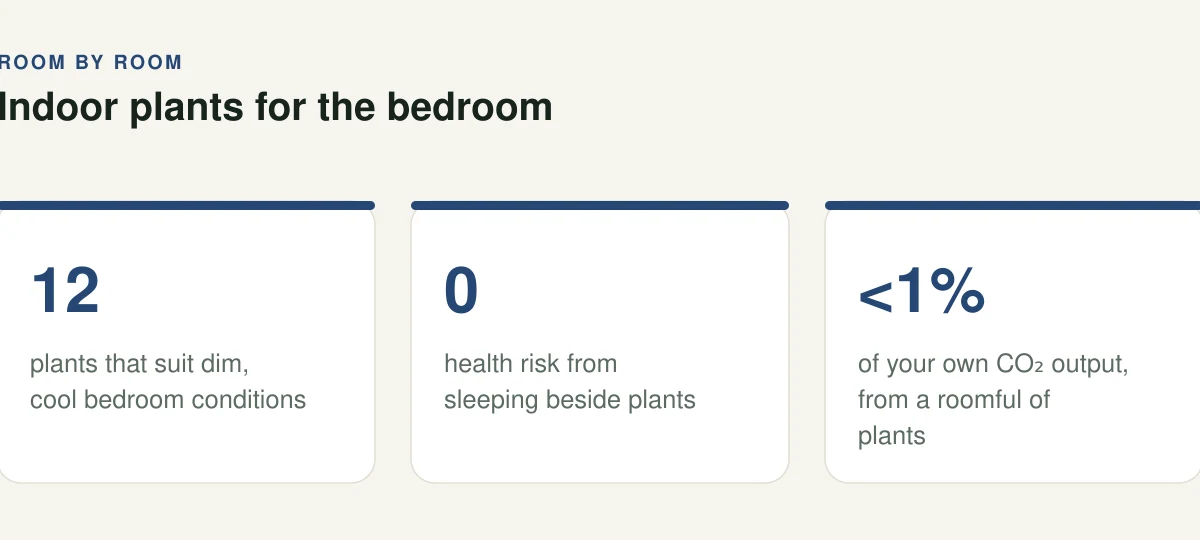
Indoor Plants for the Bedroom: 12 Best Picks (and the Sleep Myths Explained)
Bedrooms are dim, cool and often north-facing. These 12 indoor plants suit those conditions — plus an honest look at whether plants in a bedroom affect your sleep.