Indoor Hanging Plants: 15 Trailing and Climbing Plants That Thrive
The best indoor hanging plants for baskets, shelves and ceiling hooks — including which cope with the hot, dry air that collects near a ceiling.
The short answer
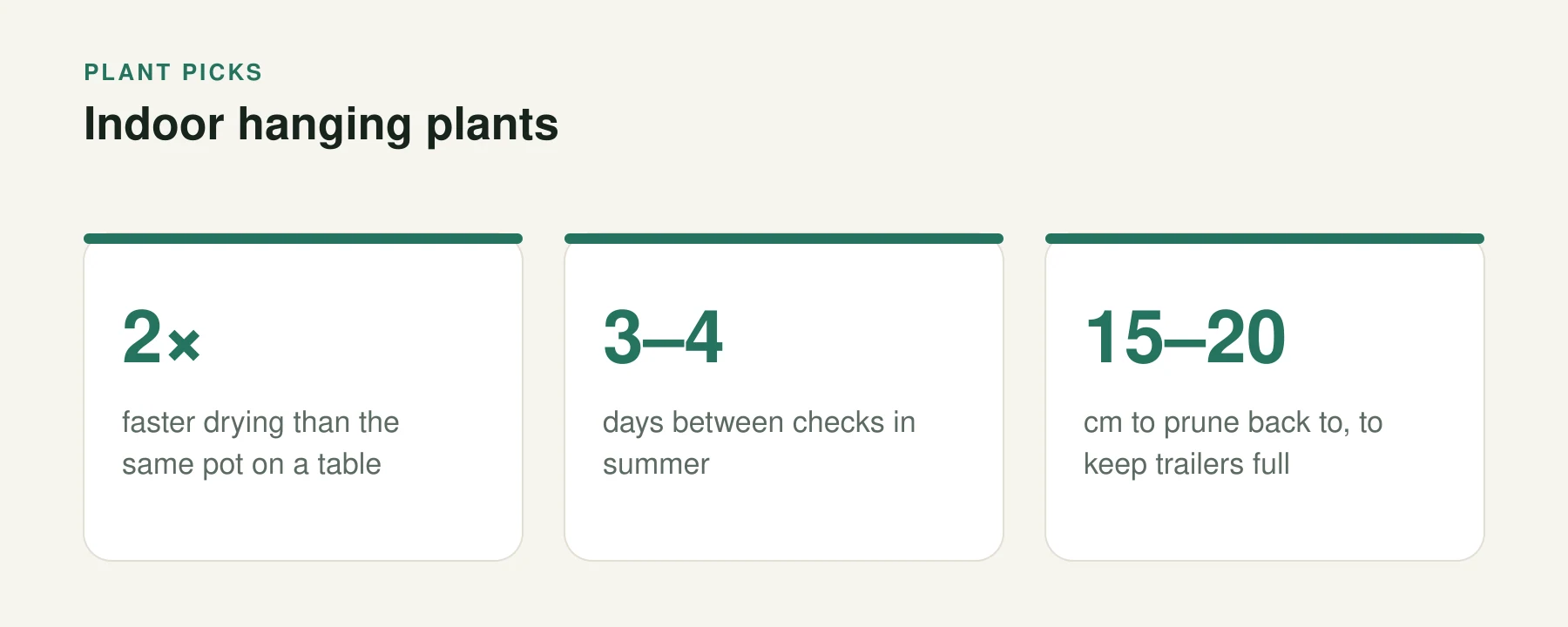
- Air near a ceiling is warmer and drier, so hanging pots dry out roughly twice as fast.
- Money plant, philodendron and scindapsus for shaded spots; string of hearts and hoya for bright ones.
- Check the fixing — a watered basket weighs two to three times its dry weight.
Key takeaways
- Air near a ceiling is warmer and drier, so hanging pots dry out much faster than the same pot on a table.
- Choose semi-succulent trailers for high, bright positions and aroids for shaded ones.
- Check the fixing: a watered hanging basket weighs several times its dry weight.
- Trailing aroids stay juvenile — if you want big leaves, let them climb instead.
Hanging plants solve two problems at once: they use vertical space that is otherwise wasted, and they put trailing foliage at eye level where it looks best. The trade-off is a harsher microclimate, and it is easy to overlook. Warm air rises, so the air near a ceiling runs several degrees warmer and noticeably drier than at table height — and a small pot in that air dries out surprisingly fast. If your hanging plants keep crisping while the ones on the table are fine, that is why.
#15 plants for hanging baskets and high shelves
| Plant | Trail length indoors | Light | Water |
|---|---|---|---|
| Money plant / pothos | 2–3 m | Low to bright indirect | Every 7–10 days |
| Heartleaf philodendron | 2–3 m | Low to bright indirect | Every 7–10 days |
| String of hearts | 1–2 m | Bright indirect | Every 14–21 days |
| String of pearls | 0.6–1 m | Bright, some direct | Every 14–21 days |
| Spider plant | 0.6–1 m plus plantlets | Moderate to bright | Every 7 days |
| Tradescantia zebrina | 0.6–1 m | Bright indirect | Every 5–7 days |
| Hoya carnosa | 1–2 m | Bright indirect | Every 14 days |
| English ivy | 1–2 m | Moderate to bright | Every 7 days |
| Boston fern | 0.5–0.8 m | Moderate indirect | Every 4–6 days |
| Burro's tail | 0.6–1 m | Bright to direct | Every 21 days |
| Peperomia 'Hope' | 0.4–0.6 m | Moderate to bright | Every 10–14 days |
| Rhipsalis | 1–1.5 m | Bright indirect | Every 14 days |
| Scindapsus pictus | 1.5–2 m | Low to bright indirect | Every 10 days |
| Chain of hearts (variegated) | 1–2 m | Bright indirect | Every 14–21 days |
| Fishbone cactus | 0.6–1 m | Bright indirect | Every 14 days |
#Matching plant to position
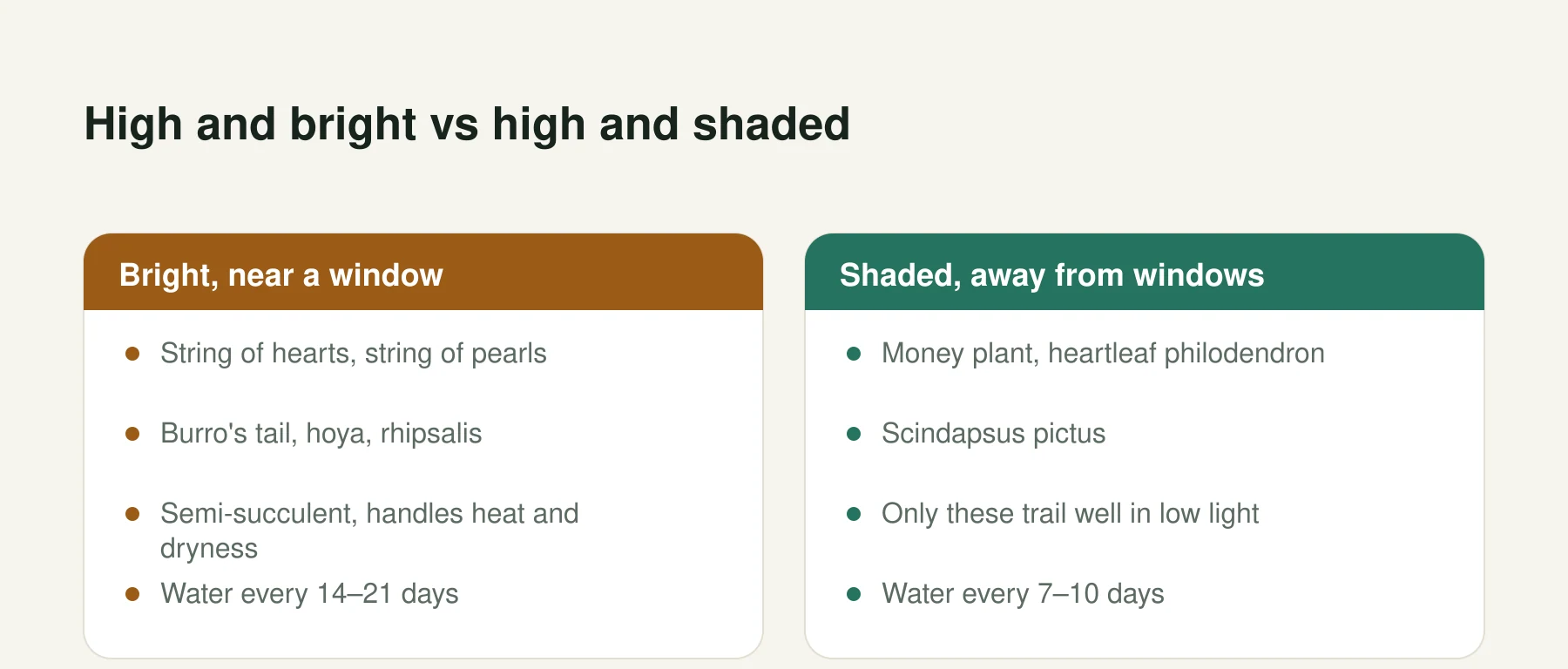
- High and bright, near a window — string of hearts, string of pearls, burro's tail, hoya. Semi-succulent trailers handle the heat and dryness of that position.
- High and shaded, away from windows — money plant, heartleaf philodendron, scindapsus. These are the only ones that trail well in genuinely low light.
- Bathroom — Boston fern, rhipsalis, English ivy. Humidity suits them and most bathrooms have soft, indirect light.
- Above a radiator or heater — avoid entirely, or use burro's tail and rhipsalis, which cope best with hot, dry rising air.
- Kitchen — spider plant and tradescantia tolerate temperature swings and occasional grease better than most.
#Watering a hanging plant without soaking the floor
Take it down to water
The most reliable method: unhook, water thoroughly at the sink, let it drain fully for ten minutes, then rehang. Choose lightweight pots so this stays practical.
Use a built-in reservoir
Hanging pots with an integrated saucer catch runoff. Check they are not permanently full — a hidden reservoir causes root rot in exactly the same way a cachepot does.
Water little and often instead
For pots that cannot come down, water in small amounts across the surface until the soil is evenly moist, rather than one large pour that runs straight through.
Use a long-spout watering can
A narrow spout gives you the reach and control to water above head height without flooding the surface.
Check more often than you think
A hanging pot in warm ceiling air can dry twice as fast as the same pot at floor level. Check every three to four days in summer.
#Keeping trailers full rather than straggly
Trailing plants naturally go bare at the top as the growing tips extend downward, leaving long stems with leaves only at the ends. Two fixes, used together. First, more light — legginess is usually the plant reaching. Second, prune: cut each long stem back to within 15–20 cm of the pot, just above a node. The plant branches at the cut, and the pieces you removed root in water within a fortnight and can be planted straight back into the same pot to thicken it.
#Hanging plants and pets
Hanging is the standard advice for keeping toxic plants away from cats and dogs, and it works for dogs. Cats are a different matter: a trailing vine within jumping distance of a shelf or worktop is an invitation, and pothos, philodendron and tradescantia are all irritants. Hang toxic species well clear of any launch point, or choose from the non-toxic options here — spider plant, hoya, peperomia, Boston fern and rhipsalis are all safe. Our pet safe plant list has the full set.
Frequently asked questions
What is the best indoor hanging plant?
The money plant (pothos) for most positions — it trails to two or three metres, tolerates low light, and forgives missed waterings. For a bright spot, string of hearts is the more elegant choice and needs watering only every two to three weeks.
Do hanging plants need more water?
They need watering more often, yes. Air near a ceiling is warmer and drier, and hanging pots are usually small, so they can dry twice as fast as the same pot at table height. Check every three to four days in summer.
Which hanging plants grow in low light?
Money plant, heartleaf philodendron and scindapsus are the only common trailers that genuinely perform in low light. Most other trailing plants, especially the semi-succulent ones, need bright indirect light to avoid becoming leggy.
How do I stop my hanging plant getting leggy?
Move it to brighter light and prune each long stem back to within 15–20 cm of the pot, cutting just above a node. Root the cuttings in water and plant them back into the same pot to thicken the top.
Which hanging plants are safe for cats?
Spider plant, hoya, peperomia, Boston fern and rhipsalis are all non-toxic. Pothos, philodendron, tradescantia and English ivy are irritants and should be hung well out of jumping range if you have cats.
Sources and further reading
- Houseplants: plant profiles — Royal Horticultural Society. Species-level profiles and cultivation notes.
- Plant Finder — Missouri Botanical Garden. Botanical names, native range and cultural requirements.
- Toxic and Non-Toxic Plants List — ASPCA Animal Poison Control. Toxicity status of every plant named, checked under its botanical name.
- North Carolina Extension Gardener Plant Toolbox — NC State Extension. Species data, hardiness and toxicity cross-checks.
Related guides
Big Leaf Indoor Plants: 14 Large-Leaved Plants for Real Impact
Fourteen big leaf indoor plants — from monstera and elephant ear to banana and rubber plants — with the light, space and pot size each one needs to get large indoors.
Indoor Plants for the Living Room: 15 That Actually Suit the Space
Living rooms have big windows, big furniture and inconsistent heating. These 15 indoor plants match those conditions — from floor-standing trees to shelf fillers.
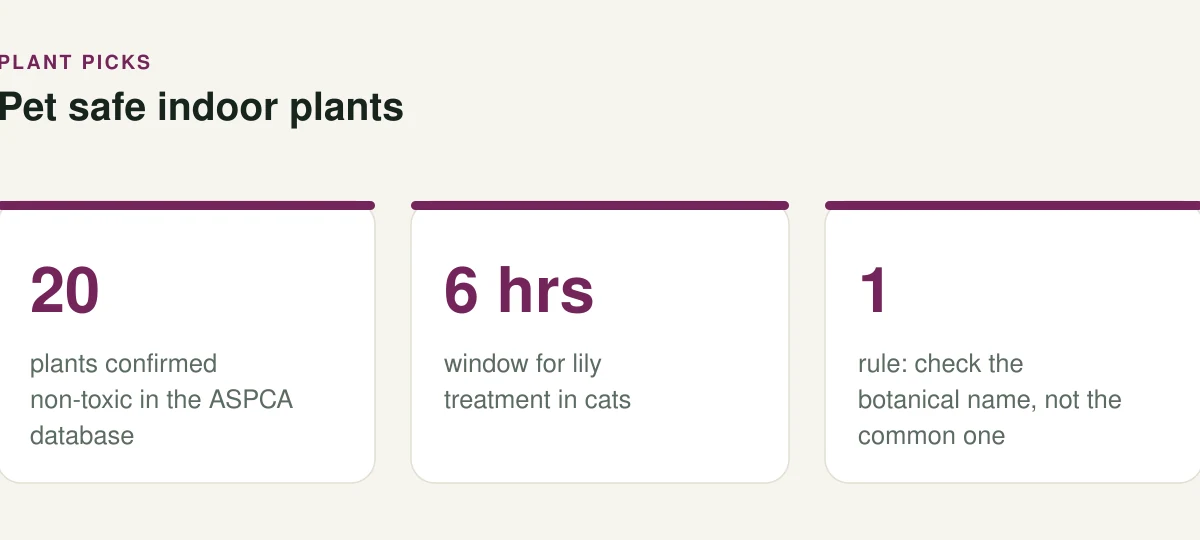
20 Pet Safe Indoor Plants (and the Popular Ones to Avoid)
Verified against the ASPCA toxic plant database: 20 houseplants that are non-toxic to cats and dogs, plus the common favourites that genuinely are not.