Big Leaf Indoor Plants: 14 Large-Leaved Plants for Real Impact
Fourteen big leaf indoor plants — from monstera and elephant ear to banana and rubber plants — with the light, space and pot size each one needs to get large indoors.
The short answer
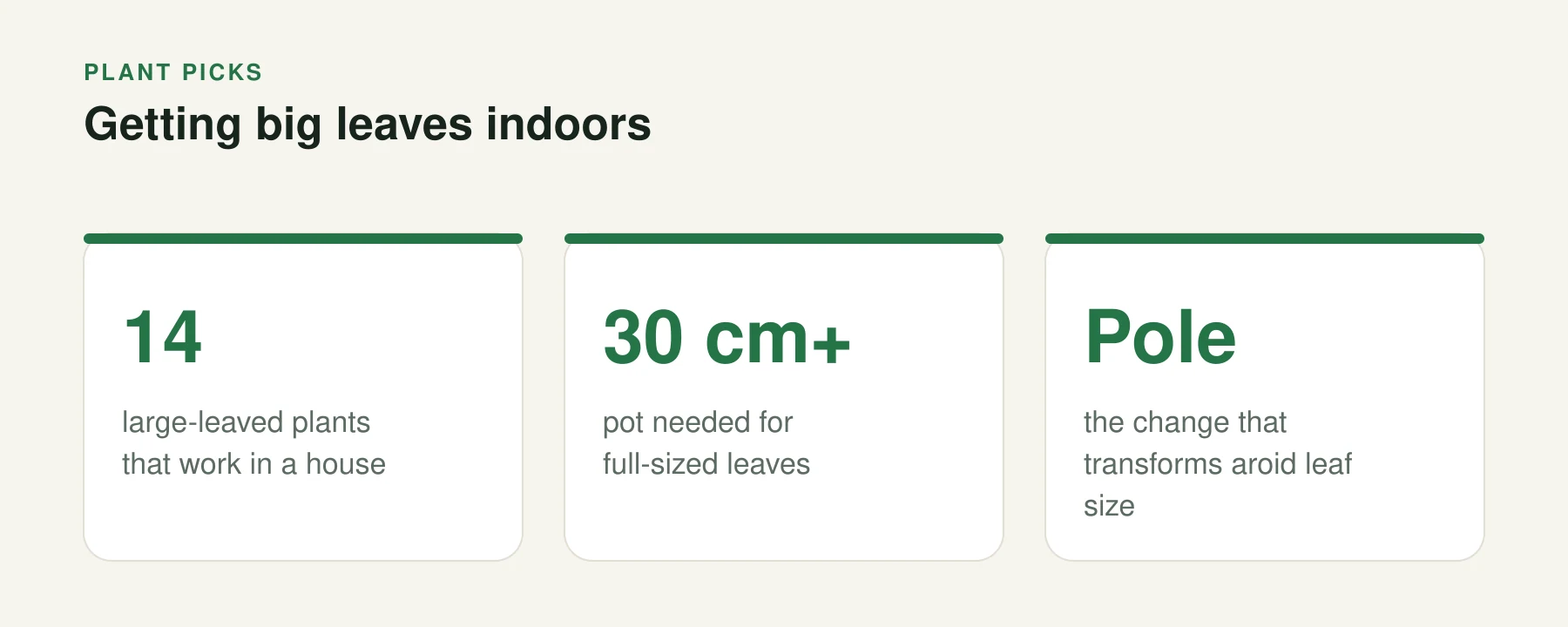
- Leaf size is set by light, root space and feeding — not by the species alone.
- Each new leaf should be bigger than the last; shrinking leaves mean something is short.
- Give climbing aroids a moss pole: it is the single biggest change you can make to leaf size.
Key takeaways
- Leaf size is driven by light, water and pot volume — a starved plant makes small leaves whatever its species.
- Each new leaf on a healthy plant should be larger than the last; that is the metric to judge care by.
- Big plants need big pots, and a 40 cm pot of moist soil is heavy — put it on castors before filling.
- Most large indoor plants grow 20–40 cm a year, so buy close to the size you want.
Large leaves are what make a room look planted rather than decorated. The catch — and it took me a while to properly believe this — is that leaf size is barely fixed by species at all. The same monstera can produce a 60 cm fissured leaf or a 15 cm solid one depending entirely on how it has been grown. Choosing the right plant is half the job. Giving it the conditions to size up is the other half, and it is the half most people skip.
#14 big leaf indoor plants
| Plant | Leaf size indoors | Light | Difficulty |
|---|---|---|---|
| Monstera deliciosa | 30–60 cm, fissured | Bright indirect | Easy |
| Bird of paradise | 40–80 cm paddles | Bright, some direct | Moderate |
| Elephant ear (Alocasia) | 30–60 cm | Bright indirect | Difficult |
| Banana plant (Musa) | 50–100 cm | Direct sun | Moderate |
| Rubber plant | 20–30 cm | Bright indirect | Easy |
| Fiddle leaf fig | 25–40 cm | Bright, near window | Difficult |
| Philodendron 'Xanadu' | 30–40 cm lobed | Moderate to bright | Easy |
| Philodendron bipinnatifidum | 40–70 cm | Bright indirect | Easy |
| Calathea orbifolia | 25–35 cm | Moderate indirect | Difficult |
| Anthurium clarinervium | 20–30 cm velvet | Bright indirect | Moderate |
| Umbrella plant (Schefflera) | Clusters to 30 cm | Bright indirect | Easy |
| Dieffenbachia | 25–40 cm | Moderate to bright | Easy |
| Ficus lyrata 'Bambino' | 15–25 cm | Bright | Moderate |
| Strelitzia reginae | 30–50 cm | Direct sun | Moderate |
#How to actually get big leaves
More light, within limits
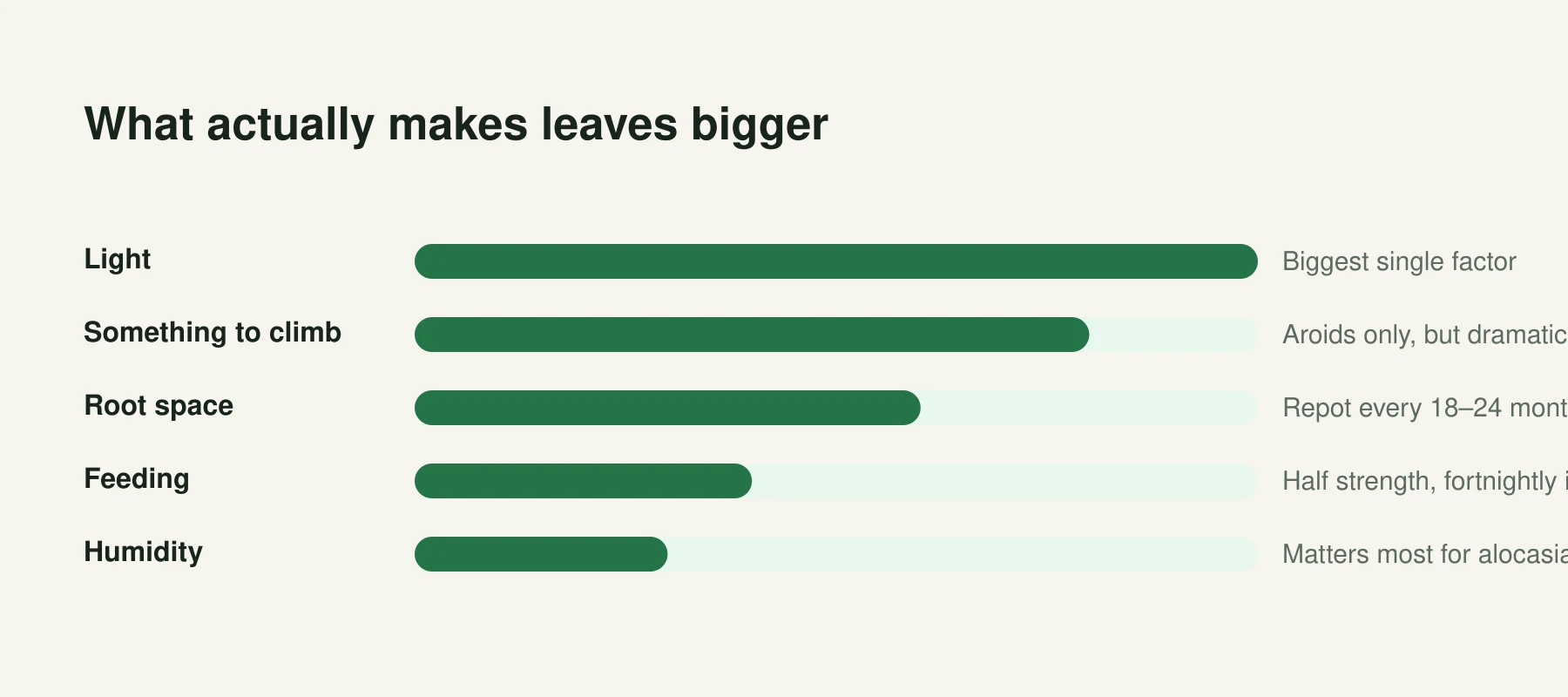
Leaf size correlates directly with the light a plant receives. Move it as close to a bright window as it will tolerate without scorching — for most of these, within a metre of an east or west window.
Give the roots room
A pot-bound plant cannot support large leaves. Repot every 18–24 months into a pot 5 cm wider, and expect a jump in leaf size the following season.
Feed through the growing season
Large leaves need nitrogen. A balanced or slightly nitrogen-heavy feed at half strength every two weeks from spring to late summer makes a visible difference.
Give climbers something to climb
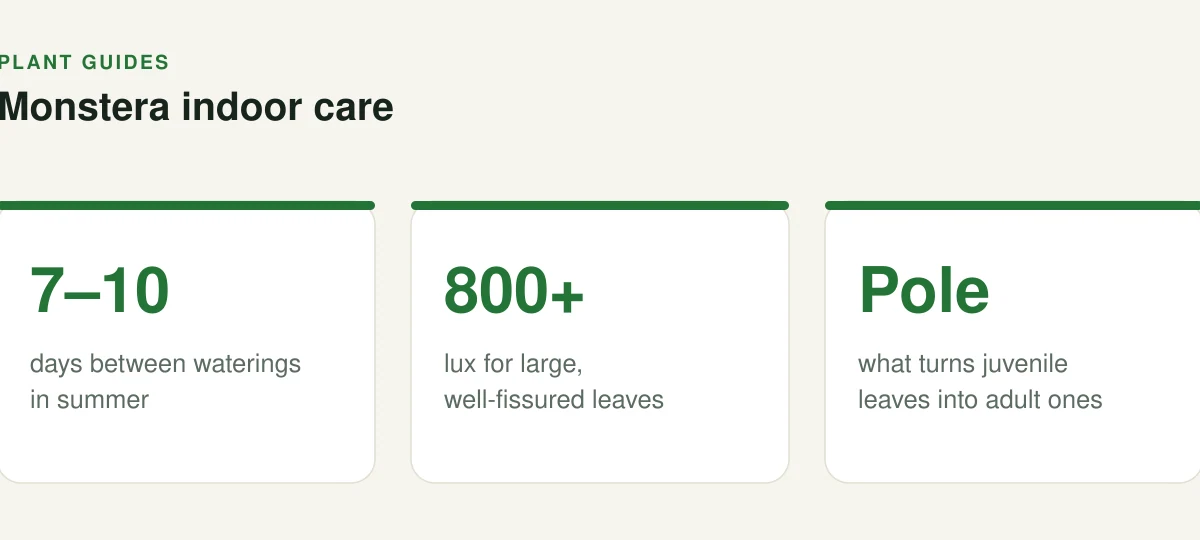
Monstera, philodendron and syngonium are climbers, and their leaves enlarge dramatically once they can attach to a moss pole. A trailing monstera stays juvenile and small-leaved indefinitely.
Keep humidity above 50% where you can
Alocasia, calathea and anthurium in particular produce noticeably smaller leaves in dry air, and their leaf edges crisp before reaching full size.
#Tall plants versus wide plants
Worth deciding before you buy, because it determines where the plant can live. Tall and narrow — snake plant, dracaena, yucca, ficus — fits beside furniture and in corners. Wide and spreading — monstera, philodendron bipinnatifidum, xanadu — needs a metre or more of clear floor and will slowly claim the space around it. A monstera in a narrow hallway becomes a problem within two years.
| Shape | Plants | Floor space needed |
|---|---|---|
| Tall, narrow | Dracaena, yucca, snake plant, ficus | 40–50 cm |
| Tall, spreading | Areca palm, kentia palm, bird of paradise | 70–90 cm |
| Wide, low | Xanadu, bipinnatifidum, monstera | 100–150 cm |
| Climbing on a pole | Monstera, philodendron, epipremnum | 50–60 cm plus height |
#Practical notes for large plants
- Put castors under the pot before filling it. A 40 cm pot of moist soil can weigh 25 kg or more.
- Use a nursery pot inside a decorative cover so you keep drainage and can lift the inner pot to judge watering.
- Check the cachepot after watering. Hidden water at the bottom of a large cover pot is the leading cause of rot in big plants.
- Dust the leaves monthly. Large leaves collect a lot, and dust measurably reduces the light reaching the surface.
- Rotate a quarter turn weekly or the plant will lean permanently toward the window.
- Top-dress instead of repotting a very large plant: scrape off 5 cm of old soil each spring and replace it with fresh mix.
Frequently asked questions
Which indoor plant has the biggest leaves?
The banana plant (Musa) produces the largest leaves indoors at up to a metre, followed by the bird of paradise and Alocasia macrorrhizos. Of the easier plants, monstera deliciosa gives the biggest leaves for the least trouble.
Why are my plant's new leaves smaller than the old ones?
Almost always light, followed by root space and feeding. A healthy plant should produce progressively larger leaves; shrinking leaves mean it is receiving less than it needs. Move it brighter, check whether it is pot-bound, and feed through the growing season.
How do I make my monstera leaves bigger and split?
Give it a moss pole to climb, bright indirect light within a metre of a window, and a balanced feed every two weeks in summer. Fissures appear on mature foliage, and climbing is what triggers the plant to produce it.
What is the best big indoor plant that is easy to care for?
The rubber plant or Dracaena fragrans. Both reach 1.5–2.5 m, tolerate a week or two between waterings, handle moderate light, and hold their shape without pruning or special humidity.
How fast do big indoor plants grow?
Most add 20–40 cm a year in good light — monstera and philodendron faster, kentia palm and dracaena much slower. Buy a plant close to the size you want rather than expecting a small one to fill the corner quickly.
Sources and further reading
- Houseplants: plant profiles — Royal Horticultural Society. Species-level profiles and cultivation notes.
- Plant Finder — Missouri Botanical Garden. Botanical names, native range and cultural requirements.
- North Carolina Extension Gardener Plant Toolbox — NC State Extension. Species data, hardiness and toxicity cross-checks.
- Houseplants growing guide — Royal Horticultural Society. Potting, feeding and seasonal care practice.
Related guides
Indoor Plants for the Living Room: 15 That Actually Suit the Space
Living rooms have big windows, big furniture and inconsistent heating. These 15 indoor plants match those conditions — from floor-standing trees to shelf fillers.
Indoor Hanging Plants: 15 Trailing and Climbing Plants That Thrive
The best indoor hanging plants for baskets, shelves and ceiling hooks — including which cope with the hot, dry air that collects near a ceiling.
Monstera Indoor Plant Care: Light, Water and Getting the Splits
Complete monstera deliciosa care indoors — how much light it needs, watering intervals, why leaves have no holes, and how to make it climb instead of sprawl.