Bird of Paradise Indoor Plant Care (and Why Yours Won't Flower)
Strelitzia care indoors: the light it needs, how often to water, why the leaves split, and the honest answer on getting a bird of paradise to flower in a house.
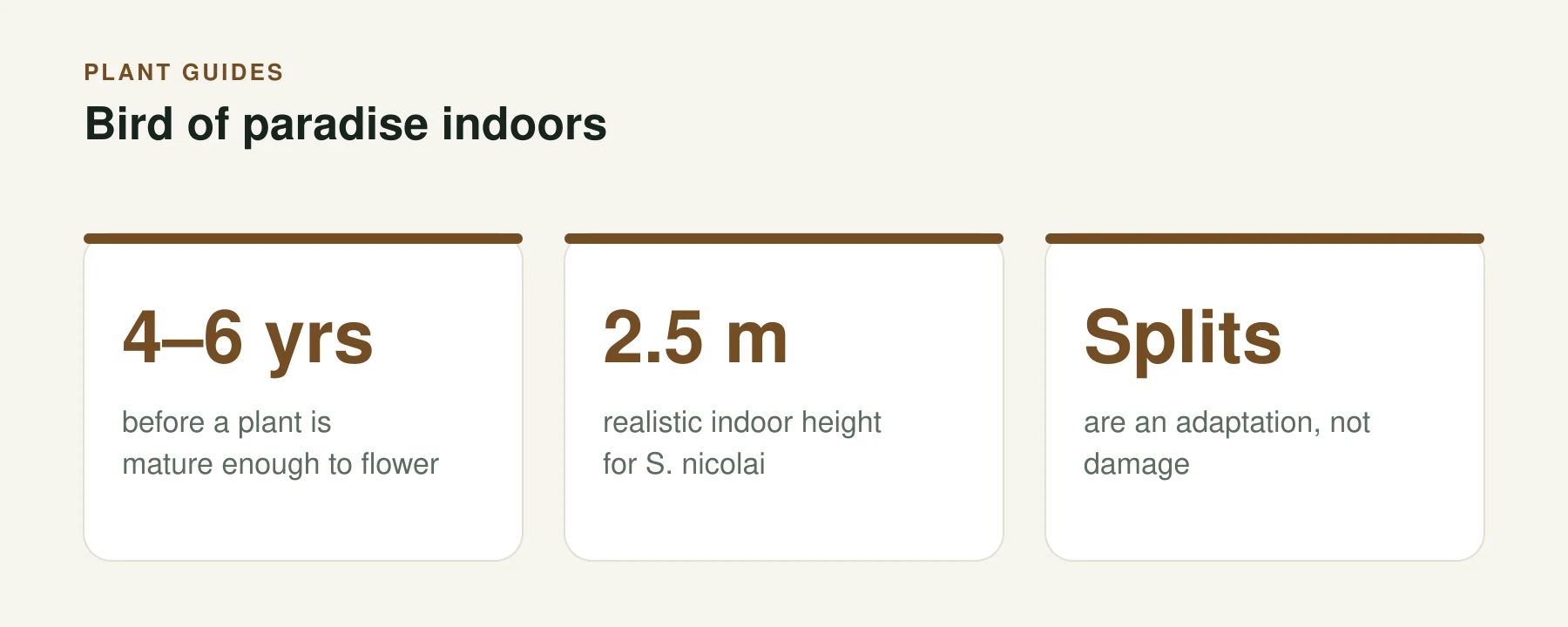
The short answer
- This is a sun plant, not a shade plant — give it the brightest window you have.
- Water every 7–10 days in summer, and keep it root-bound if you ever want flowers.
- Split leaves are normal and healthy; they are how the plant handles wind.
Key takeaways
- This is a sun plant, not a shade plant — treat it differently from every other big indoor plant.
- Split leaves are an adaptation to wind, not damage, and cannot be prevented indoors.
- Flowering indoors needs maturity, a tight pot and very high light; most house plants never get there.
- Strelitzia nicolai (white) is the common large indoor species; S. reginae (orange) is smaller and flowers more readily.
The bird of paradise is one of the few genuinely architectural indoor plants — huge paddle leaves on tall stems, easily two metres in a living room. It is also the plant most often put in exactly the wrong spot, because it looks tropical and everyone assumes tropical means filtered shade. It does not. Strelitzia comes from the open coastal scrub of South Africa, and what it wants is sun. Get that one thing right and the rest of its care is undemanding.
#Which species you have
| Species | Common name | Indoor height | Flowers indoors? |
|---|---|---|---|
| Strelitzia nicolai | Giant / white bird of paradise | 1.5–2.5 m | Rarely — needs 6+ years and full sun |
| Strelitzia reginae | Orange bird of paradise | 1–1.5 m | Possible at 4–5 years in a sunny window |
| Strelitzia juncea | Narrow-leaved | 1–1.5 m | Rarely indoors |
Most large plants sold as indoor bird of paradise are S. nicolai, grown for the foliage. If flowering matters to you, buy S. reginae and give it a south-facing window.
#Light
Give it the brightest position in the home. Several hours of direct sun is ideal — a south or west window, right up against the glass. This is one of the few common houseplants that will genuinely thrive in conditions that would scorch a monstera or a calathea. In merely bright indirect light it survives and grows slowly; in low light it stalls, produces small leaves and gradually declines over a year or two.
#Watering and feeding
- Water when the top 3–5 cm of soil is dry — usually every 7–10 days in summer, every 14 in winter.
- Water thoroughly until it drains, then empty the saucer. Big pots hold a lot of water at the bottom where you cannot feel it.
- Feed a balanced liquid fertiliser at half strength every two weeks from spring to late summer. This is a hungry plant and a fast grower in good light.
- Stop feeding from October to March, when growth slows.
- Use tepid water — cold water on a sun-warmed root ball can cause leaf spotting.
#Why the leaves split
Splitting is not a problem. In the wild the leaves tear along predetermined lines so that wind passes through the plant rather than tearing the leaf from its stem or toppling the plant. Indoors, splits happen from being brushed past, from low humidity making leaves less flexible, and simply from age. There is no way to prevent it and no need to — a plant with split leaves is a healthy plant. If you want an unsplit look, keep the plant out of traffic and raise humidity above 50%.
#Getting one to flower
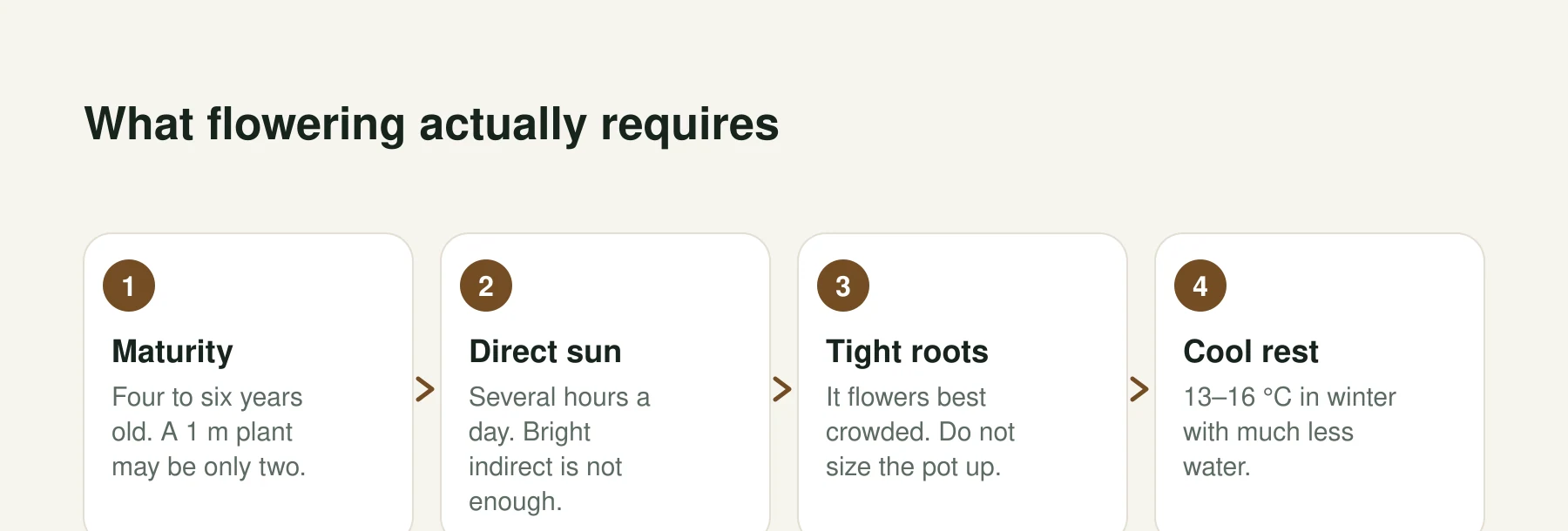
Wait for maturity
Strelitzia does not flower until it is roughly four to six years old, and often later indoors. A plant bought at 1 m tall may be only two or three years old.
Provide direct sun
Flowering requires far more light than foliage growth. A south-facing window with several hours of direct sun is the minimum realistic condition indoors.
Keep it root-bound
Strelitzia flowers best when its roots are crowded. Resist repotting into a larger pot; repot only every three to four years, and go up one size at most.
Feed with a bloom fertiliser
Switch to a higher-phosphorus feed (around 10-30-20) at half strength through spring and summer once the plant is mature.
Give it a cooler winter rest
A period at 13–16 °C with reduced watering through winter helps trigger bud formation, mimicking its natural season.
#Common problems
| Symptom | Cause | Fix |
|---|---|---|
| Brown crispy leaf edges | Dry air, underwatering, or salt buildup | Raise humidity; flush the pot every few months |
| Yellow lower leaves | Overwatering or natural ageing | Check soil moisture; one old leaf at a time is normal |
| New leaves stay rolled and small | Not enough light or water | Move brighter; check the pot is not bone dry |
| Leaf spots, dark and soft | Root rot from soggy soil | Unpot, cut away rot, repot in an airy mix |
| Slow or no growth in summer | Too little light or nutrients | Move to a sunnier spot and feed fortnightly |
| White fluffy spots in leaf joints | Mealybugs | Dab with 70% isopropyl alcohol, repeat weekly |
#Pot, soil and repotting
Use a heavy pot — a tall Strelitzia is top-heavy and will tip a light plastic one. Plant in a chunky, free-draining mix: three parts potting soil, one part perlite, one part bark. Repot every three to four years in spring, going up one pot size only, and expect the plant to sulk for a few weeks afterwards. Older plants can be divided at the rhizome, though this sets both halves back by a year or more; it is worth doing only if the plant has genuinely outgrown the room.
One last note: the leaves and seeds are mildly toxic to cats and dogs, causing stomach upset if chewed. It is not a plant to lose sleep over, but not one for a determined chewer either — our pet safe plant list has alternatives, and the big leaf plants guide covers other options for the same corner.
Frequently asked questions
Is bird of paradise a good indoor plant?
Yes, provided you have a very bright spot. It grows to 1.5–2.5 m indoors and is one of the most striking foliage plants available, but it needs several hours of direct sun to thrive — far more light than most large indoor plants.
Why is my indoor bird of paradise not flowering?
Almost always immaturity plus insufficient light. Strelitzia does not flower until it is four to six years old, needs direct sun, and blooms best when root-bound. Most indoor plants never meet all three conditions.
Should I cut the split leaves off my bird of paradise?
No. Splitting is a natural adaptation that lets wind pass through the leaf, not damage. A split leaf photosynthesises perfectly well. Remove leaves only when they are largely brown or dead.
How often should I water a bird of paradise indoors?
Every seven to ten days in summer and every two weeks in winter, once the top 3–5 cm of soil has dried. Water thoroughly until it drains and always empty the saucer — large pots hide standing water at the bottom.
How much light does a bird of paradise need indoors?
As much as you can give it, including several hours of direct sun. A south or west facing window is ideal. In low light it produces small leaves, stops growing and declines over a year or two.
Sources and further reading
- Houseplants: plant profiles — Royal Horticultural Society. Species-level profiles and cultivation notes.
- Plant Finder — Missouri Botanical Garden. Botanical names, native range and cultural requirements.
- North Carolina Extension Gardener Plant Toolbox — NC State Extension. Species data, hardiness and toxicity cross-checks.
- Toxic and Non-Toxic Plants List — ASPCA Animal Poison Control. Toxicity status of every plant named, checked under its botanical name.
Related guides
Rubber Plant Indoor Care and Benefits (Indoor or Outdoor?)
Ficus elastica care indoors: light, watering, why leaves drop, how to make it branch instead of growing into a single pole, and whether it can live outside.
Monstera Indoor Plant Care: Light, Water and Getting the Splits
Complete monstera deliciosa care indoors — how much light it needs, watering intervals, why leaves have no holes, and how to make it climb instead of sprawl.
Indoor Lavender Plant: Benefits, Care and Why It's Hard Indoors
Lavender is a Mediterranean sun plant, which makes it genuinely difficult indoors. Here is what it needs, which variety to choose, and the honest benefits.