Indoor Plants That Are Easy to Take Care Of (18 Genuinely Low Maintenance Picks)
Eighteen indoor plants that survive irregular watering, dry air and dim corners — ranked by how long each one can be ignored before it complains.
The short answer
- The easiest indoor plants all store water somewhere — thick leaves, a rhizome or a swollen stem.
- ZZ plant, snake plant, money plant, cast iron plant and spider plant cover almost every room.
- They die from being watered too often, not from being forgotten.
Key takeaways
- Low maintenance means tolerant of neglect, not tolerant of abuse — every plant here still needs drainage and some light.
- The plants that forgive missed waterings are the ones that store water: thick leaves, rhizomes or swollen stems.
- Overwatering is what kills 'easy' plants, because people keep watering something that is doing nothing.
- One large pot needs less attention than three small ones.
There is one simple rule behind every genuinely low maintenance houseplant: it stores water somewhere. Thick waxy leaves, an underground rhizome, a swollen stem base — that reservoir is what lets a plant shrug off the fortnight you forgot it existed. Plants with thin, soft leaves have no reservoir at all, which is exactly why ferns and calatheas never appear on lists like this one, however often they get recommended as beginner plants.
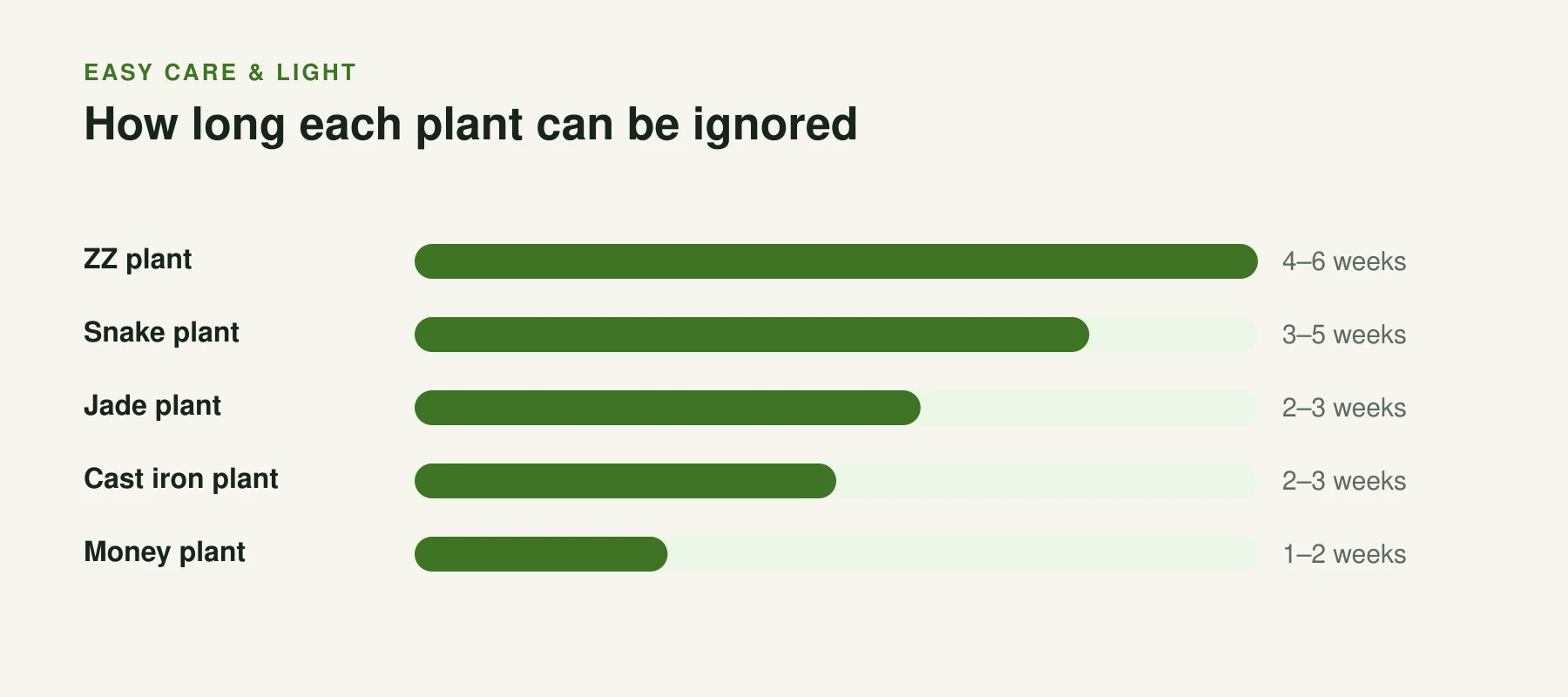
#The tier list: how long each plant can be ignored
| Plant | Can be ignored for | Light needed | Kills it fastest |
|---|---|---|---|
| ZZ plant | 4–6 weeks | Low to bright | Overwatering |
| Snake plant | 3–5 weeks | Low to full sun | Overwatering |
| Cast iron plant | 2–3 weeks | Low | Direct sun |
| Jade plant | 2–3 weeks | Bright to sun | Overwatering |
| Money plant / pothos | 1–2 weeks | Low to bright | Cold draughts |
| Philodendron | 1–2 weeks | Low to bright | Soggy soil |
| Spider plant | 1–2 weeks | Moderate to bright | Fluoride in tap water |
| Aglaonema | 1–2 weeks | Low to moderate | Cold below 15 °C |
| Rubber plant | 1–2 weeks | Bright indirect | Being moved often |
| Aloe vera | 3–4 weeks | Bright to sun | Pots without drainage |
#Eight more that are nearly as forgiving
- Ponytail palm (Beaucarnea recurvata) — stores water in its swollen trunk; water monthly.
- Haworthia — small, slow, happy on a bright shelf, water every 3 weeks.
- Syngonium — fast, cheap, roots from any cutting, tolerates moderate light.
- Peperomia — semi-succulent leaves, small root system, hard to overwater in a small pot.
- Yucca — architectural and drought-tolerant, wants a bright spot.
- Dracaena 'Janet Craig' — holds deep green in low light and drinks slowly.
- Lucky bamboo — lives in a vase of water; change the water weekly and that is the entire routine.
- Hoya carnosa — waxy leaves, tolerates drying out, and eventually rewards you with scented flowers.
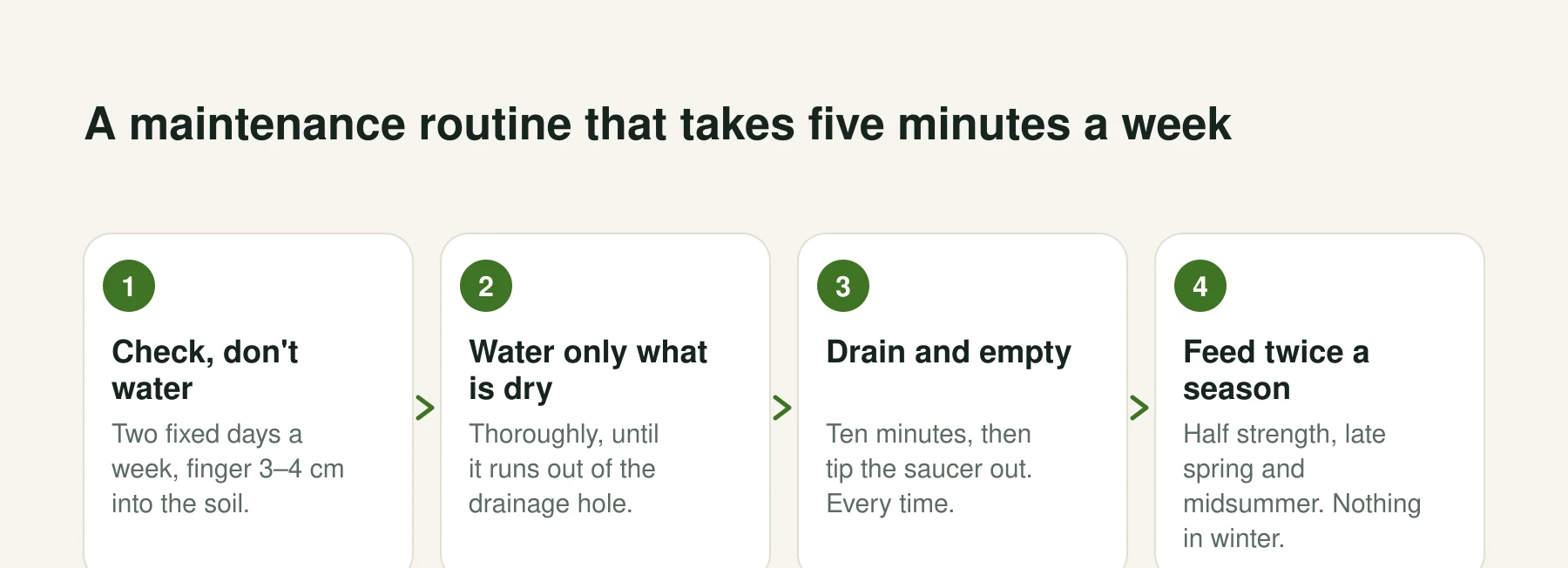
#The four-rule maintenance routine
Check, do not water
Pick two days a week to check — press a finger 3–4 cm into the soil. Water only the pots that are dry at that depth. This single change prevents most houseplant deaths.
Water thoroughly, then drain
When a pot is dry, water until it runs out of the drainage hole, wait ten minutes, then empty the saucer. Small daily splashes keep roots shallow and let salts build up.
Feed lightly, twice a season
A balanced liquid fertiliser at half strength, once in late spring and once in midsummer, is enough for every plant on this page. Low maintenance plants grow slowly and cannot use more.
Dust and turn monthly
Wipe the leaves with a damp cloth and give the pot a quarter turn. Dust measurably reduces the light reaching a leaf, and turning keeps growth even rather than leaning.
#Set-up choices that cut the work
- Bigger pots. A 20 cm pot holds roughly four times the water of a 12 cm pot, so it needs attention half as often.
- Plastic nursery pots inside decorative covers. You get drainage plus the look, and you can lift the inner pot to judge weight.
- A chunky mix. Adding 25–30% perlite or coarse bark means a pot can be wet without suffocating the roots, which widens the margin for error.
- Group plants together. They raise humidity around each other and you water them in one circuit rather than wandering the house.
- Skip anything variegated in a dim room. White and yellow leaf sections have no chlorophyll, so variegated cultivars need noticeably more light to stay healthy.
#Plants marketed as easy that are not
| Plant | Why it is not low maintenance |
|---|---|
| Calathea / prayer plant | Reacts to tap water, dry air and drying soil with permanent brown edges |
| Fiddle leaf fig | Drops leaves after any change in position, light or temperature |
| Maidenhair fern | Dies within days if the soil dries out once |
| Boston fern | Needs 50%+ humidity to avoid constant leaf drop |
| Orchid | Not difficult, but needs a completely different watering routine from every other plant you own |
| Air plants | Require weekly soaking and fast drying; forgetting twice is usually fatal |
None of those are bad plants — a calathea in the right spot is beautiful. They simply have a narrow tolerance, and narrow tolerance is the opposite of low maintenance. If you want green in the house without a hobby attached, stay in the top table and you will not lose one. If you want the hobby, start with the room-by-room guide and add the fussier plants once the easy ones are thriving.
Frequently asked questions
Which indoor plant needs the least care?
The ZZ plant (Zamioculcas zamiifolia). Its underground rhizomes store water and starch, so it tolerates four to six weeks without water and grows in light levels where most plants stall. Water it monthly and it will outlive most of the collection.
How often should low maintenance indoor plants be watered?
Every two to four weeks for the succulent-type plants such as ZZ, snake plant and jade, and every seven to ten days for pothos, philodendron and spider plants. Always check the soil first — the interval doubles in winter and in dim rooms.
Are low maintenance plants slow growing?
Usually, yes. Drought tolerance comes from a conservative growth strategy: storing resources rather than spending them. The exceptions are pothos, philodendron and syngonium, which are both tough and fast.
What is the hardiest indoor plant for a beginner?
The snake plant. It tolerates low light and full sun, survives weeks of drought, is unbothered by dry indoor air, and the only common way to kill it is to keep the soil constantly wet.
Do easy indoor plants still need fertiliser?
A little. Two half-strength feeds across spring and summer is enough. Overfeeding a slow-growing plant leaves unused salts in the soil, which shows up as brown, crisp leaf tips.
Sources and further reading
- Houseplants — Royal Horticultural Society. General indoor growing guidance, light and watering advice.
- Houseplants growing guide — Royal Horticultural Society. Potting, feeding and seasonal care practice.
- Plant Finder — Missouri Botanical Garden. Botanical names, native range and cultural requirements.
- Toxic and Non-Toxic Plants List — ASPCA Animal Poison Control. Toxicity status of every plant named, checked under its botanical name.
Related guides
25 Best Indoor Plants for Home (With Names, Light Needs and Care)
The 25 indoor plants worth keeping at home, sorted by how much light you have and how much attention you can give — with names, pictures and honest difficulty ratings.
Low Light Indoor Plants: 12 That Genuinely Survive a Dark Room
North-facing room? These 12 houseplants genuinely tolerate low light — with the light levels each one needs, in lux, and honest notes on what they will not do.
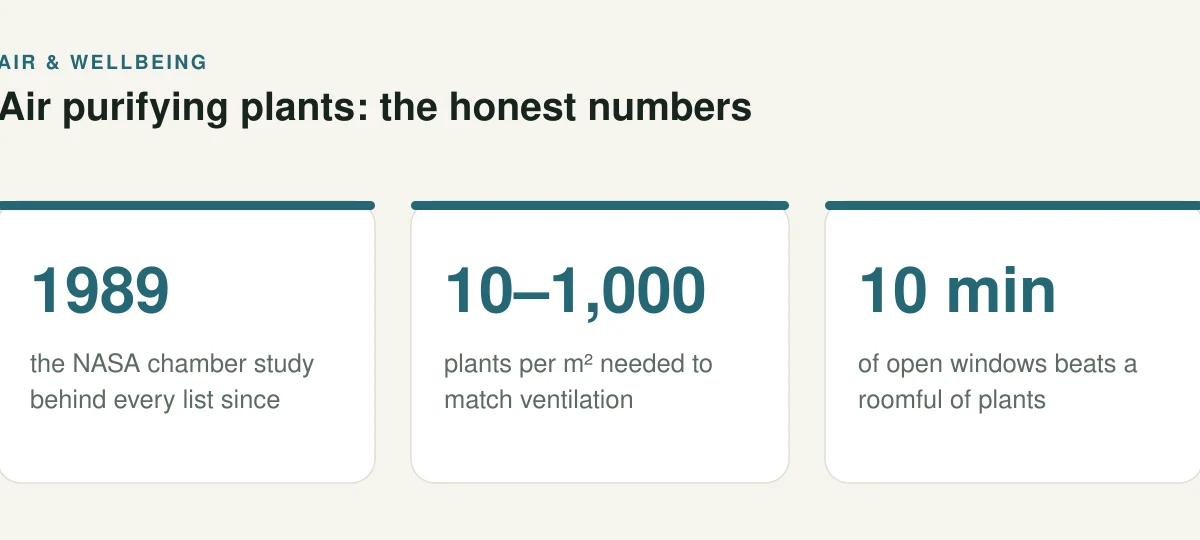
Air Purifying Indoor Plants: What the NASA Study Really Found
The 12 plants from NASA's clean air study, what they actually remove, and the honest arithmetic on how many you would need to change the air in a real room.