Mosquito Repellent Plants Indoor: What Works and What Doesn't
Citronella, tulsi, lemongrass and lavender are sold as mosquito plants. Here is what the research shows about repelling mosquitoes indoors — and what actually works.
The short answer
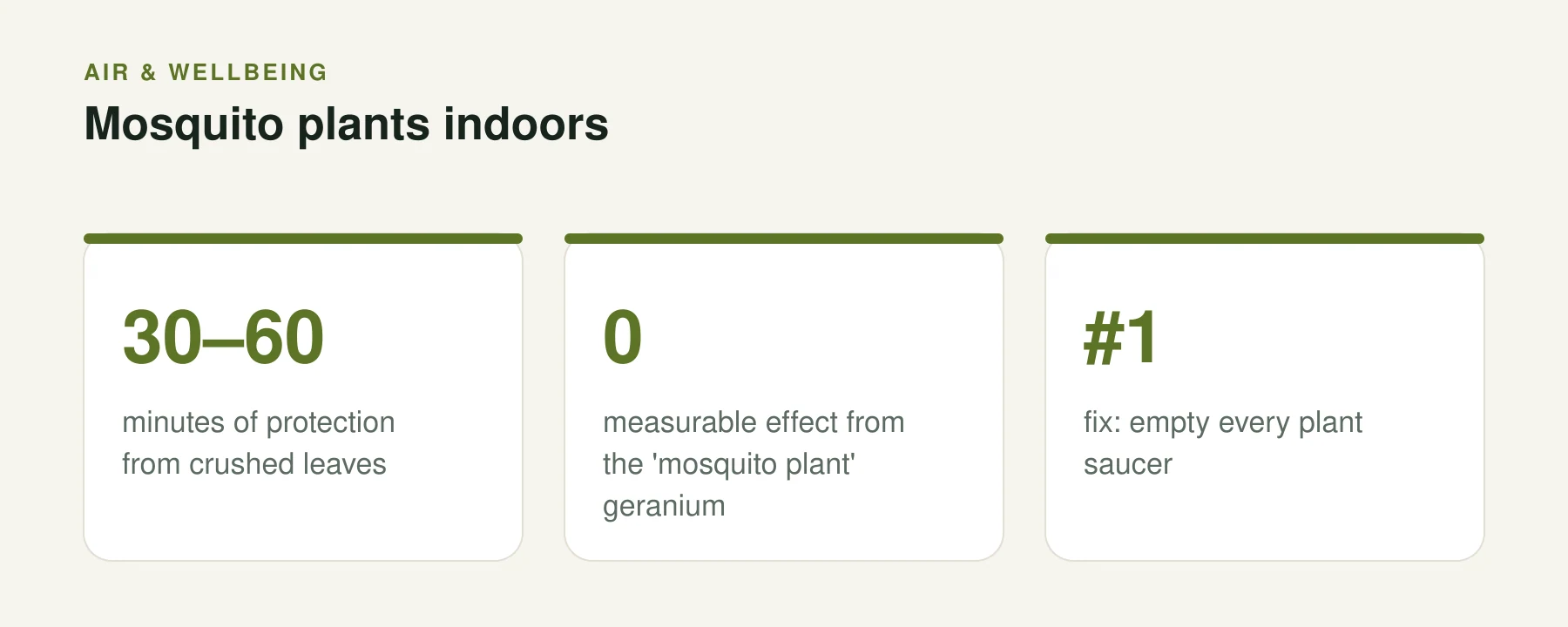
- An intact plant releases very little repellent — the compounds are only freed when leaves are crushed.
- Citronella, lemongrass, tulsi, lavender and catnip do contain genuine repellents.
- Emptying plant saucers and fitting screens does far more than any plant on a windowsill.
Key takeaways
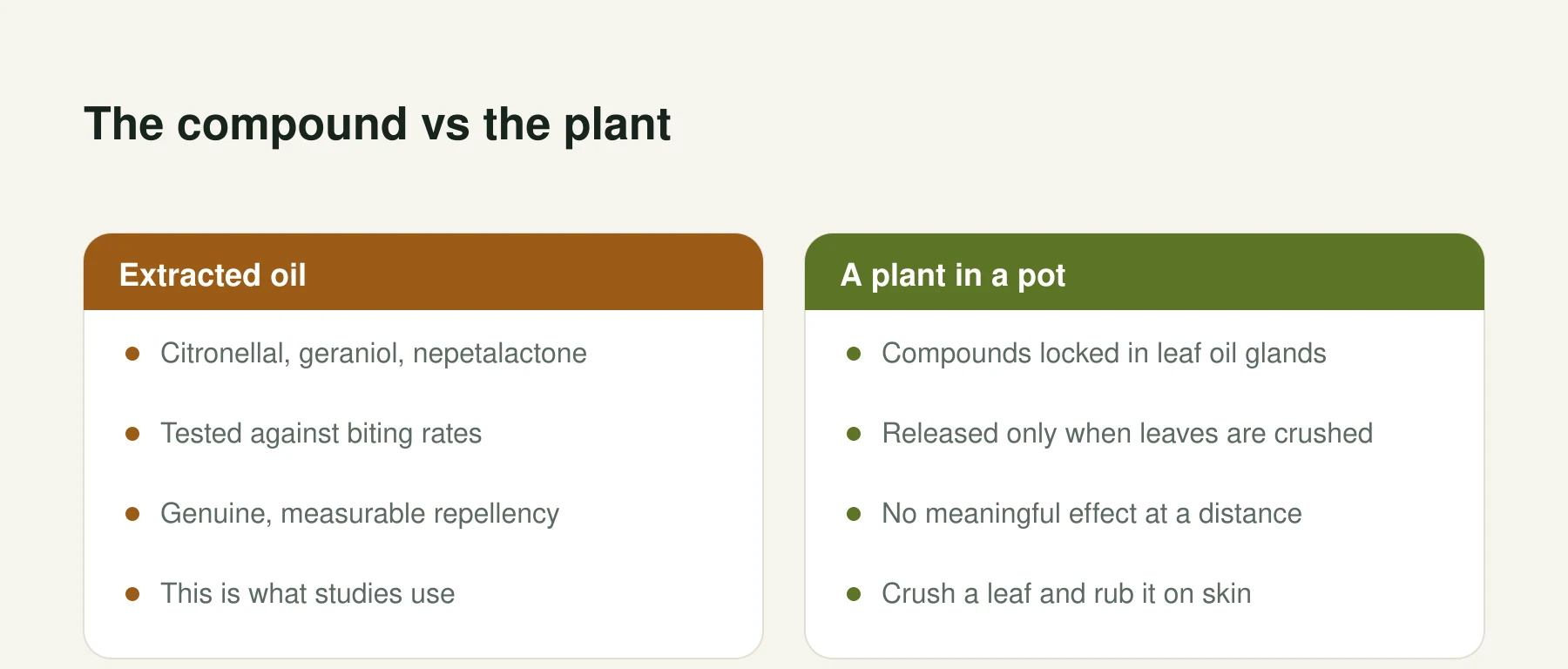
- An intact plant releases very little of its repellent compounds — crushing the leaves is what releases them.
- The citronella geranium sold as a 'mosquito plant' contains almost none of the citronella oil used in repellents.
- Removing standing water indoors is the single most effective control, and it is free.
- These plants are still worth growing — as herbs, for scent, and for the crushed-leaf effect.
Mosquito repellent plants are one of the most reliably oversold categories in gardening, and I want to be fair to both sides of it. The underlying chemistry is real: citronellal, geraniol, linalool and nepetalactone genuinely repel mosquitoes, and some have been tested against DEET in laboratory conditions. The gap — the entire gap — is between what an isolated compound does and what a plant quietly standing in a pot does. Once you see that, the whole category makes sense.
#Why an intact plant does so little
Plants store these compounds inside leaf tissue, in oil glands, as a defence against being eaten. They are not continuously broadcast into the air — that would be metabolically wasteful. Crushing or bruising a leaf ruptures the glands and releases a burst of volatile oil, which is why every study showing meaningful repellency uses crushed leaves, extracted oil, or a burning preparation.
#The plants with real repellent chemistry
| Plant | Active compound | Evidence | Indoors? |
|---|---|---|---|
| Citronella grass (Cymbopogon nardus) | Citronellal, geraniol | Strong for extracted oil | Needs full sun; hard indoors |
| Lemongrass (Cymbopogon citratus) | Citral, citronellal | Good for crushed leaves and oil | Needs bright direct light |
| Catnip (Nepeta cataria) | Nepetalactone | Some studies show high repellency | Bright light; grows readily |
| Tulsi / holy basil | Eugenol, camphor | Moderate evidence for extracts | Needs 4–6 hrs direct sun |
| Lavender | Linalool | Moderate for oil | Difficult indoors — needs full sun |
| Rosemary | Cineole, camphor | Effective when burned or crushed | Bright windowsill, good airflow |
| Peppermint | Menthol | Moderate for oil | Easy indoors, tolerates part shade |
| Marigold | Pyrethrum-like compounds | Some repellent activity | Needs full sun; short-lived indoors |
| Scented geranium ('citronella plant') | Citronellol, geraniol | Weak — despite the marketing | Bright light |
#How to actually get an effect from these plants
Crush the leaves
Rub a handful of lemongrass, catnip or rosemary leaves between your palms and apply to exposed skin. Repellency lasts perhaps 30–60 minutes and is genuine while it does.
Position them where you brush past
In a doorway, beside a chair, at the edge of a balcony — anywhere movement disturbs the foliage and releases oils.
Grow them near open windows
Not because the plant repels at a distance, but because it is where you will brush against them and where mosquitoes enter.
Dry and burn rosemary
Burning dried rosemary or citronella releases the compounds effectively — this is the traditional method and it works, with obvious ventilation caveats.
Treat them as herbs first
Lemongrass, tulsi, mint and rosemary are all useful in the kitchen. The mosquito effect is a bonus, not a reason to buy.
#What genuinely reduces mosquitoes indoors
- Eliminate standing water. Plant saucers, cachepot reservoirs, water-grown plants, buckets and blocked drains all breed mosquitoes indoors. This is the single highest-impact action.
- Fit window screens and keep doors closed at dusk and dawn, when most biting species are active.
- Use a fan. Mosquitoes are weak fliers and struggle in moving air; a ceiling or desk fan measurably reduces landings.
- Use registered repellents on skin — DEET, picaridin or oil of lemon eucalyptus (PMD) — if you are being bitten.
- Use a bed net in high-risk areas. Nothing else comes close for overnight protection.
- Change water in vases weekly, which you should be doing for the plants anyway.
#Growing the useful ones indoors
Lemongrass is the most practical: it needs a bright window with some direct sun, grows quickly, and can be harvested for cooking. Mint is the easiest and tolerates less light, though it needs a pot of its own — it swamps anything planted with it. Tulsi and rosemary both need real direct sun, four to six hours minimum, and will go thin and woody in an ordinary room. Catnip grows readily in a bright spot but comes with the obvious consequence in a house with cats.
Frequently asked questions
Do indoor plants repel mosquitoes?
Barely, while intact. The repellent compounds in citronella, lemongrass and lavender are stored inside leaf tissue and released mainly when leaves are crushed. Removing standing water and fitting screens does far more than any plant.
Which plant is best for repelling mosquitoes indoors?
Lemongrass and catnip have the strongest repellent chemistry among plants that will actually grow indoors. Both work best when the leaves are crushed and rubbed on skin, rather than by simply standing in a pot.
Does the citronella plant really work?
The plant sold as a citronella or mosquito plant is a scented geranium, and trials have found it provides no measurable protection despite its strong scent. True citronella oil comes from a tropical grass, Cymbopogon nardus.
Can indoor plants cause mosquitoes?
Yes. Standing water in plant saucers, cachepot reservoirs and vases is a common indoor mosquito breeding site. Empty saucers after watering and change the water in water-grown plants weekly.
Does tulsi repel mosquitoes?
Tulsi contains eugenol and camphor, which show repellent activity in extract studies. A living plant releases far less, so the effect indoors is small. It needs four to six hours of direct sun to grow well anyway.
Sources and further reading
- Find the Insect Repellent that is Right for You — US Environmental Protection Agency. Registered mosquito repellents and their tested active ingredients.
- Indoor Air Quality (IAQ) — US Environmental Protection Agency. Ventilation and source control as the primary indoor air measures.
- North Carolina Extension Gardener Plant Toolbox — NC State Extension. Species data, hardiness and toxicity cross-checks.
- Plant Finder — Missouri Botanical Garden. Botanical names, native range and cultural requirements.
Related guides
Best Indoor Plants for Oxygen: Which Ones Give Oxygen 24 Hours?
Snake plant, aloe, tulsi and orchids release oxygen at night — here is why, how much it actually amounts to, and the 10 highest oxygen producing indoor plants.
Air Purifying Indoor Plants: What the NASA Study Really Found
The 12 plants from NASA's clean air study, what they actually remove, and the honest arithmetic on how many you would need to change the air in a real room.
Scented Indoor Plants: 12 That Actually Perfume a Room
The indoor plants that genuinely smell good — flowering, foliage and herb options — with how strong each one is and how much light it needs to produce scent.